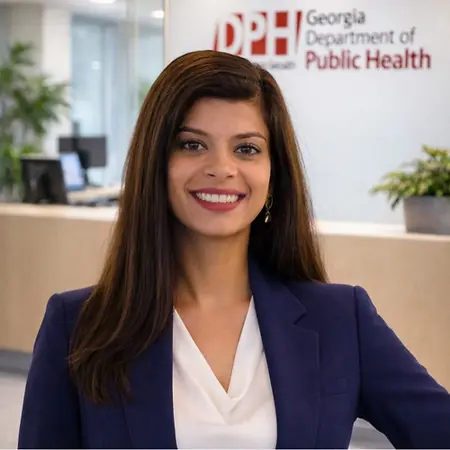
Her Story
About Gitanjali
I've always been passionate about public health, and my background lies in dentistry. What inspired me most in dentistry was whenever I went to community health camps - that's what inspired me to go on the community level and help people, to help the community on that level, not just by seeing one individual person. That's how I was drawn more towards public health, where we can have outreach programs and cover larger populations, raising awareness about issues like HIV, hepatitis C, and other public health concerns. When I was doing my Master's in Public Health, I realized that I'm more inclined and have more interest towards data analytics. So that's how both sides - my love for public health and data analytics - just led me to public health informatics. Today, my work is all about disease surveillance, mostly data about the disease outcomes and spread, how the disease is spreading, what are the progressive areas. I worked on the COVID team in 2020 as an epidemiologist, and now I'm responsible for implementing a new electronic health record system across all 18 districts of Georgia, including 235 clinics and local health departments. We're trying to centralize all the health information - right now there is no system, every district has their own system, and some in the southern and northern areas don't even have any system, they're doing it on paper and pen. This is a very huge development, and in the entire United States of America, no state has done this so far.
Her Interview
Ten minutes with Gitanjali
01What advice would you give to young women entering your industry?
I'm very career-oriented, and I really want every woman to be like that - you have your personal life, and then kids, and then other things, but there is one more life, it's career life. I just love making small differences by working in people's lives. Maybe it's not visible, but we do make a difference just by working in public health. That's the thing I want to say to young women - do not give up on your career just because you got married or have kids. Just keep on moving.
02What are the biggest challenges or opportunities in your field right now?
Honestly, I want to say that people are not ready for the change. For example, we are trying to implement this new EHR system, and all the 18 districts and all the directors of those districts are not ready for those things. There are so many concerns, so many resistance. Rather than adopting, we have to explain why, and what, why, what, how, where, things like that. So I see this resistance, and it just requires a lot of training, a lot of new information. We're trying to set a new example, implementing a new system, and it's just so new for everyone. So I feel like the biggest challenge is change. And we also know the answer is communication, but the communication's supposed to happen strategically, and I think we are not there yet to find that strategy. So that's the problem we are facing so far.
03What values are most important to you in your work and personal life?
I would say it's about balance. It creates an equilibrium between all those things. It's just not possible, one without other things. It just creates a balance.
Join Influential Women and start making an impact. Register now.