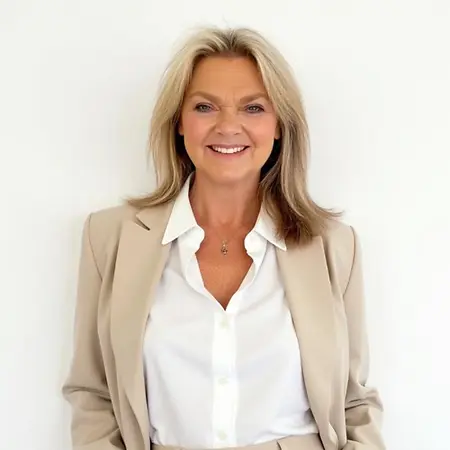
Her Story
About Gwendolyn
Gwendolyn “Sam” Smith, BS, CHSOS, is a Simulation Specialist at the New York Institute of Technology College of Osteopathic Medicine at Arkansas State University, where she has spent nearly a decade advancing healthcare simulation education. Based in the Jonesboro-Paragould area of Arkansas, she is certified as a Certified Healthcare Simulation Operations Specialist (CHSOS) and specializes in designing and operating high-fidelity simulation experiences that prepare medical students for real-world clinical practice. Her work centers on using advanced simulation tools, including birthing and emergency medicine mannequins, to create immersive learning environments that build clinical confidence, technical skill, and critical thinking.
Sam began her journey in medical education in 2016 as a standardized patient, portraying real-world clinical scenarios such as cardiac events and abdominal pain to help students develop diagnostic and communication skills. She quickly advanced into leadership within the standardized patient program before transitioning fully into simulation operations. Over time, she has become a key member of the simulation team, supporting learners from their first-year introductions to medicine through their final Transition to Residency experiences, while also contributing to scheduling, case development, and lab operations.
Throughout her career, Gwendolyn has been deeply committed to student growth and experiential learning in healthcare education. She takes pride in watching medical students evolve from beginners into confident, capable physicians, knowing she has played a role in their development. Recognized for her long-standing service and dedication, she continues to champion innovation in simulation-based training while fostering a supportive, hands-on learning environment that helps shape the next generation of doctors.
Her Interview
Ten minutes with Gwendolyn
01What do you attribute your success to?
I think it's just been my dedication and wanting to learn more. From the very beginning, you know, from starting out as a standardized patient and seeing just where that role could take me - that has been a lot of it. And then just the people who have supported me and had my back, giving me strength as my backbone. I wouldn't be where I am today without the guidance and support of mentors who invested in my development. Dr. Andrea Reid got me to the medical school - we worked together at a clinic here in Lepanto, and she told me about the medical school opening. She called me one day and said I need you to get over here and fill out an application now, and she helped me get through all of it. She taught me so much stuff. Because of her, I am in the position that I am now. I've also worked with Amber Gibson, the associate director in our department, pretty much the whole 10 years. And Matt Charnetzky was the one who talked to me so much about simulations. Those three would probably be the main ones who have supported my journey.
02What’s the best career advice you’ve ever received?
The best career advice I’ve ever received is to stay open to growth opportunities and trust the people who invest in your development—advice reinforced by Dr. Andrea Reed, who helped me step into this role, along with the ongoing support and mentorship of Amber Gibson and Matt Charnetzky, who each played a meaningful part in my career journey.
03What advice would you give to young women entering your industry?
I would say, probably, if you're not familiar with what it is, definitely check into it, because it is the most rewarding job that I've ever had. We have medical students from their first year through fourth years, and the first and second years are actually on campus with us, and then the third and fourth years only come back to campus for testing. Just watching the medical students grow from coming in and not really knowing anything - unless they have a medical background - to watching them graduate as an actual doctor, it really is a rewarding job. And to notice that I am part of that is very special to me. My dedication and wanting to learn more from the very beginning, from starting out as a standardized patient and seeing just where that role could take me, has been key to my success.
04What are the biggest challenges or opportunities in your field right now?
One of the biggest challenges in my field right now is navigating financial pressures, including rising costs and tuition-related constraints, which can impact resources and access, although I prefer not to go into specific details.
05What values are most important to you in your work and personal life?
Education has always been important to me, and completing that milestone reinforced my belief that learning should never stop.Beyond my professional responsibilities, I believe strongly in giving back to the community. My volunteer involvement with the American Red Cross and the Make-A-Wish Foundation has allowed me to support individuals and families facing challenging circumstances. These experiences have reinforced the importance of compassion, service, and human connection—values that also guide my work in healthcare education
As I reflect on my career, I am grateful for every opportunity, challenge, and lesson that has shaped my path. The field of healthcare simulation continues to evolve, and I am excited to remain part of an industry dedicated to preparing the next generation of healthcare professionals.
Join Influential Women and start making an impact. Register now.