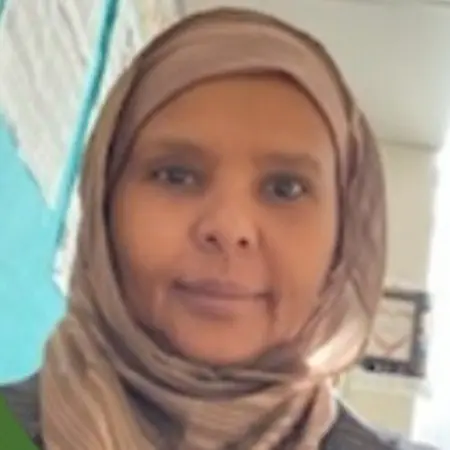
A General's daughter who never planned on America, I married young, moved, and rebuilt from scratch by earning my GED, BA, and Ms.Ed while raising 5 children.
Hana Tallan · In Her Own Words
Her Story
About Hana
Hana Tallan is a dedicated educator with over 30 years of experience serving the Portland Public Schools in Maine. She began her career in 1996 as an interpreter and language facilitator, supporting newly arrived Somali refugee students and their families, and has since advanced to teaching English to speakers of other languages (ESOL) in Kindergarten and Grade 1. Throughout her career, Hana has also mentored educational technology staff and stepped into interim assistant-principal responsibilities, demonstrating her leadership and commitment to student success.
Passionate about equity and inclusion, Hana specializes in helping multilingual learners achieve grade-level proficiency while advocating for BIPOC students, families, and staff. She also directs youth programs, including the Somali Girls Summer Camp, fostering leadership, confidence, and community engagement among young girls. Hana emphasizes persistence, lifelong learning, and taking initiative, inspiring both her students and colleagues to embrace growth and opportunity.
Hana pursued higher education while working full-time and raising her family, earning a Bachelor’s degree in Liberal Arts and engaging in Master’s-level coursework in Teacher Leader and Principal Education at the University of Southern Maine. She is actively involved with professional associations such as the Maine Education Association, the Portland Education Association, and the National Education Association, reflecting her dedication to advancing educational practice and fostering inclusive school communities.
Her Interview
Ten minutes with Hana
01What do you attribute your success to?
I attribute my success to never giving up, even when people tried to discourage me. When I first started, other educators in the system would tell me, 'Don't ever become a teacher in this country,' and there was no welcoming environment. But I kept going with my education, taking two courses at a time while working full-time and raising my children. I'm a lifelong learner, always looking for what I can work on next. I lived by telling my kids to be well-rounded, and I think I've lived by that myself. Even though I've faced systemic racism and discrimination, including being told I looked like a terrorist by a colleague, I didn't let that stop me. I finished my job, and then I spoke up publicly because I realized that staying silent was allowing these things to happen to others. I've learned that you can't wait for doors to open - sometimes you have to push them open yourself and bring people with you as you rise up. My faith, my commitment to service, and my investment in the students and staff who need support have kept me going, even when advancement opportunities haven't come as they should.
02What’s the best career advice you’ve ever received?
The best career advice I’ve ever received is, “Do not let someone else’s limited vision determine your future.” I’ve carried this guidance through barriers in leadership and learned the importance of speaking up—sharing challenges openly so they can be addressed and don’t continue for others.
03What advice would you give to young women entering your industry?
They are already in the industry as social workers, as techs, as teachers, as admins, and what I tell them is to never give up and never let anybody discourage you. Keep going on with your education and get to dream of what you want to do. There will be doors that open someday - it might not be today or tomorrow, but don't let anyone tell you that you can't have dreams just because of how you look or what language you speak. I've seen so many people who look like me suffer in this system, people who grew up here and went through these schools and came back to make a difference, only to be told the district cannot help them with systemic racism. That's why I've made it my mission to stand by them, to help them navigate and advocate for them, to tell them this is not the right way to treat people. We've created focus groups to provide the support that we didn't have, so they have somewhere to go and people who understand their struggles. What they need to know is that they shouldn't have to shrink themselves or accept being treated as if they can only do the jobs others give them. Keep pushing, keep speaking up, and know that there are people like me who will support you and work to change the system so the next generation doesn't have to fight as hard as we did.
04What are the biggest challenges or opportunities in your field right now?
The biggest challenge right now is the systemic racism that's still widely spread in education. I've seen it firsthand - BIPOC staff who grew up in Maine, went through the schools here, and came back to make a difference are being told the district cannot help them with discrimination and to step down from their positions. We had an admin, an assistant administrator, who was in that role for two and a half years and was forced to step down because of this. The district even dismantled the BIPOC office that was helping people advance their education, apply for jobs, and recruit more BIPOC employees to reach the district's goal of 10% BIPOC staff. People are being harassed and discriminated against in their school buildings, and it's not the norm yet to hire women who are covered up, who are Muslim, as leaders. But there are opportunities emerging too. The narrative is starting to change - the administration is now inviting people like me to apply for teaching positions, which didn't happen before. The superintendent and HR are beginning to understand that my role goes beyond my title, that I'm somebody trying to open doors and change mindsets for the next generation. We've created focus groups to address these issues, to make a mission and vision for the district, and to support staff who have suffered. More people are speaking up now, and that public awareness is creating pressure for change. The opportunity is in continuing to push for equity, to ensure that advancement is based on education and talent rather than what people look like or what their faith is.
05What values are most important to you in your work and personal life?
The most important values to me are perseverance, service, and never giving up on people who need help. I believe in being a lifelong learner and always looking for what I can work on next. I tell my kids to be well-rounded, and I've lived by that myself. I value taking pride in how I present myself and staying true to my faith, even when others discriminate against me for it. I believe in not waiting for other people to tell me what to do - when I see a child struggling or someone who needs help, I just do what's needed. I value speaking up when something is wrong, even when it's hard, because staying silent allows injustice to continue happening to others. Family is incredibly important to me - I raised five children while working full-time and pursuing my education, and seeing them all graduate college and achieve their goals is one of my greatest accomplishments. I also deeply value community and being there for people who speak my language and share my background, helping them navigate systems and advocating for them when they face discrimination. Above all, I believe in opening doors for others and bringing people with me as I rise up, because no one should have to face these struggles alone.
Join Influential Women and start making an impact. Register now.