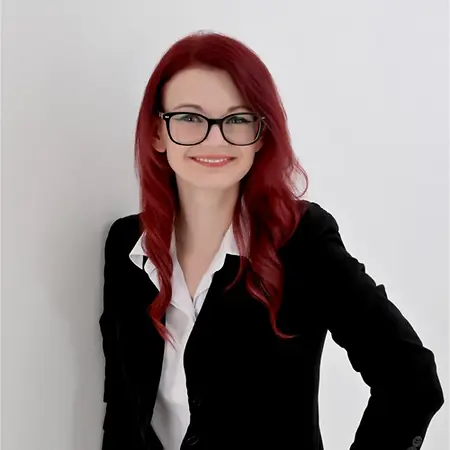
Her Story
About Hanna
Hanna Hefley is a Metallurgical Consultant specializing in superalloys at CCMA, LLC, where she provides expert guidance on metallurgical performance, analytical methods, and materials optimization for demanding industrial applications. Based in Tampa, Florida, she brings a strong background in metallurgical engineering and operations, with a career focused on advancing materials reliability, quality, and innovation within the metals and aerospace sectors. Prior to her consulting role, Hanna spent nearly eight years at Chromalloy, holding progressive leadership and technical positions including Director of Master Alloy and Metallurgical Operations, Metallurgical Lab Manager, and Master Alloy Metallurgist. In these roles, she led complex manufacturing and laboratory operations, managed multidisciplinary engineering teams, and supported critical production, development and quality initiatives. Her experience spans manufacturing operations management, engineering leadership, and applied metallurgy, with a particular emphasis on master alloys and superalloy systems. Hanna earned her Bachelor of Science in Metallurgical and Materials Engineering from The University of Alabama, where she was actively involved in Women in Science and Engineering, Materials Advantage, and several technical and competitive projects. She is deeply engaged in the professional community through ASTM International, currently serving as Chair of the E01 Committee on Analytical Chemistry for Metals, Ores, and Related Materials, as well as Chair of Subcommittee E01.08. Recognized for her leadership, mentorship, and dedication to standards development, Hanna is passionate about developing the next generation of metallurgists and contributing to the advancement of an underrepresented field.
Her Interview
Ten minutes with Hanna
01What do you attribute your success to?
I attribute my success to a lifelong commitment to learning, a deep passion for metallurgy and chemistry, and the support of an exceptional professional community that has generously shared its knowledge and mentorship over the years. I began my career producing, testing, and certifying superalloys for investment-cast aircraft turbine engine components—materials that remain central to my current work as a superalloy metallurgist and consultant. Through my involvement with ASTM and the University of Alabama’s Industrial Advisory Board, I strive to raise awareness of this critical yet underrepresented field of engineering and to encourage more women to pursue careers in STEM disciplines, including metallurgy.
02What’s the best career advice you’ve ever received?
During my undergraduate studies, there was a course focused on examining the causes and tragic results of several major engineering failures throughout history. The objective was clear: to teach future engineers that they carry the burden of responsibility for ensuring that the products they design, manufacture, and certify are safe for intended use, and to underscore the seriousness of the qualifications and certifications they sign.
That message was reinforced early in my career by my first manager, who consistently reminded us never to put our names on a certification unless we were prepared to defend it in a court of law. As I advanced into higher level roles, however, I faced increasing external pressure to compromise my professional and personal ethics, at times to the extent of facing threats to both my career and my personal well-being. After one such experience, an accomplished mentor reassured me that my integrity as an engineer and a scientist carries greater value than any company, position, or professional relationship. These are words I continue to live by.
We are in a cycle of industry that often focuses on lowering costs and accelerating timelines, and while efficiency and competitiveness are essential, it is the responsibility of engineers and scientists to ensure that these priorities never come at the expense of safety or human life. Technical diligence, ethical decision-making, and adherence to established standards must remain non-negotiable, particularly in fields where the consequences of failure are severe and often fatal.
I am fortunate to now work for a company like CCMA, whose leadership and culture align with these principles. By prioritizing integrity, sound engineering judgment, and long-term responsibility over short-term gains, CCMA demonstrates that operational excellence and ethical practice are not mutually exclusive, but fundamentally interconnected.
03What advice would you give to young women entering your industry?
Never listen to the people who tell you that you care too much or that the cost of professionalism and success is your humanity. Instead, be a leader that cares about and inspires people: be sincere in all you do, be present for those that rely on you, and be outspoken about the things that matter. Prove just how powerful passion and empathy can be in a world dominated by indifference!
04What are the biggest challenges or opportunities in your field right now?
Over the past several decades, the United States has steadily outsourced critical metallurgical expertise while simultaneously shrinking its domestic manufacturing base and its pipeline for technical talent. Today, only seven accredited universities offer degree programs in metallurgy or metallurgical engineering—down from more than twenty in the 1980s. The result is a growing shortage of technical expertise, particularly in metallurgical engineering disciplines that support superalloys and aerospace applications. By some estimates, retirements now outpace new graduates by as much as three to one.
Compounding this challenge, the on-the-job training models that sustained industry for generations are no longer assured. With fewer experienced metallurgists remaining in the workforce and limited formalized documentation, decades of institutional knowledge are being lost. Newer generations are increasingly forced to relearn what was once passed down through mentorship and practice.
Recent geopolitical events have made clear that these capabilities are more critical than ever. Addressing the emerging resource and supply-chain challenges will require not only meaningful domestic investment in cleaner, more effective manufacturing, refining, and recycling technologies, but also sustained support for education and workforce development to rebuild a resilient and enduring technical foundation.
05What values are most important to you in your work and personal life?
The values most important to me, both professionally and personally, are creativity, continuous learning, and empathy. I strive to live in a way that contributes meaningfully to society—seeking growth through travel and new experiences, supporting the arts and maintaining an appreciation for creative expression, and volunteering as a resource to those who may find my perspective or support valuable in some way.
Join Influential Women and start making an impact. Register now.