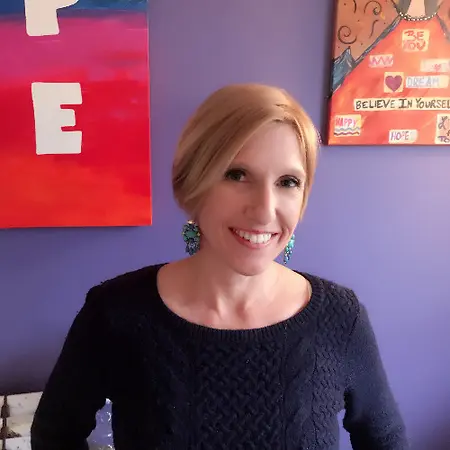
Influential Woman · Mental Health
Heather Baker, LCSW-S, CEDS-S
Founder and CEO, Prosperity Eating Disorders and Wellness Center
Reston, VA 20191
In Conversation
Heather Baker for Bold. Brilliant. Unstoppable.
Read the transcript
Heather Baker, LCSW-S, CEDS-S: Speaker: Heather Baker, Founder and CEO - Prosperity Eating Disorders and Wellness CenterWhat does being an Influential Woman mean to you?Heather Baker: Hey, I think being an influential woman, to me, it started with just having an initial passion and motivation to provide eating disorder treatment. In the state of Virginia, I was the first person, Crazy enough to ever provide eating disorder services in Virginia. Which means a lot of people suffered alone, And so, part of my journey is, is creating the legacy of finally having eatingor services in Virginia. I've trained hundreds of clinicians and dietitians and psychiatric providers on the treatment, And I think as a, as a woman, I feel like we should all be empowered to do what we feel led to do and how we can have influence without feeling like we've earned it or we we've done something special, but just because we are as women empowered, and we have the right to feel confident and to be able to set boundaries and be able to be strong and humble and confident, and help others and also really take care of ourselves with that apology. I hope to influence that on anybody I come across, my clients, my employees, people I meet on the street. I want them to see that I embody. A woman of confidence, not because I've earned it or because of my title, but that I just reflect that as a woman that they can also be as well.What's one piece of advice you would give to younger women chasing their dreams?Heather Baker: My advice that I would give to younger women, is, is really that you don't ever have to apologize for where you are in life. If you are a brand new professional, you don't need to keep apologizing or, trying to make up for the fact that you're new. Embrace that you're new, be an active learner, and don't apologize for it and don't compare yourself to others who know more. No matter how long you've been in a certain field, every day is you're learning, and even for older people who've been in the field for a long time, they're still learning too, and we all started from somewhere. So you can be confident, you could be an active learner, you can be strong. And you don't have to apologize for the weaknesses of being new. So I think that would be something I would really encourage. I remember when I just finished grad school and I was leading a team, and I had no idea what I was doing. I felt like a fraud. I remember like buying myself a briefcase and wearing glasses, so I looked older. But the best advice I got from my grandmother was just to act as if I've done it a million times, and that helped me get through that first meeting, and then I kept learning from that. I was watching others and how they did it. So, just giving yourself permission to just start where you are, keep learning and stop apologizing.
Her Story
About Heather
Heather Baker, LCSW-S, CEDS-S, is a licensed clinical social worker, entrepreneur, and nationally recognized eating disorder specialist who has dedicated her career to expanding access to compassionate, specialized mental health care. After earning her Master’s degree in Social Work from Arizona State University in 1998 and becoming licensed in 2000, she began her career as a general practitioner providing counseling for a wide range of mental health concerns. By 2007, after completing advanced clinical training, she specialized in the treatment of eating disorders and quickly recognized the significant lack of specialized care available in Virginia. Determined to fill that gap, she founded Prosperity Eating Disorders and Wellness Center in 2012, becoming one of the first providers in the state to create a comprehensive treatment model that extended beyond traditional individual therapy.
Under Heather’s leadership, Prosperity Eating Disorders and Wellness Center expanded into a respected clinician-led organization with locations in Northern Virginia and the Norfolk area. As the sole owner of the private practice, she has remained deeply involved in every aspect of the organization, including clinical supervision, operations, budgeting, marketing, staff development, and program design. In an industry increasingly dominated by large corporations and investment-backed treatment companies, Heather has remained committed to maintaining an independent, clinician-driven model focused on patient care and long-term recovery outcomes. Despite challenges including the COVID-19 pandemic, inflation, and ongoing insurance reimbursement limitations, she has successfully sustained and grown the practice while continuing to advocate for better access to eating disorder treatment and education.
Throughout her career, Heather has helped guide approximately a thousand individuals toward recovery from eating disorders and has trained hundreds of clinicians in the field. Her work combines clinical expertise with advocacy, education, and a strong commitment to social justice within mental health care. In addition to treating patients across the lifespan, she is passionate about improving professional understanding of eating disorders and addressing the growing impact of diet culture and social media on mental health. Known for her persistence, leadership, and dedication to helping others heal, Heather continues to make a lasting impact on both the individuals she serves and the broader behavioral health community.
Her Interview
Ten minutes with Heather
01What do you attribute your success to?
For me, success has never been about the money or fame - there's not a ton of money in this field if you're taking insurance. It's really about making an impact and having a legacy. I would never say it's a financial success like having 3 houses and traveling the world - that to me is not success, though of course that would be an added bonus. Success for me is about client satisfaction - when clients leave here saying they got so much out of the program, they accomplished all their goals, and they're able to go out and live their life to the fullest. It's about being able to pass it on, to go out in the community and hear somebody talking about their diets and say, hey, you know, let's talk about something else, because that's so not important. Success is also training doctors who get zero education in eating disorders - only 20% of medical schools teach any classes on eating disorders, and yet that's the go-to first person people see. If I'm one person but I can train up a lot of people, then the more I can do. Having a bigger stage beyond just my small community would be really helpful.
02What’s the best career advice you’ve ever received?
Dream bigger than what you think you can do. Then do one thing today that will get you one step closer to that dream or goal.
03What advice would you give to young women entering your industry?
It is easy to feel scared that you might fail, make mistakes or not be good enough. This can take hold of you and prevent you from excelling at what you love to do and really go at it. Make the mistakes, be less than perfect - as this happens and you ask for help, seek guidance and learn to be more proficient, you will eventually be the one that others come to for help in being the best they can be.
04What are the biggest challenges or opportunities in your field right now?
I think in this world we live in, mental health is going to continue to be a major issue and major struggle. I don't think anybody's trained growing up on how to manage this amount of stress, this amount of grief and hardship in the world. Eating disorders are not going away - they're just increasing with the normality. You have both ends of the spectrum - parents who are hyper-focused on their kids eating the healthiest foods and not gaining weight, doing 3 sports at the same time, making sure they're eating really healthy food and don't eat that cookie. Then you have the other end where maybe there's parents who are more neglectful and the kids are doing a lot on their own. But an eating disorder is a coping mechanism, an adaptation to whatever else might be going on. When you think about how rampant sex abuse is right now and how that's normalized, and mental health is rising in young adults and in males most right now - males have anorexia but there's also this pressure where they're not okay unless they're in a big body and super muscular, so they're taking steroids and creatine and forcing themselves past fullness to gain weight. It's the same thing as somebody trying to be underweight. We all have a design body that our body thrives at, but if it doesn't fit what you think is socially acceptable, then you're kind of at a fight with your body to be something that it's not, and that's not sustainable and causes health consequences and psychological consequences.
05What values are most important to you in your work and personal life?
I value humility. I show my human side of not being perfect and asking for help. After 26 years in my field, there is always something to learn, someone I can learn from and can still sharpen my skills.
Join Influential Women and start making an impact. Register now.