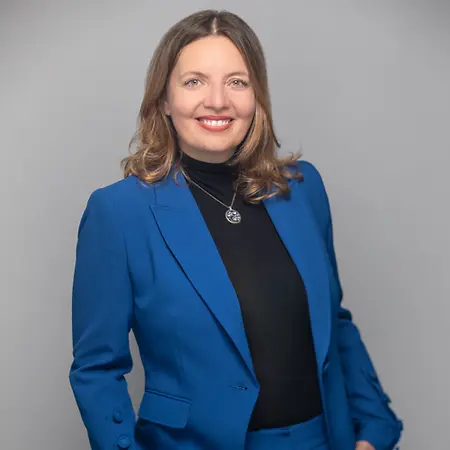
Influential Woman · Biotechnology & Biopharmaceutical
Heike Fuhrmann-Stroissnigg
Founder and Principal, Zeitlos BioStrategy
San Francisco Bay Area, CA 94404
Her Story
About Heike
Heike Fuhrmann-Stroissnigg is the Founder and Principal of Zeitlos BioStrategy, a consulting firm that helps translate aging biology into therapeutics. With more than 20 years of experience spanning academia, biotech startups, and large pharmaceutical companies, she specializes in de-risking preclinical programs and guiding aging-focused innovations toward successful IND submissions.
Her work focuses on senotherapeutics and age-related diseases, helping founders and investors pressure-test biological mechanisms, define translational endpoints, and build data-driven development strategies.
Heike began her scientific career in Vienna, earning a PhD in Biochemistry before moving to the United States for postdoctoral research at The Scripps Research Institute. There, she played a pioneering role in the emerging field of senolytics, developing high-throughput single-cell screening assays that contributed to the identification and validation of foundational senolytics such as Quercetin & Dasatinib, Fisetin, and Navitoclax. She also coined the term “senomorphics,” establishing a new class of senotherapeutic drugs.
Transitioning into industry, Heike held leadership roles at Gilead Sciences and Rubedo Life Sciences, leading in vivo pharmacology, target validation, biomarker selection, and IND-enabling studies across fibrosis and aging-related programs. Today, through Zeitlos BioStrategy, she works at the critical inflection point between discovery and development—ensuring promising programs reach their full potential.
Her Interview
Ten minutes with Heike
01What do you attribute your success to?
I was raised in a family with strong women where work was simply work. There was never any talk about what a woman could or couldn't do; we just did what needed to be done. That upbringing gave me a resilience and a default belief in my own capability that I bring to the lab and the boardroom today. Because science is a long and windy road, I stay excited by looking at the big picture. Attending conferences and staying connected to the broader scientific community helps me see the field’s progress over years, not just days. That perspective fuels the vision needed to follow the data until it yields a solution.
02What’s the best career advice you’ve ever received?
The most impactful advice I’ve received is to focus on the bigger picture rather than day-to-day challenges. In complex drug development, when tensions rise or teams lose focus, the best approach is to step back and ask: ‘What is objectively best for the project right now?’
By distancing yourself from the immediate politics or frustration, you gain the clarity needed to lead. Success in this field isn’t about being right, it’s about moving the project forward. Keeping the focus on the data and the potential solutions ensures that the work that truly matters stays on track.
03What advice would you give to young women entering your industry?
Science is tough, and drug development is even tougher. Most of the time, experiments fail, and your theories don’t work - but that’s part of the process. And when breakthroughs happen, all the effort is worth it. My advice is simple: if you have a strong enough ‘why’ behind your work, don’t let anyone tell you that you can’t do it.
Immerse yourself in the science—read, ask questions, and connect with people who share your curiosity. Most importantly, if you believe in an idea, work hard to prove it—but then work even harder to challenge it. In this field, you have to follow the data and never fall in love with your own ideas too much. The goal isn’t to be right; it’s to gain new insight to ultimately help patients.
04What are the biggest challenges or opportunities in your field right now?
One of the biggest challenges - and opportunities - is solving the 'translational bottleneck' in longevity research. Currently, our healthcare model is largely reactive, treating diseases only after they appear. The real opportunity lies in shifting to a proactive strategy that targets the underlying biological drivers of aging to extend healthspan, not just lifespan.
However, the biology is incredibly complex. Interventions that work in the lab often fail to translate to humans, and we still lack the validated biomarkers needed to measure success quickly. We also face a regulatory landscape where aging isn’t yet recognized as a clinical condition, which forces us to be exceptionally disciplined in how we choose our development paths.
This is exactly why I founded Zeitlos BioStrategy. My role is to help founders and investors navigate these risks by identifying the gaps in preclinical data and moving past the marketing hype to find drug targets that are truly viable. In a field this ambitious, the greatest opportunity is ensuring we focus resources on the science that will actually reach the clinic and deliver meaningful results for patients.
05What values are most important to you in your work and personal life?
The values I hold most dear are integrity, humility, and persistence. In both science and life, integrity means confronting reality—even when it contradicts what you hoped to be true. Humility is equally essential. In longevity research, we are confronting some of the most complex questions in biology. Acknowledging how much we still have to learn is the only way to move closer to real solutions. Persistence is what carries that work forward; drug development is a marathon including setbacks but also rewarding victories.
For me, a life well lived means doing work that matters. Improving lives through new medicines gives purpose to the inevitable setbacks and makes the effort worthwhile.
Join Influential Women and start making an impact. Register now.