Her Story
About Helen
Dr. Helen Sung is a conservation genomics scientist and zoologist whose work focuses on understanding how endangered species adapt to environmental change. Her research bridges field ecology, molecular genetics, and computational biology to generate insights that inform conservation strategies and biodiversity management.
She recently completed her Ph.D. in Zoology at the University of Hawaiʻi at Mānoa, where she investigated hybridization and gene flow in endangered crocodilian species using genomic and quantitative approaches. Her work examines how genetic exchange between species can shape adaptive potential, offering new perspectives on conservation in rapidly changing environments.
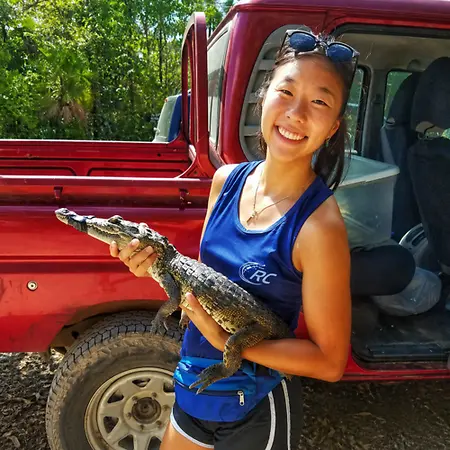
Helen has conducted extensive fieldwork in Central America through her collaboration with the Crocodile Research Coalition, contributing to ecological surveys, population monitoring, and conservation planning efforts. In parallel, she applies bioinformatics and statistical modeling to analyze genomic data and better understand patterns of genetic variation, population structure, and long-term species resilience.
Her research has been recognized through prestigious awards, including the National Science Foundation Graduate Research Fellowship and the ARCS Foundation Award in Zoology, along with multiple competitive fellowships supporting her doctoral work. She has also been invited to present her research at international genomics and conservation conferences.
Beyond her research, Helen is committed to advancing conservation science through education, mentorship, and public engagement. She has taught undergraduate courses in biology, genetics, and marine science, and contributes to interdisciplinary collaborations that connect scientific research with real-world conservation challenges.
Currently in a post-PhD transition, she continues her research collaborations while exploring opportunities that bridge genomics, conservation policy, and interdisciplinary biological research.
Her Interview
Ten minutes with Helen
01What do you attribute your success to?
I attribute my success to perseverance, passion, and the strong support system that has guided me throughout my career in a male-dominated field. Facing dismissive remarks only strengthened my determination to prove myself, while my commitment to meaningful scientific work kept me focused through the challenges of my PhD journey. Just as important has been the encouragement of my team and the compassionate mentorship I received, which provided stability, confidence, and growth even in moments of failure. Altogether, I’ve learned that success in science is less about innate brilliance and more about resilience, purpose, and the people who help you keep going.
02What’s the best career advice you’ve ever received?
The best career advice I’ve received comes from my mentors and has deeply shaped how I approach both my work and life. One piece from my mentor, Dr. Marisa Tellez—whom I call my “Yoda”—is: “Work hard, play harder.” This has reminded me to maintain balance, especially in demanding environments like a PhD program, where work can easily become all-consuming. It taught me that I am not defined by my career and that sustaining joy outside of work is essential. Another impactful lesson came from my PhD advisor, Dr. Floyd Reed, who emphasized the importance of enduring passion through inevitable challenges, explaining that even the things I love most will sometimes feel overwhelming or frustrating. His advice to focus on small wins and take challenges step by step has stayed with me, reinforcing that persistence, incremental progress, and finding meaning in small victories are what ultimately carry you through major obstacles.
03What advice would you give to young women entering your industry?
My advice to young women entering this field is to believe in your capability and stay persistent, even when challenges or doubts arise. Early in my career, I learned that success is not about excelling in every aspect immediately, but about continuing to develop your strengths, seeking support where needed, and relying on your professional community. Fieldwork is only one part of a much broader research landscape, and there are many ways to contribute meaningfully and build a fulfilling career. I’ve found that perseverance—especially in moments of uncertainty or when faced with doubt from others—has been key to my progress. Growth comes through steady effort, learning from setbacks, and continuing forward despite them. Most importantly, I encourage young women to stay connected to supportive mentors and peers, because no one succeeds in isolation, and a strong community can make a significant difference in navigating and thriving in this field.
04What are the biggest challenges or opportunities in your field right now?
The biggest challenges in my field include securing consistent research funding and navigating the dynamics of working in a male-dominated environment, which can sometimes present barriers to visibility, advancement, and inclusion. Despite these challenges, the field also offers significant opportunities, particularly in the breadth of research directions available and the potential to contribute meaningful, impactful work. It is an exciting space with room for innovation, collaboration, and growth across a wide range of scientific questions.
05What values are most important to you in your work and personal life?
The values most important to me in my work and personal life are collaboration, perseverance, community, and kindness with empathy. I’ve learned that meaningful progress in science depends on working together rather than in isolation, especially in a field that can sometimes emphasize competition. Perseverance has helped me push through challenges and setbacks, while my community has provided essential support and motivation along the way. Above all, I value kindness and empathy in both mentorship and teamwork, as I believe strong, inclusive environments bring out the best in everyone and lead to more impactful work.
Join Influential Women and start making an impact. Register now.