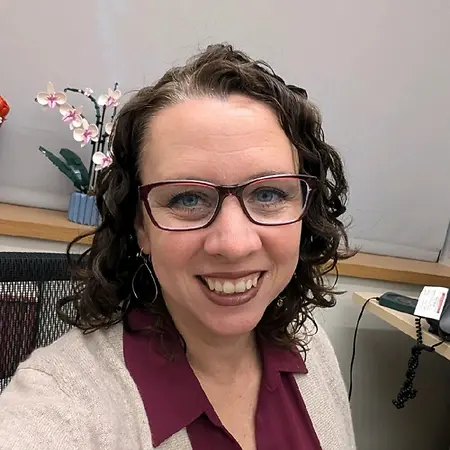
Her Story
About Hilary
My day-to-day work has no consistent routine, but the key elements are meeting with youth and families, having them be the center of all of our work. I collaborate with our teams whether that's in a clinical setting, at a school, or out in the community like at the library or at their homes. There's a lot of shared decision making and a lot of paperwork, but it's all to have the youth and the family at the center of our work, to be able to help them reach their goals. I'm stepping into a new role as a Certified Counselor in Washington, and in the next 5 years, I hope to really lean into my care management skills and be able to connect families to different resources that could help them after treatment. Sometimes it's hard to end care for the youth and families because they feel like, okay, now what? I'm left to my own devices. But life doesn't end, the challenges don't end. So it's about how do we set them up for success and connect them to all of the people that can help them once we're no longer there.
Her Interview
Ten minutes with Hilary
01What do you attribute your success to?
I was really excited when you reached out to me, because I think the answer to your question is the great women that I was surrounded by. I truly do believe in the value of strong women in my life. My mom was a single mother up until I was a certain age, and she always instilled in me hard work, compassion, caring not only for yourself but others, the world that you live in, just leaving everywhere better from when you got there. She worked as a nanny for a long time, then she was a chef, then she was a CNA, and now she's going back to school almost at a certain age, so that's really inspiring. She taught me that you are more than your circumstances, and it's never too late to make a shift. And just because you have to make a shift, or if things change, it doesn't reflect poorly on you, it's just context, and you just gotta keep pushing through it. I also want to mention Latino Network, because I myself as a first-generation person really value the hard work that my grandmother and mom put into raising me.
02What advice would you give to young women entering your industry?
A central theme that's been coming up for me and my colleagues a lot, especially as we finish this program and step into new roles, is being comfortable in the uncomfortable. There is that new stress that comes up, that at first it feels like I shouldn't be doing this, maybe you have some fear around am I going to be good enough, am I gonna cause harm in any way. However, I think shifting that and reframing that stress as it's my body telling me that there's something that needs to be done, urging me to take the next steps to take on that challenge, because I am ready. I just have to dive in. So all that to say, I would say being comfortable in the uncomfortable.
03What are the biggest challenges or opportunities in your field right now?
The first thing that comes to mind is burnout. In any public health field and health field in general, I feel like we pour so much into clients and patients that we forget to pour into ourselves. I think that's the biggest thing, just making sure you take care of yourself consistently and intentionally so you can continue to do the work. That's the hardest part. As far as opportunities, Children's behavioral health foundationally aligns with a lot of different things that are already existing. I think the new thing with this degree and this career as a practitioner is that we're filling in the gaps. So I could see it evolving into its own independent career and just growing to be on the same wavelength as social work, or BCBA, or occupational therapy.
Join Influential Women and start making an impact. Register now.