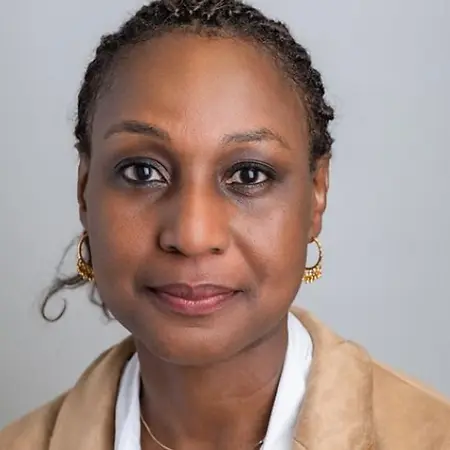
My leadership superpower is making people feel seen as human beings. Leadership is about seeing the people behind the roles and guiding them toward a shared goal.
Ifeoma Nwogu, PhD · In Her Own Words
Her Story
About Ifeoma
Ifeoma Nwogu is an Associate Professor in the Department of Computer Science and Engineering at the University at Buffalo, where she has served as a faculty member and researcher since 2009. With a Ph.D. in Computer Science and Engineering from the University at Buffalo and a dual major in Computer and Information Science and Electrical Engineering from the University of Pennsylvania, Dr. Nwogu has built a distinguished career at the intersection of artificial intelligence, computer science, and human-centered research. Her work reflects a commitment to developing innovative technologies that address real-world challenges while advancing scientific understanding through interdisciplinary collaboration.
Dr. Nwogu's research focuses on the intersection of artificial intelligence, human behavior, and health, where she partners closely with social psychologists and researchers across engineering, public health, and the social sciences. She develops machine learning and multimodal AI systems capable of interpreting complex human behaviors through video, audio, and physiological signals. Her research spans social interaction analysis, affective computing—enabling computers to recognize and interpret human emotions—and sign language translation, including AI systems that translate sign language into English and generate sign language from English text. More recently, her work has expanded into maternal and infant health, using digital modeling and artificial intelligence to better understand and support interactions between mothers and infants across diverse social environments. Through both her research and teaching, she mentors students and fosters interdisciplinary partnerships that translate cutting-edge AI into meaningful societal impact.
Beyond the laboratory, Dr. Nwogu is a passionate advocate for broadening opportunities in artificial intelligence and inspiring the next generation of researchers. A Senior Member of the Institute of Electrical and Electronics Engineers and a member of the American Association for the Advancement of Science, she is a sought-after speaker who has delivered keynote presentations, including at Buffalo Women in Technology, where she highlighted the experiences and achievements of emerging women leaders in AI alongside her senior Ph.D. students. Looking toward the future, Dr. Nwogu envisions establishing a dedicated Human Behavior Modeling Center that brings together experts from multiple disciplines to leverage artificial intelligence and advanced computational methods to better understand human behavior, emotion regulation, and social interaction. Guided by the belief that technology should improve lives and expand opportunities for people from all backgrounds, she continues to shape the future of AI through research, education, mentorship, and innovation.
Her Interview
Ten minutes with Ifeoma
01What do you attribute your success to?
First of all, having great people around me - mentors, people that I can check in with, that check in with me. People who have mentored me in different shapes and forms, or have been role models really make our work a success. Secondly, the National Science Foundation and other funding agencies like the National Institutes of Health have been incredible. The NSF is what has allowed the U.S. to be a science leader for so many generations. They look for the best sciences and put money behind it, and my area has been well funded by them. I've also worked with great students. I teach them fundamentals, and by the time they're graduating, they know way more than I do. They teach me, so I piggyback on their knowledge. That's been very helpful. Being in a great university like University of Buffalo has also been key. The governor takes a special interest in the university, we have really great leadership, and they're very forward-thinking. Seeing that your university is not stagnant, that they're riding the wave all the time and trying to be at the cutting edge of the latest and greatest concepts in the community and society, that also helps.
02What are the biggest challenges or opportunities in your field right now?
Entry level is hard right now. My students are having a hard time finding jobs, because the entry-level positions that would hire them right out of college are now looking for people with 3 to 5 years of experience. Companies know that AI can do what entry-level people would have done immediately, and the question is, how do you get that experience when that's what the AI does? Skills are changing a lot in my field. I spend a lot of my summer learning new skills, new programming styles. The fundamentals and math foundations don't change, but the skills that one has to learn to really keep up with the AI field is a lot. Just being a programmer is going to be a dying skill. But as we settle down to see where the gaps are, it will open new opportunities. The AI might write the core code, but you need people who understand what it's writing and can check it. Designing and evaluating are going to be skills that are more needed. There are also opportunities in policy. We're not making many policies around technology yet and this needs to change. The people who will help make those policies are the computer scientists graduating today who understand the powers of AI and can help craft and shape those boundaries. As the AI keeps progressing, the policy needs to keep shaping, and cybersecurity needs to keep up. It's like an arms race. AI is advancing, but it's going to shape a whole new set of skills that people will need to have to continue to make sure it's still just a tool that can used to help humans and not cause harm.
03What values are most important to you in your work and personal life?
First and foremost, my faith I am Christian, so there are a lot of Christian values that are important to me. Professionally, fairness is important. Integrity is crucial I really want to work with people where I believe there's integrity on my part and on their part. Service is important. As I said, I want my work to make meaningful difference in people's lives. I don't want my research to just sit in the lab or in a paper. I want it to actually go out to the communities to serve people, to help people.
Join Influential Women and start making an impact. Register now.