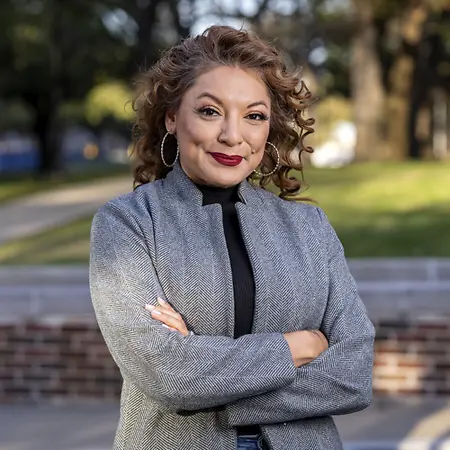
Progress isn't always loud or immediate. Sometimes it's built quietly, over years of doing the work, until one day you realize you've earned your place.
Imelda Gutierrez · In Her Own Words
Her Story
About Imelda
My journey in education began unexpectedly. As a teenager in need of a job, I started working as a receptionist at a public charter school. What began as a position behind the front desk quickly became a calling, as I developed a deep connection to the students and the school community.
With the encouragement of a mentor who recognized my potential, I made the decision to pursue higher education. As a first-generation college student, raised by a single mother in a low-income household, my path was not traditional. I became a mother at 17 and did not begin college until my 30s. Today, as a wife, mother of five, and grandmother of four, I carry both personal and professional responsibility in this work, grounded in lived experience and a deep commitment to the communities I serve. Despite these challenges, I earned my bachelor’s degree in Psychology with a minor in Education and am now pursuing a Master of Public Policy at Southern Methodist University.
I currently serve as a Character Specialist within a public charter school network, where I focus on student behavior and discipline. In this role, I witness daily how existing policies disproportionately impact Black, Brown, undocumented, and mixed-status students. These experiences have shaped my commitment to educational equity and strengthened my resolve to be part of the decision-making spaces where policies are developed and implemented.
I was recently selected for the seventh cohort of the LBJ Women’s Campaign School at the University of Texas at Austin, further advancing my goal of becoming a policy leader and advocate for more equitable education systems.
I am committed to advancing policies that center equity, accountability, and the lived experiences of the students and communities most impacted.
Her Interview
Ten minutes with Imelda
01What do you attribute your success to?
I’ve never really thought of my journey as “success.” For me, it’s simply about doing the work and staying committed to the students and communities I care about.
I love working with kids, building relationships, and giving back. Being bilingual has been a powerful part of that. It allows me to connect with Spanish-speaking families in a way that helps them feel comfortable, understood, and supported, especially when they may already feel unseen.
A big part of what drives me is my own story. I am from Laredo, Texas, and I see myself in the students I serve every day. That connection keeps me grounded and reminds me why this work matters.
I understand that I may not be able to reach every student. But if even one student hears me, believes in themselves, and chooses a different path because of that connection, then that impact matters.
And that is the work I will continue to do, ensuring that students not only feel seen but understand that their voice, their story, and their future have value.
02What’s the best career advice you’ve ever received?
The best career advice I’ve ever received is to never stop learning. Stay curious, keep reading, and challenge yourself to grow every day.
In education, change is constant, whether it’s new leadership, new students, new policies, or new roles. The ability to adapt is essential. Growth doesn’t happen in comfort, and change is rarely easy, but it is necessary.
Learning to embrace change rather than resist it has been one of the most important lessons in my journey.
Because the more willing you are to grow, the more prepared you are to lead, no matter where you are called to serve.
03What advice would you give to young women entering your industry?
My advice to young women entering this field is simple: don’t get in your own head. It’s easy to feel like you don’t belong or that certain spaces aren’t meant for you. I’ve felt that way myself. But those spaces were never meant for just a few. They are for all of us, and there is room for more.
Find your person, someone who will support you, remind you of your strength, and stand beside you when the work feels heavy. Having even one person who believes in you can make all the difference.
It’s also important to remember that there is no single path. It is never too late to start, to go back, or to step into something new. Your journey is valid, exactly as it is.
In my work with students, I constantly remind them that they are capable of greatness and that their voices matter. I believe the same is true for every woman stepping into this field.
You belong in these spaces. Your voice matters. And by choosing to show up, you are not only changing your own path but also creating one for those who will come after you.
04What are the biggest challenges or opportunities in your field right now?
One of the biggest challenges in education right now is the growing gap between what students need and what systems are currently designed to provide. Schools are still recovering from the long-term impacts of the pandemic, with many students, especially in underserved communities, continuing to struggle academically, behaviorally, and emotionally.
At the same time, there are increasing pressures around policy, funding, and political influence in education. Shifts in policy and ongoing debates around equity, curriculum, and discipline are shaping what schools can and cannot do, often without fully addressing the realities students face every day.
Another major challenge is student engagement and learning gaps, particularly in middle school, where many students are still not performing at grade level and need continued support beyond what systems were originally designed to provide.
But within these challenges, there is also an opportunity.
There is a growing recognition that schools must evolve, whether that means rethinking discipline practices, strengthening student support systems, or creating policies that are more responsive to the communities they serve. There is also an opportunity to bring more voices, especially those with lived experience, into the decision-making process.
From where I sit, working directly with students, the opportunity is clear: to bridge the gap between policy and practice. To ensure that the people writing policies truly understand the impact those decisions have on students, families, and schools.
The challenge is real—but so is the opportunity to reshape education into a system that is more equitable, more responsive, and more grounded in the realities of the students it is meant to serve.
05What values are most important to you in your work and personal life?
The values that guide both my work and personal life are kindness, honesty, and humility.
In my work with students, I firmly believe that behavior is a form of communication. When a child is acting out, it often reflects an unmet need, something they may not yet have the words or tools to express. That perspective has shaped how I respond, leading with patience, empathy, and a commitment to understanding rather than judgment.
Many of the students I serve carry challenges that extend far beyond the classroom. Some come to school facing food insecurity, housing instability, or other hardships that deeply impact their ability to learn and engage. Recognizing this has strengthened my commitment to lead with kindness and extend grace whenever possible.
Honesty is equally important to me. I believe in being transparent and genuine in all of my relationships, with students, colleagues, and my own family. I want the people around me to know that they can trust me, that they will be heard, and that they are in a safe and supportive space.
At the core of everything I do is a commitment to showing up with compassion, speaking with integrity, and creating environments where people feel seen, valued, and understood.
Join Influential Women and start making an impact. Register now.