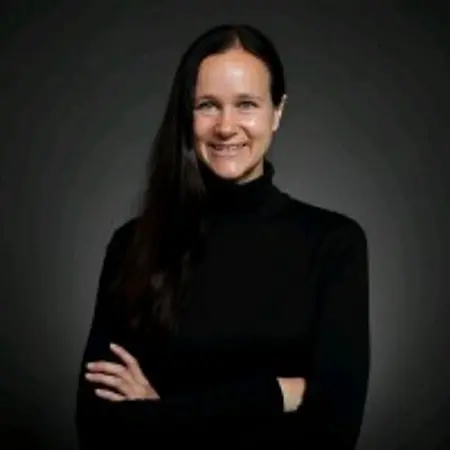
Influential Woman · Healthcare Technology and AI
Ines Voellinger
Founder, IV.ai Solutions
Chattanooga, TN 37405
Rest isn't the opposite of ambition. It's what makes ambition survivable, and what our healthcare systems must give back to clinicians and patients running on empty.
Ines Voellinger · In Her Own Words
Her Story
About Ines
Ines Voellinger is one of the few AI leaders who moves comfortably between two fields that rarely meet: safety-critical automotive engineering and clinician-facing healthcare. Over nearly 17 years at a global vehicle manufacturer, she built things that lasted. She created the company's product compliance program from the ground up, started a purchasing training academy from scratch, and led AI strategy and digital transformation across the North American Region, deploying a portfolio of enterprise AI use cases. Those years also hardened a standard she has never been willing to compromise: do the work the right way, even when cutting the corner is faster. She would sooner pass up a promotion than bend the rules, or herself.
Today she leads IV.ai Solutions, the company she founded in late 2024, as Founder and CEO. The work is hands-on: she helps physicians, therapists, and mental health providers evaluate and pilot the AI tools that genuinely fit their patients and their workflows, then put them to use without adding to the load clinicians already carry. Her priority is health disparities, beginning in rural Tennessee, where access is thinnest, with an approach built to carry over to underserved communities elsewhere in the country.
As a keynote speaker and healthcare futurist, Ines helps clinicians and health systems see where new technology is heading before it arrives, and how to steer it toward prevention rather than crisis. In the U.S., she is CME faculty with the Missouri Association of Osteopathic Physicians and Surgeons, the Tennessee Osteopathic Medical Association, and VOCCME, where her programs meet AOA and ACCME standards, and she is now preparing to bring that teaching to Europe for the first time. Her aim is constant: make tools like AI and wearables genuinely useful at the bedside without eroding the trust between clinician and patient. She supported a workshop for Reuters Digital Health, and in April 2026 she was at DMEA in Berlin, one of Europe's largest digital health events, where she began building partnerships to bring European health technology to U.S. providers.
Her formal training reaches across both fields. At Stanford she completed the AI in Healthcare program and the Digital Transformation in Healthcare course, and she has also studied integrative and preventive health. She was selected for the Harvard Emerging Leader Program, one of just 30 chosen from a workforce of more than 10,000. As a founding member of the AI TechX Consortium of Tennessee, based at the University of Tennessee, Knoxville, she works across academia, the public sector, industry, startups, and medicine, with a shared goal of putting Tennessee among the country's leading states for applied AI.
Ines is based in the Greater Chattanooga area, but her path there was a winding one. A native German speaker, she started out in tourism across Spain and the rest of Europe before moving to the United States in 2007. Later, navigating the healthcare system as a patient herself, she saw firsthand where care breaks down, and that experience pointed her toward healthcare AI.
She does her most ambitious work alongside people who share her curiosity, the ones who would rather test and build than wait, and she has a gift for turning her own excitement into a vision others want to join. She is now looking to grow that work internationally, with partners in MedTech, AI, and healthcare who believe, as she does, that access should not be a privilege. IV.ai Solutions already operates in both the United States and Germany, and the same problem pulls at her on both sides of the Atlantic: the rural and village areas, including those near her own German hometown, where clinician shortages are deepening and the need to understand these new tools is greatest. Increasingly, that conviction reaches past the clinic. She wants the AI literacy she brings to physicians to reach patients and everyday people too, so they can understand the technology shaping their care and take a real part in their own health. In the end, she is after care that prevents rather than only reacts, and that reaches the people it has too often missed.
Ines welcomes connections on LinkedIn at linkedin.com/in/ines-voellinger-3a7716114.
Her Interview
Ten minutes with Ines
01What do you attribute your success to?
For years, I was told my empathy was a weakness. It came up more than once, usually paired with my insistence on staying practical and realistic about what actually works. I tried to change. I couldn't, and I'm glad I didn't, because that instinct turned out to be exactly what worked, with every client and in every industry I've ever been in.
Two other things have carried me just as far. The first is integrity. Working in highly regulated, safety-critical environments taught me there's always a right way to do something, and I've never been willing to bend the rules, or myself, to get ahead. I'd give up a promotion before I would, and that has never once felt like a sacrifice.
The second is energy. When I get genuinely excited about an idea, that excitement turns into a vision, and the vision pulls people in. I do my best work surrounded by people with the same curiosity, the ones who want to test, experiment, and build something. Right now I'm aiming all of it at one thing I believe in completely: helping the U.S. move toward real, preventive healthcare. I don't need my part to be big. I need it to count, and I'm giving it everything I have.
02What’s the best career advice you’ve ever received?
The best advice I ever got didn't sound like career advice at the time. I was twenty-seven, and a physician who had treated me for a long stretch looked at me and said, "You should study medicine." I took it seriously. Then I talked myself out of it, certain I was too old to start over.
He was right, and somewhere I knew it. Years later, when I was hungry for something that stretched me again, I started studying medicine in my own time, quietly, because I couldn't not. That detour turned out to be a straight line to where I am now.
What he really taught me, along with a few hard turns since, is to trust my gut and believe in my own vision. For someone who leads with empathy, that instinct is rarely wrong. If I have one regret, it's that I didn't trust it sooner.
03What advice would you give to young women entering your industry?
My advice is simple: just do it, and stop doubting yourself. I spent seventeen years in automotive, an industry that's male-dominated in every corner, from purchasing to engineering, and women still aren't recognized the way they should be. But here's what I wish more people saw: the way women tend to work is a strength, not a liability. We connect things, and people, that others overlook. We see the whole board.
What gives me the most hope is women building networks and lifting each other up, where everyone pitches in something, a contact, an introduction, a word of encouragement. That is real power.
I felt it firsthand. Two years ago I hired a woman who went on to start her own business writing children's books, and her sheer determination is part of what gave me the courage to go all-in on mine. I hired her, and she ended up inspiring me. So if you have an idea you believe in, don't sit on it alone. Say it out loud, share it, let people in. That's how it becomes real. And if I can be the reason one woman stops doubting herself, that's more than enough for me.
04What are the biggest challenges or opportunities in your field right now?
The biggest challenge in my field is also its biggest opportunity, and I think we badly underestimate it: the AI literacy gap. The technology keeps racing ahead while the people it's meant to serve, physicians and patients alike, get left behind. And the gap is widest exactly where health disparities already are, in rural and underserved communities. There's enormous hype right now, and a lot of people hiding behind the word "AI." But no matter how good a tool is, if you can't explain its benefit in plain terms a person can actually understand, it fails. You have to meet people where they are, and you have to earn their trust before anything else.
There's a quieter challenge underneath it. Physicians are so buried in administrative work that they barely have time to look up from the screen and be present with the patient in front of them. People don't leave medicine because they stop caring. They leave because they're exhausted. Used well, AI can give some of that time and attention back.
That's the work I want to do next. Not just helping physicians, but going into communities directly, with plain-language workshops and The Trust Lab, a mobile setup I could take into rural towns where people can see and touch AI tools and wearables for themselves, and ask their own questions in their own words. Familiarity first. Trust first. Everything real follows from that.
05What values are most important to you in your work and personal life?
A few things are non-negotiable for me. Integrity sits at the foundation; I've never been willing to win by cutting corners. Then comes curiosity, which is really the engine for everything else. I'm endlessly drawn to new ideas, new technology, new ways of solving old problems, and I believe creativity matters just as much in this field as the technical skill does. The best solutions usually come from looking at a problem sideways.
But none of it means much to me unless it serves people. That instinct goes all the way back to my first job at fifteen, in hotel catering and events, where the entire job was making sure the person in front of you felt taken care of. I never lost it. Today I care about working alongside others, lifting them up, and making a real impact, especially for the patients and providers who are too often overlooked. At the end of the day, my measure is simple: is the technology actually serving the human being in front of us? If it isn't, it isn't worth building.
Join Influential Women and start making an impact. Register now.