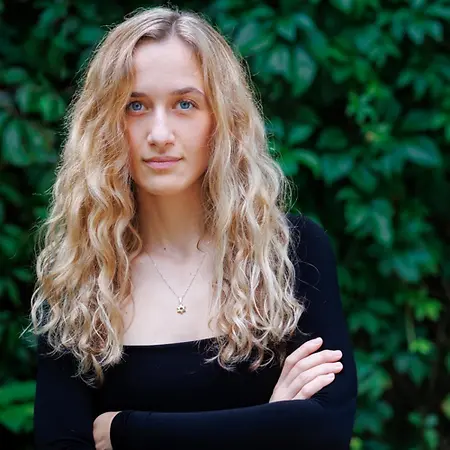
Her Story
About Isabel
Isabel Brodsky is a Chicago-based playwright, editor, and freelance writer whose work centers on storytelling as a vehicle for social change. A Contributing Writer for Encyclopaedia Britannica, she brings a rigorous research-driven approach to both journalism and theater. Isabel is currently pursuing her MA in Dramaturgy and Writing for Performance at Goldsmiths, University of London, where she continues to refine her voice as a dramaturg and playwright. With a background that bridges performance, academia, and editorial work, she is committed to creating art and writing that are both intellectually grounded and emotionally resonant.
Isabel earned her Bachelor of Arts in Anthropology and Literary Arts from Brown University (2016–2020), where her passion for playwriting took shape. Frustrated by the lack of depth and authenticity in female roles she encountered as a young actor, she began writing her own work—determined to craft complex, fully realized women characters. After graduating in 2020, she moved to Chicago and explored stand-up comedy before returning to playwriting with renewed focus. Her journalism career emerged unexpectedly when she successfully completed a trial assignment for Britannica, leading to the publication of numerous researched pieces and sharpening the investigative lens she now applies to her dramatic writing.
Within her creative practice, Isabel gravitates toward dark comedy, believing that audiences are most open when they are laughing—or when they are unsettled. Her current thesis play explores themes of hunger, repression, and desire, examining how women navigate appetite in its many forms. Beyond writing, she has worked as a writing tutor and Common App essay consultant for over five years, supporting students in finding clarity and confidence in their voices. Whether collaborating with directors and actors in rehearsal rooms or publishing research-based essays, Isabel Brodsky is dedicated to creating work that invites audiences not just to watch or read—but to live inside the story.
Her Interview
Ten minutes with Isabel
01What do you attribute your success to?
I think my biggest success has been committing to my writing and moving to London for my master's program. When I was applying to grad school, my family was like, all these playwriting programs are so selective, you should apply to some other types of programs, and I was like, well, I don't want to do anything else, so I'm not gonna do that. I ended up getting into two programs and getting offered an alternate position at another one out of the four schools I applied to, which was awesome. It showed me that honestly, my biggest obstacle is just, you know, like it is for a lot of women, being like, oh, well, I'm not... it's not gonna work out, and they're not gonna think I'm good enough. Moving here by myself with 3 gigantic suitcases that I hauled through the airport on my own has been a physical indication to myself and to others that I'm really committed to my writing and to my work. I've been working on being more delusionally confident in myself, because it seems to work. The only thing I wanted to do when I was a kid was to write a book - when I was in kindergarten and first grade, I would staple printer paper together and write on it. I feel happy that I've prioritized writing so much that now it's becoming my career.
02What advice would you give to young women entering your industry?
I would advise young women in this industry to fully commit to their craft and be courageous in pursuing opportunities, even if it means taking bold steps like relocating. Cultivate strong confidence in your voice and ideas, and prioritize connection and collaboration—relationships are what bring projects to life and open doors.
03What are the biggest challenges or opportunities in your field right now?
Right now, some of the biggest challenges in my field are securing funding for projects, reaching audiences beyond the traditional theatre community, and addressing the lack of fully developed roles for women in existing scripts. At the same time, there are exciting opportunities: using film, video, and other media to engage wider audiences, and expanding networks across sectors to increase both funding and visibility for new work.
04What values are most important to you in your work and personal life?
Connection and collaboration are at the heart of everything I do. That's why I love playwriting so much, as opposed to other types of writing I've done - it forces me to leave my witch's hut where I sit and do all my writing. You have to go talk to people and collaborate, which I think is really important. I think connecting through shared interests and storytelling is a big thing for me. I love meeting people wherever I go - I'm about to go on a solo trip to Spain and I'm planning on talking to people wherever I go. I think it's really exciting, and I also think it's important as a writer to hear people's stories and to interact with people in lots of different places, and not just stay in one place, like where you grew up. I don't want to make theater just for people who are already seeing theater - I want to draw in people who aren't in the theater world because they might need to see it more, since they're not already having these kinds of conversations. I spend a lot of time sitting at the National Theatre cafe working on my writing and networking with other people in my program. I also think it's important to give back - I do pro bono tutoring work for people who can't afford it because it's a tricky situation to only be helping people who can afford it, as it creates an even wider discrepancy and wealth disparity in people who are able to go to college.
Join Influential Women and start making an impact. Register now.