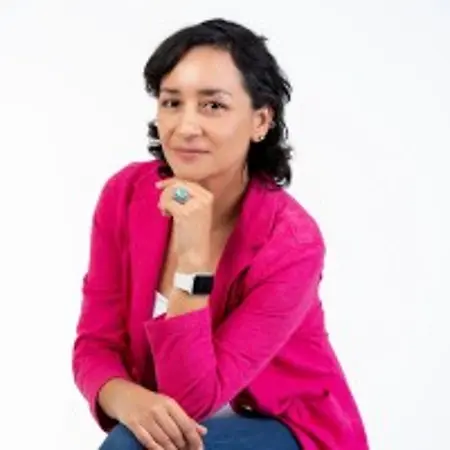
Her Story
About Ivania
I worked for the Department of Education in Chile, where I'm originally from, and in Sweden where I lived for 4 years. It took me 3 years to learn the language and insert myself as a woman and a Hispanic, as a Latino, in a Nordic and Swedish culture - it was not easy. When I came to the U.S., I realized there is much disconnection between resources and people with different barriers, not only language, but digital literacy, transportation, single moms who still don't know where to go when they need diapers. On the other side, I found out there is a lot of nonprofit that offers amazing work, but everybody's working on silos. I thought that creating safe spaces where people can go without feeling stigmatized can help to connect people with resources. That's why I founded Connecting Community, a nonprofit organization that hosts trustable, free, stigma-free safe spaces in mobile home parks and more underserved and vulnerable communities. We meet with them every week and connect them with different service providers around social determinants of health. I'm also a consultant for nonprofits with expertise in how organizations work, grant writing, program evaluation, and measurement. My main expertise is to be a connector, a bridge - I can navigate different systems because of my professional background and bilingual abilities, giving me access to people with higher education, nonprofit leaders, and business people, while also being able to go to my community, my people who look like me.
Her Interview
Ten minutes with Ivania
01What do you attribute your success to?
I attribute my success to having a very clear why and being willing to sacrifice and give up a lot for that purpose. I've had to work incredibly hard because I wasn't raised here and didn't have the connections that some people have when they went to Duke, UNC, or Chapel Hill - they have networks that help them access resources. I struggled with the same thing that my community struggled with - the connections. That was the hardest part to start a nonprofit, because I had to create that network myself. I've had to do a lot of work creating awareness, meeting many people and stakeholders to really create awareness of what we do, what we see, and what we need. But it's good because I really feel on my own skin what it means to be an immigrant or someone who has no connections and you have to open the space yourself. That takes a lot of energy, effort, and courage, because there are haters out there wondering what a Latina is doing here, that feeling that you don't belong. But it takes a lot of courage and motivation and passion for what you believe and the people that you serve.
02What advice would you give to young women entering your industry?
You need to be able to really leave a lot of things and sacrifice a lot - it's a big commitment. You need to have very clear what is your why, and you need to know how much you're willing to give up for that why, because it takes a lot of years, family space, and other spaces. Nonprofits are like residences - they're competitive, they open and then they close. If people don't have the courage, the passion, the motivation, and their why clear, it's better not to do it because they're gonna end up feeling so frustrated. It's not for everyone. You need to have your passion, your goals, your why very clear, and be willing to go for it.
03What are the biggest challenges or opportunities in your field right now?
The biggest challenge is that there is a big gap between resources and communities that don't know where they are. There is a lot of disconnection between resources and people with different barriers - not only language, but digital literacy, transportation, single moms who still don't know where to go when they need diapers. On the other side, there are a lot of nonprofits that offer amazing work, but everybody's working on silos. It's hard to build community and find your people when we work in systems that are not designed to meet the most vulnerable communities. Even more, there are systems in place that aim to chase people for the color of their skin or their migration status. It's really hard to navigate those systems. What's missing is the opportunities, the understanding that we are all in the same boat together, and that a healthy community means different stakeholders helping other people who didn't have the same privilege of having a white skin, or a better education, or being born in a family that has more opportunities.
04What values are most important to you in your work and personal life?
The most important value to me is moving with intention - if I don't move with intention, then I prefer not to move. I don't do this for my ego or for awards and recognition. I do this for my people, for the community I serve. When people wanted to give me an award, I said no, and I actually gave an award to a community member instead. Visibility is important to me when it has purpose and intention - when it's going to inspire other women and be a role model. But if it's just for receiving an award, a picture, and social media, that's not my thing. My thing is to inspire and to be a role model. At the end of the day, we are all moms, parents, and people - people are the same, we just struggle and have different opportunities. What's important is creating opportunities so people can really thrive, and understanding that we are all in the same boat together. A healthy community means different stakeholders helping other people who didn't have the same privilege.
Join Influential Women and start making an impact. Register now.