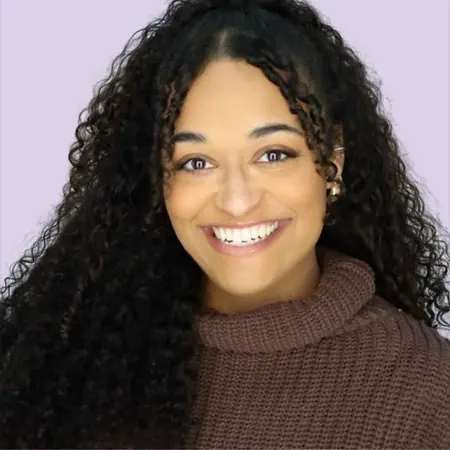
Her Story
About Jada
She is a strategic enrollment management leader with over a decade of experience in graduate recruitment, admissions operations, and student services, currently serving as Senior Director of Enrollment Management at Fordham University Graduate School of Arts and Sciences, where she leads long-range strategic planning and enrollment growth. She is also a doctoral candidate in Higher Education Leadership at NYU, where her research focuses on the experiences and institutional support of students with chronic illnesses in higher education. Prior to her current role, she spent over five years at NYU Tandon School of Engineering in progressively roles including Assistant Director of Graduate Recruitment & Operations and Assistant Director of Enrollment Operations, where she led strategic planning, managed over 16,000 annual applications, oversaw financial aid processes, and utilized Slate CRM to enhance recruitment and yield strategies. Her career includes roles as Admissions Outreach Specialist and Student Support Services Center Coordinator at Mercy University, as well as positions at White Plains Hospital and Manhattanville University. She is recognized as a strategic, data-driven, and student-centered enrollment leader who is deeply committed to building diverse graduate cohorts and fostering student success through innovative recruitment, operational excellence, and cross-functional collaboration.
Her Interview
Ten minutes with Jada
01What do you attribute your success to?
I attribute my success to being willing to learn, take risks, and genuinely care about the work that I do. I've never been someone who wanted to simply do a job and check a box. I like understanding why something is being done, figuring out how it can be done better, and being willing to speak up when I see an opportunity for improvement.
I also think a big part of my success has been staying grounded in the students and people I'm serving. That keeps the work meaningful for me and reminds me that the decisions we make have a real impact on someone's experience. I've been fortunate to have people who have believed in me throughout my career, but I've also had to learn to believe in myself, take up space, and recognize that I belong in the rooms I'm in. For me, success hasn't been about having everything figured out. It's been about being willing to keep learning, advocate for myself and others, and not be afraid to create my own path.
02What’s the best career advice you’ve ever received?
The best career advice I've received is to not be afraid to advocate for yourself and, at the same time, to never lose who you are in the process. There were times earlier in my career when I thought I needed to prove myself first and wait for someone else to recognize my potential. I've learned that you can do the work, be humble, and still be confident enough to say, "I know what I bring to the table."
I've also learned how important it is to be authentically myself. I don't think you have to change your personality, your voice, or the way you lead to fit into a certain idea of what a successful leader looks like. Some of the best things in my career have happened when I trusted myself and leaned into who I am. I think that's especially important for women. We're often taught to wait until we feel completely ready or until someone gives us permission to take the next step. I've learned that sometimes you have to put yourself forward, ask for the opportunity, negotiate for yourself, and trust that you belong in the room. You don't have to know everything before you take the next step. Sometimes you just have to be willing to take it and trust yourself enough to do it as your authentic self.
03What advice would you give to young women entering your industry?
My biggest advice would be to trust yourself and don't be afraid to take up space. You don't have to have everything figured out, and you don't have to wait until you feel 100% qualified to go after an opportunity. If you know you can contribute something, speak up and let people know what you're capable of. I'd also encourage young women to be authentically themselves. There can be a lot of pressure to change how you communicate or lead to fit a certain idea of what a successful person looks like. You don't have to do that. Your perspective, your experiences, and your voice are part of what makes you valuable. Build relationships and don't be afraid to ask for help. I've learned so much from the women and mentors who have supported me throughout my career. You don't have to figure everything out on your own. Take the opportunity, advocate for yourself, and trust that you belong in the room. You may not always feel ready, but that doesn't mean you're not ready.
04What are the biggest challenges or opportunities in your field right now?
I think one of the biggest challenges in higher education right now is balancing the changing needs of students with an institution's ability to adapt. Students are coming to us with different expectations, financial considerations, career goals, and life circumstances than they have in the past. At the same time, institutions have to think strategically about enrollment, technology, and how we're delivering education. I actually see that as a huge opportunity. We have an opportunity to rethink how we recruit and support students and make the graduate experience more intentional and student-centered. Technology, including AI, is changing how we work and communicate with students, but I think the key is using it to enhance the student experience rather than allowing it to replace the human connection.
For me, the opportunity is in finding better ways to meet students where they are while still maintaining the value and rigor of a graduate education. That's what makes this field exciting to me. There's a lot that needs to evolve, and I think enrollment professionals have an important role in helping institutions think differently about how we serve students.
05What values are most important to you in your work and personal life?
The values that are most important to me are authenticity, empathy, integrity, and purpose. My own experiences have really shaped how I think about those values. Roughly 7 years ago I was diagnosed with Lupus and going through that journey taught me that you never really know what someone else is carrying, even when it isn't visible. That has stayed with me both personally and professionally. It's one of the reasons empathy is so important to me. In higher education, we're working with students who may be navigating things we know nothing about, and I think it's important to approach people with understanding rather than assumptions. My experiences have also taught me a lot about resilience and perspective. My Lupus journey showed me that you can have moments where life looks very different than you expected, but those moments don't have to determine where you ultimately go. I've learned to trust my voice, advocate for myself, and recognize that my experiences, even the difficult ones, have shaped how I lead and how I connect with others.
Ultimately, I want my work to have purpose. Success for me isn't just about what I accomplish personally. It's about whether I've made something better for someone else, created an opportunity, or made someone feel like they belong. I think my personal journey has made that part of my work even more important to me.
Join Influential Women and start making an impact. Register now.