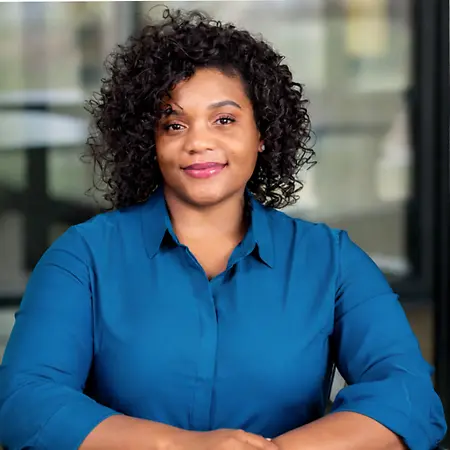
Her Story
About Jalessa
Jalessa Bryant is a seasoned educator, researcher, and evaluation professional with over 20 years of experience in community-based educational spaces. Her work focuses on fostering culturally responsive learning environments and supporting programs that empower historically marginalized communities. Currently, she serves as an Evaluation Project Assistant and Consultant with Vision Shift Catalyst, LLC, where she leads program design, evaluation, and curriculum development initiatives for education, nonprofit, and government organizations, helping align organizational visions with measurable outcomes. Throughout her career, Jalessa has worked across schools, nonprofit organizations, and community programs to create meaningful educational experiences for learners of all ages. She has extensive experience in youth development, program evaluation, and community arts initiatives, including roles with AmeriCorps Jumpstart, Citizen Schools, and the Rhode Island School of Design. She also serves as Board President of House Urban Arts Initiative, a dance company providing scholarships to predominantly Black and brown students, and has contributed to youth entrepreneurship programs with the Madison Black Chamber of Commerce. In addition to her professional work, Jalessa is completing her PhD in Curriculum and Instruction at the University of Wisconsin–Madison, where her research examines culturally responsive curriculum development and the role of Black pedagogical practices in learning communities. Her publications, including work in the Harvard Educational Review and the proceedings of the International Conference of the Learning Sciences, reflect her expertise in critical qualitative research methods and equity-centered evaluation. As a participant in the American Evaluation Association’s GEDI Fellowship, she is preparing to launch her own evaluation consulting firm, Johnson and Hodge, honoring her family’s legacy of community service and empowerment.
Her Interview
Ten minutes with Jalessa
01What do you attribute your success to?
I attribute my success to the joy I've consistently found in working with young people and the learning process. From my very first position teaching at my elementary school, where the kids thought I was so cool because I knew all the SpongeBob songs, to watching preschoolers navigate complex cultural identities, to seeing middle schoolers ask more questions after visiting college campuses - that constant outpouring of joy from the smallest things is what has fueled all the energy I've put into this work. The privilege of working in multiple all-Black research and evaluation groups has been very special to me and very rare, and it's something I carry forward. I also credit the energy I feel came from my grandmothers to my mother and dad to me - that legacy of getting the facts, helping the folks, feeding them, giving them good things to consume, and being of service. Everything is not always about money, sometimes it's just about the people you have in your corner. My community mother mentors, like Dr. Hazel Simonette, have shown me that all they want to do is see you be better than them, reminding me to keep doing what I'm doing but also to rest, find balance, and enjoy life. I do this type of work because it fuels me, not because I have to go to work.
02What’s the best career advice you’ve ever received?
The most impactful advice I've received comes from my community mother mentors like Dr. Hazel Simonette, who I run into randomly all over the place and who just lights energy under me every time. She and other mentors remind me that 95% of their lives, they were not famous - they were just doing the work. They tell me to keep doing what I'm doing, but also to rest, take a break, find a partner, enjoy life, eat good food, and travel. It's about staying grounded in your purpose while also taking care of yourself. They want to see me be better than them, and they share what they learned not as a prescription but as wisdom to carry forward. That balance between dedication to the work and dedication to living well has been transformative for me.
03What advice would you give to young women entering your industry?
I would encourage young women entering education and evaluation to stay connected to what fuels them and not just what they have to do. Find work that brings you joy, not work that makes you tired. Be open to learning from young people - they will teach you about resilience, cultural navigation, and what really matters in ways that no textbook can. Don't be afraid to offer your skills freely to build experience and relationships in the community, because sometimes it's not always about money, it's about the people you have in your corner. Seek out spaces where you can work with people who share your identity and values - I've had the privilege to work in multiple all-Black research and evaluation groups, and that's been very special and rare. Find your community mother mentors who will light energy under you and remind you to balance your dedication to the work with taking care of yourself. And remember that the most meaningful work often happens in community-based spaces where you can honor lived experiences and help people unlearn what no longer serves them so they can thrive.
04What are the biggest challenges or opportunities in your field right now?
Right now, the job market in evaluation and education is very challenging. At the American Evaluation Association conference, there were only about two job postings, and in every session I attended, somebody was saying they were just laid off, including people who worked for USDA. The climate is not great at the moment, and I was not expecting this level of instability. However, there are significant opportunities in community-based learning models and culturally responsive evaluation. There's a growing recognition that we need to honor lived experiences and create learning environments that help people unlearn survival patterns that no longer serve them so they can thrive. Organizations are increasingly seeking support with program evaluation, board development, curriculum consultation, and quality improvement, but many lack the human resources and data infrastructure to access larger funding opportunities. The opportunity lies in building those structures and capacities while staying rooted in the communities we serve, ensuring that evaluation and education work is culturally grounded and truly responsive to the people's needs.
05What values are most important to you in your work and personal life?
The values most important to me are rooted in what I learned from my lineage - get the facts, help the folks, feed them, give them good things to consume, and be of service. Community is at the center of everything I do. I believe in honoring lived experiences and creating spaces where people can unlearn what they had to learn to survive that no longer helps them and prevents them from thriving. Equity and cultural responsiveness are essential - I've seen how young people navigate multiple marginalizations from a very young age, and education must address those realities. I value the privilege of working in spaces with people who share my identity, particularly in all-Black research and evaluation groups, because that shared understanding is rare and powerful. Joy is also central to my work - I'm drawn to the constant outpouring of joy from young people and the smallest moments of connection. Finally, I believe that everything is not always about money; sometimes it's about the people you have in your corner and being willing to offer your gifts in service to community, even when there's no immediate financial return. I want my work to pay forward the energy and support I received from my grandmothers, my parents, and my community mother mentors.
Join Influential Women and start making an impact. Register now.