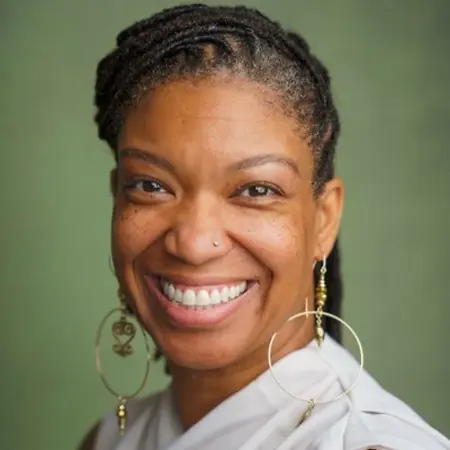
Her Story
About Ja'Nohn
My journey into the semiconductor industry 23 years ago was a complete accident - I didn't even know about the industry, I just needed a job at the time. But I wound up really becoming quite interested in it and realized this was completely the place for me. What makes me unique in this field is that I don't have the typical electrical engineering degree that most people have. I went to school for psychology at Florida Memorial College, so I'm definitely considered an oddball in that my degree, my education, and the way that I think doesn't come from the electrical engineering community. It really comes from a psychology understanding. But being around that community and learning on the job, I had some really great engineers who taught me a lot, and I was able to meld how I do business and go to market with the standard understanding of electrical engineering to sell semiconductors. A few years ago when I was working for IBM as a consultant, I was surprised at how well I was doing and how much I really loved consulting. I knew it was something I didn't want to stop doing, but I also knew that as I got older, I wanted to slow down. Being a founder doesn't mean slowing down, but it does mean having a little bit more control of how fast you're going. I started my own company just a month ago because there are many people out there that do what I do, but they don't do what I do how I do it - and that's the important part for me. At large consultancies like IBM, they really focus on very large clients, but I'm very interested in mid-market. I feel like the mid-market client does not get the attention it needs to build their business in the same way as enterprise clients, and the technology is the same - it's just a matter of access to skill and information. So my target is really mid-market, not necessarily the large enterprise clients.
Her Interview
Ten minutes with Ja'Nohn
01What are the biggest challenges or opportunities in your field right now?
The challenge, regardless if you're a founder or a manager or an executive, is focus - really being clear about what it is that you're trying to achieve, being able to communicate it clearly to others, and then going and doing it. You can ask anyone and they say yeah, that's what I'm supposed to do, but it rarely ever happens. The people who do succeed are the people who decided on a thing, agreed upon the thing, and then did the thing. I think that goes for any role - individual contributor, manager, executive, founder. As for opportunities, the semiconductor industry as a whole is on track to be a trillion dollar market in just a few years. With the advent of AI, there's going to be a lot of opportunity for people to enter the semiconductor industry because a lot of people are also aging out. It's a very incestuous industry - people jump from one part of the industry to another and everybody knows one another. The semiconductor industry is woefully in need of diversity in every way, that being women, people of color - it's very homogenous. I think that's just because it's been incestuous and people hire their friends, and their friends don't happen to be people of color and women. There are definitely some initiatives to really include and expand the landscape of human beings that are entering this market, and I think there's a big opportunity there, absolutely.
02What values are most important to you in your work and personal life?
Accountability, honesty - literally radical candor - and a lot of humor. We take ourselves way too seriously. Even if it's a tough conversation, we can usually chuckle right afterwards. So yeah, I would say those are the big three that lead in what I do. Accountability, radical candor, and humor are foundational to what I do.
Join Influential Women and start making an impact. Register now.