Her Story
About Jasmijn
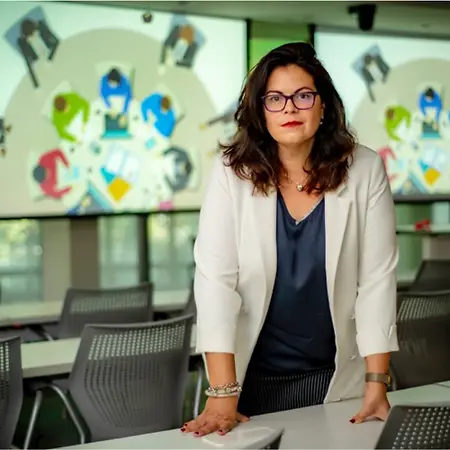
Jasmijn Bol is the PwC Professor of Accounting at Tulane University’s A. B. Freeman School of Business, where she holds the Francis Martin Chair in Business. An internationally recognized scholar, keynote speaker, and author, she has spent more than two decades studying how organizations design performance management, decision-making, and control systems in complex operating environments.
Her recent work focuses on one of the most important leadership challenges of our time: how organizations can redesign management in the age of artificial intelligence. She is co-author of the forthcoming book Empowered by Design: How AI Is Rewriting the Logic of Management, which examines how AI can help organizations rethink authority, coordination, expertise, culture, and feedback so that technology expands human judgment rather than replaces it. Her research shows how leaders can redesign work from the ground up, creating organizations that are more adaptive, empowering, and capable in a rapidly changing world.
In addition to her work on AI and organizational redesign, Dr. Bol conducts influential research on fairness and inequality in the workplace. Her studies show that women are often assigned essential but career-limiting work that is less likely to be recognized or rewarded, while men performing similar work are more likely to receive credit and advancement. By connecting research on AI, incentives, organizational design, and gender dynamics, she offers a distinctive perspective on how organizations can become both more effective and more equitable.
At Tulane, Dr. Bol teaches MBA students and engages regularly with academic and practitioner audiences around the world. Her work is known for combining rigorous scholarship with practical organizational insight, helping leaders rethink how management systems must evolve in response to technological and societal change. She earned her MSc in International Business from Maastricht University and her PhD in Business Administration and Management from IESE Business School.
Her Interview
Ten minutes with Jasmijn
01What advice would you give to young women entering your industry?
My advice is to protect both your time and your sense of purpose. Do not feel obligated to take on roles or responsibilities that do not align with your interests or long-term goals. It is important to invest your energy in the work that matters most to you, and in the teaching and research where you can make your strongest contribution.
Research, including some of my own, shows that women are often expected to take on service work that is valuable to the organization but does little to advance their careers. Because these expectations are deeply ingrained, saying no can be difficult. Yet for women who are ambitious and want to grow professionally, learning to set boundaries is essential.
I would also encourage women to let go of the belief that they do not belong. Imposter syndrome is common, but it can be deeply misleading. Everyone has moments of doubt, imbalance, and exhaustion. That does not mean you are not capable, and it does not mean you do not belong. You worked hard to get where you are, you have earned your place, and you should trust that.
02What values are most important to you in your work and personal life?
I believe balance is incredibly important, but I do not see it as a permanent state one achieves and then simply maintains. Rather, it is something we must continually work toward, revisiting and adjusting as life evolves. Balance is not a fixed destination but an ongoing practice of reflection, recalibration, and self-compassion when things inevitably fall out of sync.
In my own life, time with my children, family, and friends is a central part of that balance. I cherish the simple moments we share, whether that is swimming with my kids or spending time together outdoors. Those everyday experiences matter deeply to me, especially because childhood passes so quickly. They serve as a powerful reminder of what matters most and why balance is worth protecting.
Join Influential Women and start making an impact. Register now.