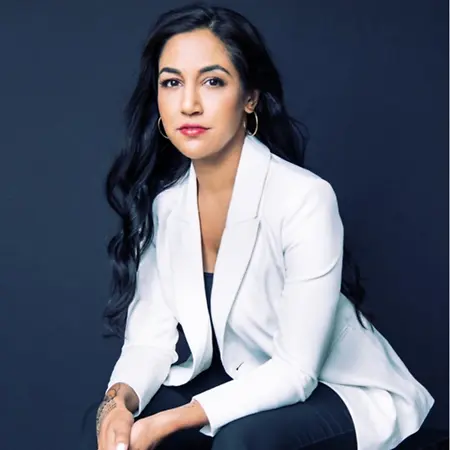
Her Story
About Jaya
My career has been a non-linear journey spanning over 20 years, and I've kept an open mind along the way, which has allowed me to take on opportunities I might not have otherwise expected. I originated as a practicing lawyer, then spent about 6 years in law school administration before transitioning into inclusion work. For the past 10 to 15 years, I've been working in the inclusion space in various capacities at global professional services firms. I spent about 3 years at the global law firm White & Case, then led inclusion efforts for a global economic consulting firm, and for the past 4 years, I've been working as part of a global inclusion team in my current role. As an organizational strategist, I help institutions and organizations evolve legacy structures and focus on building cultures of belonging and inclusion. My work focuses on several key areas: thinking about representation and the kind of talent we bring into organizations, helping those individuals be successful and advance, creating inclusive cultures where people feel seen, heard, valued, and respected, supporting clients in the market, and engaging with leaders on these issues. Ultimately, my work is about transforming workplace cultures so that organizations can be as successful as possible and each person is able to thrive. In addition to my professional work, I'm also a certified death doula and have been engaging more with the death work community in the DC area over the past year.
Her Interview
Ten minutes with Jaya
01What do you attribute your success to?
I would attribute my success to how I was raised. I think it begins in the home, and the values that my parents raised me with set the foundation for the kind of person I wanted to be. From there, it was just an intrinsic sense of wanting to be a good person and do good in the world. Now, as I've gotten much older, I think about the impact that I want to have on the world, the legacy I want to leave behind, and how I will be remembered. I think about those kinds of things, and that all influences the kind of mother I want to be, the kind of children I want to raise. So all of that influences how I show up day in and day out.
02What’s the best career advice you’ve ever received?
I think one of the things I keep in mind that I learned from a relatively young age is that no matter what you're hired to do, do it well. Try to do your best. That could be anything. If you're starting out as an intern and your job is some basic administrative task, do it well. That goes all the way to an important client deliverable - do it well. The other piece of advice that comes to mind is to treat every single person you encounter in an organization with respect and kindness. It could be the janitorial staff that cleans up after the office is closed, it could be the person who sits at the front desk, it could be a senior member of the leadership team. Treat individuals with kindness, because A, it's important, and also B, you never know how these folks can help you in the future.
03What advice would you give to young women entering your industry?
I think the one thing I would probably say for young women is around imposter syndrome. This is the idea that a lot of women, and also folks from underrepresented groups often have, where they feel like they don't belong in a certain role or position, even though there's nothing to support that. This idea of being an imposter - like, I don't belong at this table, I don't belong on this team, I don't belong in this organization. I'm sure many of us have experienced that at some moment in time, and what I would say is, for those who are experiencing that, remember that if you are in the room, if you are there, you earned it. You have to almost talk yourself out of that experience, because there is no evidence to support that you don't deserve to be at the table, at the chair, in the organization you're at. It's natural to sometimes feel like that, and yet at the same time, you're there because someone believed you could do it. If we're hired for a position, if we're invited to a certain meeting, then we've earned our seat at that table, and we should believe in that.
04What are the biggest challenges or opportunities in your field right now?
When it comes to challenges, there's no secret that the work of diversity, equity, and inclusion has seen a lot of scrutiny in the past few years, and that's been challenging for a lot of organizations, certainly in the U.S., but even more broadly. Beyond that, there's a lot of research around how women, and women of color in particular, experience the workplace, with challenges around advancing and being promoted. Research shows that women in general are not as well represented at the top. As a woman and as a woman of color, I've had my own experiences throughout my life where I've really tried to think about how I can be successful in an organization, how I get the opportunities to showcase my skills and my strengths so that I can be promoted and advance. In terms of opportunities, I think there's a real opportunity right now in the inclusion space to really think about how we demonstrate our value and impact to organizations. Research shows that the more diverse teams you have, the more diverse an organization, the more that people feel a sense of belonging, the more successful you will be from a business perspective. So despite the recent scrutiny, there's a real opportunity to articulate clearly why this continues to be important and how it can really help organizations be as successful as possible. I also think there's a lot of opportunity in the end-of-life death care space. There's an opportunity to do more advocacy work around ensuring that more people have access to end-of-life care, because right now, it's not covered by insurance.
05What values are most important to you in your work and personal life?
Fairness is a big one for me. That's really what led me to be a lawyer in the first place many years ago, so having a sense of fairness, whether that's in someone's personal life or even in the workplace. A lot of the work I do now is to help create spaces where everyone can be successful. The other value is kindness. I think given the polarized state of the world and all that's happening in our society, at times we've lost that sense of just basic human kindness. Also, with technology and everything being so quickly accessible in a digital way, I think we've lost some basic values, including just how we treat one another. Respect and dignity for all is important. I think that if each of us did things in our own spheres of influence, like small actions that we each take day to day, the ripple effect of that would be to actually change the world. Each of us has the ability to be kind and to demonstrate these behaviors and to treat one another with respect, no matter what our job is, what our title is. And if we all do that, the waves of that would just ripple across the world.
Join Influential Women and start making an impact. Register now.