Her Story
About Jean
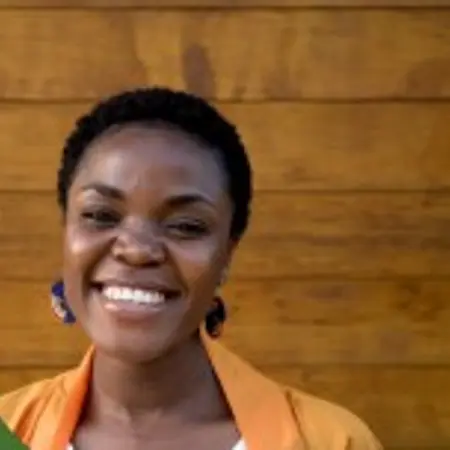
I have been working in my field for about 7 years now, and my current role is Lead Storyteller, a position I've held for 3 years. I support survivors of sexual violence, as well as immigrant and refugee clergy who have gone through immigration trauma. I do this work both through an organization and personally, running support groups with women survivors and leading wellness runs for them to process any traumas they are holding through their body. I'm also a singer and songwriter - I've been singing since I was young, but I've been releasing my own music for 4 years now through my company, Tales of a Black Girl. My music is very much about uplifting and healing. My day-to-day looks like understanding what the trauma is about, where the survivors are in their healing journey, and what they need. I write curriculums around best practices to support survivors, and when I'm working directly with survivors, it looks like running support groups and really sitting with them as they process and share their story, just being a sounding board for them and walking through the journey with them. This work can get really heavy, so my evenings look like practice - I go practice with the band from 6 p.m. to 8 p.m., preparing for gigs and writing new songs. Some days look like rehearsal for music and writing music, and some days look like teaching dance. I teach women Afrobeats dance on Thursdays, and we kind of just process and move our bodies and bring a sense of joy within your body, especially after going through so much or processing so much pain. I'm a survivor myself, and I really wanted to know how life would look like for me. I had questions around my own story, questions around what a sense of joy and healthy relationships look like. There are a lot of misconceptions about somebody who's gone through sexual violence, how they show up in relationships and how you take care of them, and I was really curious about that, which led me to study psychology to ensure that I know how to actually really take care of people who've gone through sexual violence. First it started off trying to understand myself and my story and how life looks like for me, and then eventually it looked like working and walking alongside others.
Her Interview
Ten minutes with Jean
01What do you attribute your success to?
I attribute my success to a lot of other survivors who are doing this work that I've come across, that are leading wonderful organizations, but also allies that continue to speak up, to provide platforms for people to share such heavy conversations, because I know how hectic it can be to even have conversations around it. I attribute that to my friends, who are absolutely wonderful activists as well in their right, and the survivors I've worked with. I think they've just let me know that yeah, what I'm doing, this is really what I was called to do, and whether I'm doing it through dance and music, or through a support group or speaking, that this is needed, and I'm doing exactly what I was meant to do. So they just kind of affirmed my journey.
02What’s the best career advice you’ve ever received?
The best career advice I ever received was when I was turning a certain age and I was losing my mind about not knowing what I'm supposed to do, feeling like life was supposed to be a certain way, and I was just in this headspace. My mentor asked me, 'Who told you that age is like a timeline, and that you have to achieve certain things by then?' She said I was really limiting myself to the beauty of what I could achieve, and also taking away the gratitude of looking back and being like, this is how far I've come, and the beauty that comes with that. So I guess my best career advice, for somebody who immigrated to the States, was that I am exactly where I'm supposed to be at this particular age, at this particular time. I'm doing exactly what I'm supposed to do. And for my next age next year, it'll be a different season, and I should embrace that season for what it is as well.
03What advice would you give to young women entering your industry?
The advice I would give is when you're working with others and walking alongside people who've gone through trauma, you don't have to do that alone. Sometimes I could feel like I have to carry the burden of the listener, the helper, and the one you call, but it's okay to walk alongside others. Others can support you, and others can support the survivor as well. It's okay if the only role you play is being a listener, maybe at group therapy, and somebody else is the person that goes with them to hospital appointments. Survivors require a village to support them, and it's okay to just feel like I'm just one part of that village. I always think about it in an example: when you're on a flight and you look down when you're about to land and you look at the lights, it looks pretty, right? It looks really pretty, but imagine there was only one light on - it won't be as pretty. You would look down and you'll be like, oh, okay. It won't be as captivating. But what makes it so beautiful is there's so many lights on at the same time, making this wonderful view. I think each person, it's okay to embrace your light and embrace the next person's light, that all together you make a great support system. If you do work by yourself, you could hurt yourself, you could burn out. You also require being taken care of as well when you're taking care of others. It's better to support people from an overflow, where your cup is overflowing because you have others pouring into you, than just pouring into others without anyone else pouring into you.
04What are the biggest challenges or opportunities in your field right now?
The biggest challenge in my field of work is that I do love working alongside survivors and supporting them, but it's also the realization that, wow, this is still happening. It's happening to so many people. It's 1 out of 3 women and 1 out of 6 men, which just kind of gets really sad to think about. It's like, yes, this is my job, and this is what I like and love to do, but the fact that I'm still doing this means that this is still happening, and people are still being hurt and harmed in this way.
05What values are most important to you in your work and personal life?
Compassion and authenticity are most important to me. I want to show up truly myself in my most artistic, but also empathetic self, who's an advocate, but at the same time, a creative. So I want to authentically be myself in my work and show all those parts. And compassion - I think my work is driven by my compassion.
Join Influential Women and start making an impact. Register now.