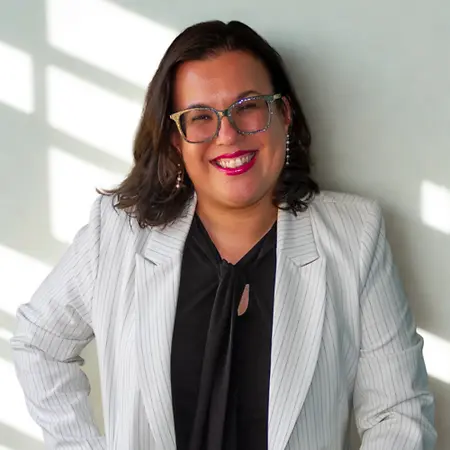
I've learned not to confuse being misunderstood with being wrong. Resilience is knowing your worth and refusing to make yourself smaller to fit someone else's narrative.
Jennifer Bushinger-Ortiz, CFRE, ACNP · In Her Own Words
Her Story
About Jennifer
Jennifer Bushinger-Ortiz, CFRE, ACNP, is a nonprofit fundraising and development leader with nearly two decades of experience advancing mission-driven organizations through strategic philanthropy, partnership development, and community impact. She currently serves as Director of Development at Move For Hunger, where she leads donor engagement, corporate partnerships, and national fundraising initiatives focused on reducing food insecurity and food waste across the United States and Canada. Her work centers on transforming generosity into measurable impact through innovative collaboration and relationship-driven leadership. Jennifer’s professional path began in theatre, where storytelling, discipline, and production demands shaped her creative and entrepreneurial foundation. Jennifer’s professional journey began in theatre, where she developed the creativity, adaptability, and entrepreneurial mindset that continue to shape her leadership approach today. While in college, she raised funds to independently produce plays long before realizing fundraising could become a career path. She went on to tour nationally with the National Theater for Arts and Education, before continuing her career working in theatres of all sizes across the country, both on and off stage. Those experiences strengthened her ability to think quickly, connect with diverse audiences, and lead with both resilience and empathy—skills that continue to influence her work in nonprofit leadership and development. After relocating from New York City to Southwest Florida, Jennifer stepped into a formative role as Director of Community Impact for a regional organization supporting individuals with intellectual and developmental disabilities. There, she expanded her scope beyond communications and advocacy to include organizational visibility, public engagement, and early-stage fundraising strategy—working closely with executive leadership while learning development through direct experience. During her tenure, she advanced to Chief Philanthropy Officer, helping lead the organization to one of the strongest fundraising years in its 60-year history. Since joining Move For Hunger in 2023, Jennifer has played a key role in accelerating the organization’s fundraising growth, donor and corporate engagement strategy, and national visibility. She has helped cultivate and strengthen partnerships with major brands, corporate supporters, and philanthropic stakeholders to expand the organization’s reach and impact nationwide. Under her development leadership, the organization achieved its highest fundraising year in 2025, helping fuel a record-breaking programmatic impact that included the delivery of 15 million meals. Beyond her professional work, Jennifer remains actively engaged in advancing the fundraising profession through leadership and service with the Association of Fundraising Professionals Southwest Florida Chapter, where she has served on the board and is a Chamberlain Scholarship recipient. Jennifer is also a proud wife and mother to their 10-year-old son. She is driven by a simple belief that guides both her personal and professional life: that leadership and service should leave communities, and the world, better than we found it for the next generation.
Her Interview
Ten minutes with Jennifer
01What do you attribute your success to?
I attribute my success to a combination of my background in theatre and my commitment to authenticity in every room I enter. Theatre trained me to think quickly, adapt under pressure, read a room, and approach challenges with a solution-oriented mindset. The funny thing is, those same skills translate directly into fundraising and leadership. At the end of the day, both are about connection, storytelling, and understanding how to move people toward action. At the core of my work, I deeply believe in the mission I represent. I’m not asking people to support an abstract idea. Instead, I’m helping them understand the real impact they can create. That alignment gives me the ability to move through challenges and find a way forward, even in complex or resource-constrained environments. That belief in the work also creates a level of confidence and conviction that has carried me throughout my career. I’ve learned to walk into every room grounded in the belief that I belong there, that I’ve earned my seat, and that my perspective adds value. I also move through imposter syndrome by staying focused on preparation, purpose, and execution. I also view fundraising differently than many people do. I’m inspired by the psychology of giving. My role is not simply to raise funds, but I consider myself the “chief storyteller”. I serve as a connector, translating mission into meaning so people feel compelled to engage and invest in change. Authenticity is central to how I lead. People can tell when what you say and what you do don’t align, and trust is built through consistency over time. I’ve also learned to take lessons from every experience, including challenging leadership environments. Ultimately, every experience has reinforced the same belief: strong storytelling, integrity, and clarity of purpose are what move people to action.
02What’s the best career advice you’ve ever received?
Theatre taught me far more than performance. It taught me how to listen deeply, read between the lines, understand timing and energy, accept feedback, collaborate under pressure, and lead with empathy and intention. He always said, “Take center stage and stand behind your choices.” That has stayed with me as a grounding principle in leadership and decision-making. Another director I worked under, Ellen Lieberman of Connecticut Free Shakespeare and National Theatre for Arts and Education, would begin every rehearsal with a simple question: “How did you choose joy today?” That perspective shifted how I think about intention, mindset, and how we show up in demanding environments. I’ve also learned a great deal from difficult experiences and challenging leaders. Over time, I realized that even the hard moments have something to teach you if you are willing to reflect on them honestly. Some experiences show you exactly what kind of leader you want to be, while others teach you what not to become. Ultimately, the best advice I’ve internalized is that every experience has value if you are willing to learn from it, adapt, and carry those lessons forward.
03What advice would you give to young women entering your industry?
My advice for young professionals entering this field is to stop waiting until you feel fully qualified. Nonprofit work, especially fundraising, is one of those careers where you learn by doing. There is a level of ambiguity that comes with the work, and learning how to move forward without always having every answer is part of becoming a strong leader. Honestly, one of the best things I ever did for my career was study theatre. I jokingly tell people all the time to take a theatre class, but I mean it. Theatre taught me how to think quickly, adapt under pressure, communicate clearly, read a room, accept feedback, and connect with people. A lot of fundraising is storytelling and improvisation in real time. Early in my career, I often found myself as the youngest person in the room, serving in leadership roles, and at times as the only woman or Hispanic voice at the table. Those experiences reinforced something important: you have to walk into every room knowing you belong there. You’ve earned your seat, and your perspective has value. I also think young professionals spend too much time talking themselves out of opportunities because they don’t meet every qualification on paper. If you care about the mission, are willing to work hard, and stay open to learning, you will figure out the rest along the way. At the end of the day, the people who succeed in this work are the ones who stay curious, lead authentically, build strong relationships, and never lose sight of why the mission matters in the first place.
04What are the biggest challenges or opportunities in your field right now?
One of the biggest challenges in the nonprofit world right now is trust. People’s perceptions are shaped so quickly—by social media, a single bad experience, or even something they hear secondhand. And unfortunately, it often only takes one negative interaction to influence how someone views an entire organization, or sometimes even the sector as a whole. There’s also still a lingering stigma around fundraising. When it’s done poorly, it can feel transactional, and that’s where the “salesy” perception comes in that so many fundraisers are working hard to move past. The reality is most people in this field are incredibly mission-driven, but it just requires trust to be built consistently over time, not assumed from the start. Those dynamics show up very specifically in the work we do at Move For Hunger, largely because we operate differently than what people typically expect. We’re not a food bank or a direct food provider. Rather, we sit within the logistics and transportation ecosystem, recovering surplus food and connecting it to local hunger relief partners. Because of that, part of our work is constantly helping people understand where we fit in the system, and how essential that connective role really is. At a bigger level, food insecurity and food waste are deeply complex issues, and one of the biggest realities we face is that no single organization can solve them alone. It requires collaboration across industries, companies, and communities that don’t always naturally intersect, all working toward the same goal. At the end of the day, it’s not just about raising money. It’s about building trust and belief—belief in the mission, belief in the solution, and belief that when we work together, real, measurable impact is possible.
05What values are most important to you in your work and personal life?
Authenticity is the most important value to me, both personally and professionally. In the nonprofit space, trust is everything. It often only takes one negative experience to shape how someone views an entire organization or even the sector as a whole. Because of that, I believe authenticity has to show up in consistency: if you say you’re going to do something, you do it. And if something doesn’t go as planned, you own it. We’re all human, but honesty builds trust in a way nothing else can. That value also shapes how I approach fundraising. I’ve met a wide range of professionals in this field, and the ones who struggle most are those who make it feel transactional. I often joke that I don’t like “asking for money,” and people are usually surprised to hear that as a Director of Development. But I don’t see my role that way. My job is the visual connection to help people understand the mission so clearly that they feel compelled to be part of it. Communication is a big part of that too. People can sense when something doesn’t feel genuine, and in this work, trust is built through clarity, consistency, and follow-through over time. On a broader level, I also value equity and access. I believe we should be building toward a world where opportunity is not limited by circumstance—whether that’s access to food, healthcare, housing, or employment. A hunger-free future is the North Star that guides a lot of my work, even if it’s something we may not fully achieve in our lifetime. At the very least, no one should have to wonder how they’re going to feed their family or choose between basic needs.
Join Influential Women and start making an impact. Register now.