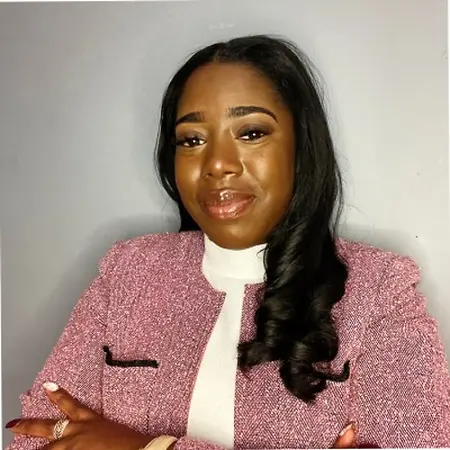
Her Story
About Jennifer
I juggle many different roles on a day-to-day basis. I am a professor at both the University at Buffalo, where I'm completing my PhD program, and at Buffalo State University, both in the social work department. My typical day involves lecturing my courses, designing and creating content and materials for my courses, grading, and meeting with students. Beyond teaching, I co-founded an initiative called Bridge with a couple of my colleagues in the PhD program. Bridge stands for Building Black Relationships by initiating development, growth, and empowerment. Through this initiative, we do a lot of education and outreach in the community. We partner with local colleges and community organizations to conduct workshops and panel discussions on topics like Sexual Assault Awareness Month and the intersection between sexual assault awareness and marginalized communities. When I'm not lecturing or prepping for lecture, I'm creating educational content for our social media platforms, developing trainings, and conducting workshops in the community. As a doctoral candidate, I work with my advisor on research connected to intimate partner violence within the Black community, and I'm also working on my dissertation focused on cultural responsiveness within service providers who work with intimate partner violence survivors. My goal is to continue growing Bridge into a nonprofit organization that focuses on education for both the community and providers, really trying to bridge that gap between research, community, and practice.
Her Interview
Ten minutes with Jennifer
01What do you attribute your success to?
I attribute my success to self-awareness and believing in myself. I know that as a social worker, that sounds very cliche, but you have to believe in yourself. You're going through so many different obstacles, and overcoming all of these obstacles is not a small feat. But believing in yourself makes it so much easier, and just acknowledging your accomplishments. I acknowledge the path that I've taken here, the progress that I have made to get here, and I try to be present in those moments. A lot of times, we run through them, and we don't acknowledge those little wins that get us to whatever goal that it is that we're trying to achieve. But all those little wins help us as stepping stones to get to that goal. So I believe in myself, and I have that self-awareness to have that moment to be like, okay, I am doing great. That check-in helps me personally - I am doing great, and I can be great. I am doing great things.
02What advice would you give to young women entering your industry?
My advice is to have self-awareness and believe in yourself. I know that as a social worker, that sounds very cliche, but you have to believe in yourself. You're going through so many different obstacles, and overcoming all of these obstacles is not a small feat. But believing in yourself makes it so much easier. Acknowledge your accomplishments, acknowledge the path that you've taken here, the progress that you have made to get here, and be present in those moments. A lot of times, we run through them, and we don't acknowledge those little wins that get us to whatever goal that it is that we're trying to achieve. But all those little wins help us as stepping stones to get to that goal. Have that self-awareness to have that moment to check in with yourself and say, okay, I am doing great. I can be great. I am doing great things. That's what helps me personally.
03What are the biggest challenges or opportunities in your field right now?
A lot of challenges that I personally feel come up as a social worker is a lack of resources. There isn't a lot of cultural responsiveness training within service providers who work with intimate partner violence survivors. There's not a lot of resources and education materials for social workers, as far as trainings. Having that lack of information can be challenging when we are not constantly getting education, especially with everything evolving. New things happen in our society, and it's hard to keep up with everything that's constantly happening, and then also having the resources to be able to support the things that are constantly happening. I've found that networking is really huge in that aspect, working together. In the social work field, from my experience, a lot of organizations are very siloed. We don't really have a lot of interconnectedness within the social work field as much as we could. So collaborating together goes a long way, and that helps us with our education too. What is it that you all are learning? How can that help me? And what is it that I've learned, and how can I provide that information to you? Cultural competency is key, but also cultural humility, and we only learn cultural humility through our interactions with clients. So what is it that your organization is learning about the clients that you are working with? Because I'm sure that would be helpful for me, and then vice versa.
Join Influential Women and start making an impact. Register now.