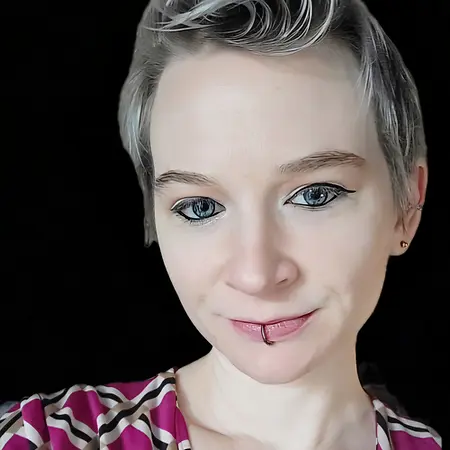
I realized I'd been hired for my leadership, not for having all the answers immediately and that realization helped me move forward with confidence.
Jennifer Nethers, MS, MBA · In Her Own Words
In Conversation
Jennifer Nethers for Bold. Brilliant. Unstoppable.
Read the transcript
Jennifer Nethers, MS, MBA: Speaker: Jennifer Nethers, Director, Quality & Health Disparity Programs - Blue Cross Blue ShieldJennifer Nethers: Listening to yourself and understanding what makes you you and unique, and really holding true to those things, holding true to your values, and not letting other things and other people get in the way of that.What does being an Influential Woman mean to you?Jennifer Nethers: Being an influential woman means I have the ability to inspire others, regardless of where they are in their career, to be themselves, to chase their dreams, to have them realize that the unique parts of us are the best parts of us, and we are never too young or too old to start chasing the dreams that make us who we are. And best part of being an influential woman means I get to celebrate with you. I get to cheer on those successes and watch as other women are uplifted in this community and succeed. And that is just the best part of being an influential woman, that ability to inspire, to celebrate, and to To be a part of a wonderful community.What's one piece advice would you give to younger women chasing their dreams?Jennifer Nethers: One piece of advice that I would give to younger women chasing their dreams is listen to yourself, you and your voice. Are the only voice that really matter. Others, they can talk and they can give advice, and you can choose whether to take it or not. But listening to yourself and understanding what makes you you and unique, and really holding true to those things, holding true to your values, and not letting other things and other people get in the way of that. Following your dreams means that they are your dreams. This is something you want to do because you are a unique and needed individual, and that space that you are wanting to enter in your dream is the space where you're supposed to be. So do not let anybody take that away. In whatever way that looks like, it, it doesn't have to be a naysayer to take away that passion. It could just be somebody who tries to give you advice that doesn't match who you are, and that's OK. You can say thank you and move on. You do not have to take that advice. The only advice you should really take is the advice that your gut is telling you. You are needed. Follow your dreams.
Her Story
About Jennifer
I started my healthcare journey about 10 years ago when I walked into Walgreens at 18 and asked how to become a pharmacy technician. From there, I worked my way through several different areas, becoming a claims analyst and claims manager, continuing to advance through the health insurance side of things, which is where I currently am as Director of Quality and Health Disparities. What I love most about being in the disparity space is that I really do get to see what affects the community within where I work and where I live, and whether the work that my team and I are doing is actually causing real change in that community. I can see some of the needs, I can see some of those needs getting met, and I can see what's still out there as far as what work we need to do in certain areas. I know that what I'm doing is directly helping people because I also get that opportunity to work one-on-one sometimes with our members and hear their spoken pain, joy, all of it, and how we assist them. We can get creative in what we do - we're not just pigeonholed into having one solution for one need. We really look into so many different things that we could do that are unique and different for these individuals who all have unique and different journeys. It's nice to see that we don't have just a Band-Aid solution - we're actually really doing the work. One of my most notable achievements has been developing the Health Equity Member Resource Team, which uses Z codes to capture social determinants of health needs. When a claim comes back to me, I can see the member fully through that experience and provide personalized solutions, whether that's specialized meals for someone with diabetes who has trouble keeping their pantry stocked, or helping cancer patients with social exclusion get back out into society. It's really a big quality of life improvement. Beyond my day-to-day work, I'm also finishing up my doctorate in organizational development with a dual concentration in neuroscience and inclusive leadership, focusing on diversity, equity, and inclusion programs and how we can truly get to a spot where they're working as intended.
Her Interview
Ten minutes with Jennifer
01What do you attribute your success to?
I think my success has been a lot of self-drive, honestly. I didn't come from a very supportive family, so it was important for me to kind of break free from that, be a support to myself, and then be able to be a support for others. That's kind of spurred a lot of my schooling - I went and got my bachelor's degree, and then I got my master's, and then I got my MBA, and I'm completing my doctorate. Being able to take myself through that journey meant that I could also give back. I've also had some amazing leaders, both men and women. I had one leader who really took me under as my mentor, and she was the same one who told me to be authentic - that I don't have to emulate the men in the field to advance, I can be who I am and still advance as that person. Having somebody kind of in my court, supporting me as me, was huge. From there I kind of learned, oh, I do have these capabilities, oh, I am smart, I can do these things. So it's been a combination of self-motivation and having amazing mentors who believed in me.
02What’s the best career advice you’ve ever received?
To be authentic. I think when I started off, I really tried to kind of emulate the men in my working professional environment, and that was how I felt - that's the way to advance. I have to be a certain way. But I really didn't align with that, it didn't align with who I was, and I felt that I was doing myself a disservice. Somebody gave me the very real advice of just be yourself, be authentic. That's how you're really going to advance and be different from everybody else. We want you, not this version that you think you should be. When I switched to being more of who I was, and what felt right to me, and really worked with my own value system, my career really advanced. I felt a lot better about the work I was doing, and I was really excited to come to work every day. I also love meeting people and I've been a people leader for a very long time, so being authentic really stepped up my leadership. I can't thank that person enough for just nudging me and being like, just be you.
03What advice would you give to young women entering your industry?
I would say it really is about being yourself. We all have such unique strengths, and we come from such different backgrounds. Even if it's somebody that we've known a long time, you can't possibly know everything about them and how their experiences have shaped them. That personal aspect of things, especially in healthcare, I think is so important, because it does lay that framework of understanding and that authenticity that when you're speaking with patients or people in the community, they feel that. If you're putting on a front, they feel that too. If you can dig in from your own personal experiences and you can make something great of that, then I think you can succeed in healthcare. Definitely not to follow into the men's footsteps - we need to be ourselves and bring our unique perspectives to the field.
04What are the biggest challenges or opportunities in your field right now?
The biggest thing that I see is just the systemic historical racism, quite honestly, that is causing a challenge when we're trying to support very specific populations. One of the biggest ones right now that I'm working on is trying to reduce disparities in our Black maternal health population. Especially in the state of New Jersey, the death rates of both mom and child in the Black community are much higher than their white counterparts, and a lot of that does have to do with historical racism within the healthcare setting. It's very difficult because you can roll out programs, but it doesn't address that underlying root issue that's been there for so long, so trying to erode that is very difficult but so important, and the focus has to be there. With all of the changes that have been happening federally as it relates to healthcare, it puts even more of a damper on the work that we're trying to do. That's definitely a challenge. I think it probably will be a challenge for a very long time. We've got a lot of work to do as a country and as a society, and until that gets fixed, I don't think healthcare can be fully fixed. It really does throw up a lot of barriers to really advancing in a way that helps everybody.
05What values are most important to you in your work and personal life?
I have 3 kids and I'm always teaching them about how to just basically be a good person, how to be an upstander. If you see something that doesn't feel right, doesn't look right, step in and check in with that person - is everything okay? How can I help? Or hey, I saw that, are you okay? So really just being aware of what's going on, being that good support system. We have enough in our own lives - stressors, things going on - that if we can offer a space for somebody, that's really important to me. That's how I lead my team. It's always from a people-first standpoint. If I have somebody come to me and they're telling me I've got X, Y, and Z going on at home, I know they're not mentally here, they're not mentally working, they need to go take care of that thing. So I let them know, hey, I'm gonna take off your plate, your items for today, so that you're not worried. Please go take care of what you need to take care of. I think that goes a really long way for individuals feeling like they can be their authentic selves, which is something else that is very important to me.
Join Influential Women and start making an impact. Register now.