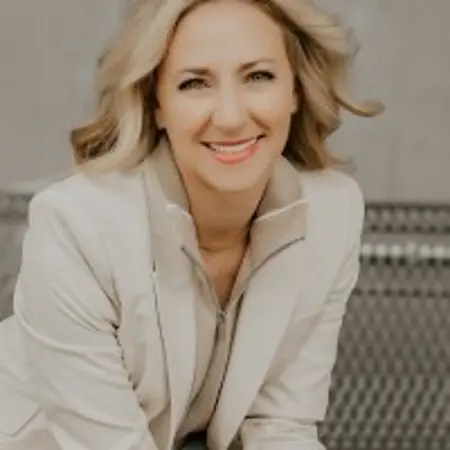
Her Story
About Jennifer
Jennifer Riggle, Ed.D., NCSP, is the Chief Innovation Officer at LIFToFFS Learning Collaborative, where she leads strategic innovation, research, and cross-sector partnerships aimed at transforming public education through structural redesign. She also serves as Director of Student Services, Prevention & Wellness at CESA 4, supporting rural and suburban districts across western Wisconsin in strengthening mental health systems, student engagement, social-emotional learning, and equitable multi-level supports. In both roles, she helps districts integrate emerging technologies, including AI, with competency-based and personalized learning models designed to improve outcomes for all learners.
With more than 18 years of experience in education, Jennifer has served as a school psychologist, school counselor, and district administrator across Wisconsin, Washington, and Kentucky. Her career has centered on understanding how students learn, behave, and thrive within school systems, with a strong focus on mental health, neuroscience, durable skills, and human-centered design. She earned her Doctorate in Educational Leadership from Sacred Heart University, where her dissertation reframed student engagement as a critical driver of both academic success and mental well-being. Her work was nationally recognized as the 2025 Carnegie Project on the Education Doctorate Dissertation of the Year.
Jennifer’s work is grounded in a commitment to reimagining rural education as a model for innovation and equity. Raised in rural northern Wisconsin, she brings lived experience and professional expertise together to help districts build scalable, future-ready systems that remove geographic barriers and expand opportunity for students. Through her leadership at LIFToFFS and CESA 4, she collaborates with educators and leaders to design learning environments that prioritize engagement, adaptability, and real-world readiness, ensuring students are prepared not just for school, but for life beyond it.
Her Interview
Ten minutes with Jennifer
01What do you attribute your success to?
I attribute my success to my love of growth and learning, probably more than anything. As a human, I value that to such an extent, and I am energized by learning new things and trying new things. I think I've got a really realistic sense that that process involves a lot of failure and a lot of self-reflection and a lot of self-critique. Being able to withstand all of that, I think, is what has allowed me to continue to stay in the game. It's just having that healthy sense of growth mindset and a healthy sense of how mistakes and failure play into that growth process.
02What’s the best career advice you’ve ever received?
The best advice I've ever received is that everybody has a really important story to tell if you're just listening for it. When you're working with a vast number of people, like when you're thinking about 18 school districts and all of their students and staff and communities, it's such a huge number of people. When you remember to appreciate that every single person has this really interesting story and a fascinating life, it encourages a whole bunch of different behaviors and ways of being that help you to be humble and have some humility around your work and your role in people's lives. It also helps you recognize the incredible power you have. You know, the old Spider-Man quote, with great power comes great responsibility. When we're trying to make system-level changes, we're actually putting ourselves in positions to change people's stories, and I just think no one should take that lightly. You should approach that with the reverence that it really deserves.
03What advice would you give to young women entering your industry?
If you believe in something so deeply, do not let individual feedback or experiences deter you from what you believe and know to be true in your heart or in your being, or with what you want for yourself. I think of all the times that we received feedback or critiques or things really didn't go well for us for a certain day or a certain event, and if we would have used that as a reason to shut down or made meaning into that, that we were on the wrong track, I think that would have been a huge mistake. We've really been unwilling to give up our dream and our vision of what we want to happen for these communities and their public education systems. We've held so strongly to that that we've been able to push through all of those potentially negative or adverse experiences. So I would say just hold on so strongly and not let it go, and look for the other believers, because there always are other people who believe what you believe and want to join up with you.
04What are the biggest challenges or opportunities in your field right now?
The biggest opportunity in my field is putting humans front and center. With structural change in education, we do a lot on emerging technology and AI in education, really exploring what is the future of emerging technology and AI and education. With my mental health background, I talk all the time about how detrimental social media and smartphones were on our generation of Gen Z students, and how are we going to rectify some of those lessons that we've unfortunately learned for all future generations. We talk a lot about how much emerging technology and AI literacy is needed for the future, but we can never lose sight of why we're human and how we're human. Everything that can be calculated and driven through calculation is going to be replaced. So the skills that we truly need in ourselves and our students for the future is always going to be those human skills that are going to make the difference for not only businesses, but also communities.
05What values are most important to you in your work and personal life?
Integrity is really important to me. I think we talk a lot about ethics and about responsibility. Dignity of the human person is really important to me, and just honoring all of these different people we come into contact with and what they can all bring to the table. But I also think balance is crucial. I think of Alexander Hamilton and his story of how we can't let ambition allow us to sacrifice our lives. Making sure we each have balance, whatever that looks like for us. I know for myself and my team of all women, we all know that we do a better job at our vision and at our life goals for professional when we also take care of our personal, and we make sure that we've got space and time for that.
Join Influential Women and start making an impact. Register now.