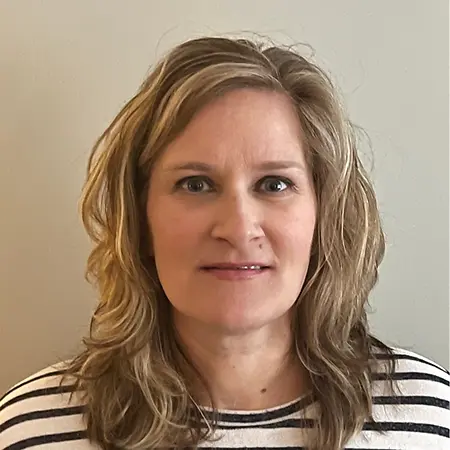
Her Story
About Jennifer
Jennifer Teichroew, She/Her, is a healthcare revenue cycle and compliance professional with approximately nine years of experience in the industry. Her journey into healthcare began as a career transition following a layoff from a different field. She entered the healthcare space as a prior authorization specialist. Although she did not initially envision a career in healthcare, she quickly discovered a strong sense of purpose in supporting patients and contributing to their care experience, even in non clinical roles.
A significant chapter of her career was her tenure with Minnesota Oncology, where she made a measurable impact on revenue cycle operations and patient financial transparency. One of her most notable accomplishments was scaling patient cost estimation processes from approximately 30 estimates per month to nearly 1,900 per month. This work significantly improved patients’ understanding of their financial responsibility during cancer treatment and strengthened organizational efficiency. Her efforts in revenue cycle optimization, compliance support, and cross functional collaboration helped drive meaningful improvements in both patient access and operational performance.
Currently, Jennifer works in the healthcare space within a startup focused on durable medical equipment DME, where she plays a key role in building foundational internal structures and processes. Her work centers on understanding insurance coverage, patient costs, and payer alignment, including coordination with Medicare and other insurers to establish scalable systems. Her experience in healthcare also inspired her to return to school to complete her Healthcare Management degree, reinforcing her commitment to the field and solidifying her passion for improving healthcare operations that directly impact patients.
Her Interview
Ten minutes with Jennifer
01What do you attribute your success to?
I would say that I try to stay true to myself. I try to fight for the right thing, not for what might be the direction, but what truly is the right decision. It might not be the easy one, it might be the hard decision, but I think that by staying true to what truly is right, and what you feel is right, I think that's where I've been successful.
02What’s the best career advice you’ve ever received?
I guess I would say that really to just follow your passion. Like, if you're in a role that brings you joy, meaning that you feel a sense of accomplishment, that's really where you're at. That's really where your home is, essentially. It might not be with that particular company, but with that particular industry. In connecting with patients the way I do, in many different levels, that's really brought me essentially my joy.
03What advice would you give to young women entering your industry?
I would say that stay true to who you are. Stay true to your moral compass. There's a lot of challenges in healthcare, and there's a lot of challenging situations, whether it's in the clinical side or the non-clinical side, but stay true to your moral compass, and fight for what you believe in.
04What are the biggest challenges or opportunities in your field right now?
The insurance companies are always very difficult, just because they change things a lot, and it's like you have to learn all the time, and relearn all the time, because they're trying to be a profitable entity. It makes it difficult to kind of keep track and keep up with their pace of change, and learning what they're doing. The AI industry is changing things for the insurance companies as well, and so just trying to keep up with them, so that reimbursements are coming back to providers is probably the most challenging piece. From the administrative side, there's a lot that I have to lift, there's a heavy lift in that aspect. When it comes to understanding what I need and how I need to be supported, I don't think that my leaders understand that, and so that's what leads to burnout from my perspective, because I don't feel like my leaders understand that I also need support in what I do. The burnout from the clinical side is very real and needs a lot of focus too, but there needs to be support all the way around in ensuring that people are not spending 12 hours a day trying to get work done, and we need to be able to work more efficiently.
05What values are most important to you in your work and personal life?
Being able to align with colleagues and companies that have the same moral standing that I do is very important. It's difficult to work for an organization or with individuals that don't hold those same moral and ethical standards that you do. It just makes it a very difficult working environment. And so, when you're able to align with industries, companies that will put the patient first, that really is important to me.
Join Influential Women and start making an impact. Register now.