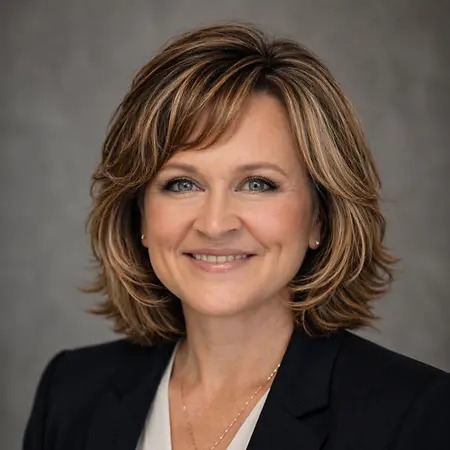
Her Story
About Jenny
Jenny Arndt is a Non-Attorney Special Education and Disability Rights Advocate and Qualified Neutral dedicated to supporting families navigating complex educational and disability systems. With a strong foundation in public service, she provides advocacy, case coordination, and systems navigation support for parents and caregivers seeking equitable access to services for children with disabilities. Her work focuses on helping families understand their rights, prepare for IEP meetings, and secure appropriate accommodations and educational supports. Her advocacy journey began after more than 20 years in cosmetology, when personal experience with her children’s autism diagnoses led her to actively engage in special education systems on behalf of her family. Through this lived experience, she developed a deep understanding of educational barriers and transitioned into full-time advocacy work. She later returned to higher education after nearly three decades, earning her bachelor’s degree summa cum laude from Minnesota State University Mankato while balancing family responsibilities and advocacy efforts during the pandemic. Today, Jenny serves families across Minnesota through independent advocacy work and participation in state-level disability policy initiatives. She is a Qualified Neutral in the State of Minnesota with completed specialized training through the Mediation Center. Additionally, Jenny has completed (SEAT 1 & 2) Special Education and AdvocacyTraining with the Council of Parent Attorneys and Advocates (COPAA). Her work is grounded in equity, inclusion, and accessibility, and she actively contributes to multiple boards and committees, including the Minnesota Governor’s Council on Developmental Disabilities, where she helps advance systemic improvements for individuals with disabilities and their families.
Her Interview
Ten minutes with Jenny
01What do you attribute your success to?
I credit my success to persistence and taking things one day at a time, especially during the toughest moments. When I returned to school after 30 years during the pandemic, I found myself at home with my children, navigating online classes because they couldn't attend in person, while also working on my own education. Looking back, I realize how overwhelming it was—how did I manage? It was simply about focusing on one day at a time, not stressing about what’s ahead, just getting through each moment. The saying, "the squeaky wheel gets the grease," really rings true—sticking with it makes a difference. If you're truly committed, you can make it happen. Many people stay silent out of fear of cancel culture, but if your heart is in the right place and you're creating positive change, you should shout it from the rooftops. Be dedicated, keep pushing forward, and others will hear you, gaining momentum. When my son was nonverbal for the first six years of his life, I fought tirelessly to get him access to intensive behavioral therapy. I went to the county and demanded solutions—refused to let them put my three-year-old in a cab alone every day. Instead, I found a medical transportation service, collaborated with officials, and made it happen. We even got the senator and state representative involved, and they assured us it would be solved. Today, southern Minnesota finally has reliable medical transportation for children with special needs requiring specific therapies. My son is now 17 and never stops talking—those achievements mean everything to me.
02What’s the best career advice you’ve ever received?
The best career advice I’ve ever received is, “The squeaky wheel gets the grease.” It taught me that persistence and speaking up are crucial when advocating for change. If your intentions are rooted in doing good and creating positive outcomes, you need to be willing to be vocal and keep pushing forward until progress is achieved.
03What advice would you give to young women entering your industry?
The squeaky wheel gets the grease. Stay persistent. When you're truly committed to something, you can make it happen. Right now, many people in society hold back because of cancel culture, but if your heart is in the right place and you're working to create positive change, you need to shout it from the rooftops, stay dedicated, and keep pushing forward—you will be heard. Momentum will build, and you'll look back someday and realize,Wow, I really accomplished that.
When my son was nonverbal for the first six years of his life, I faced the challenge of getting him access to therapy in southern Minnesota. I went to the county to ask, how will I get him to therapy every day? They suggested a cab for my three-year-old, alone. I said,No way. Instead, I found a medical transportation company that handled special needs. I asked,This is what we need—how can we make it work?
Eventually, we brought in the senator and the state representative, who assured us that there would be no more problems. Today, southern Minnesota finally has dedicated medical transportation for children with special needs, giving them access to therapies and enabling them to participate fully in their communities and schools.
04What are the biggest challenges or opportunities in your field right now?
One of the biggest hurdles we face is that there’s no formal accreditation, certification, or degree specifically for special education advocacy, despite the system’s incredible complexity. Nowadays, school districts often operate more like businesses. They’re driven by budget constraints, constantly redlining and cutting costs to make every tax dollar count. Teaching itself is becoming a dying profession, and it’s increasingly difficult to find dedicated teachers ready to step into the classroom. This situation is alarming—what will education look like in 15 or 20 years? The systems are so intricate that if you're not fully equipped to understand the nuances of assessment terminology, your child could miss out on thousands of dollars' worth of vital therapy. I remember a client who struggled with reading for years, only for the school district to insist everything was fine—and fail to provide the necessary supports and accommodations. But it wasn’t fine. All that child needed was a proper dyslexia and reading assessment. Dyslexia is a recognized disability, requiring specialized instruction tailored to how the brain processes information differently. Without this targeted support, children with dyslexia may never reach their full potential in learning to read and overcoming their challenges. What matters most to me is raising awareness. There are passionate advocates ready to help families navigate these complex systems. No family should feel alone in this journey—we’re just a phone call, email, or text message away..
05What values are most important to you in your work and personal life?
The most important thing to me is making sure that people are aware that there's help out there and that they don't have to be alone. We're just a phone call away, or even an email or a text message. I remember when we first got our children's diagnoses, and I was lost. My husband and I kind of looked at each other like, what are we gonna do? We tried asking around, and no one even knew really what autism was. It was just like you hit a brick wall. We were like, oh my gosh, you have a child that needs help, and no one really knows what it is. What are you gonna do? Now it's common because autism is so prevalent, but still in the rural communities where I'm from, in the outstate rural communities, you have families that don't know about therapies or services or even how to access those services and supports that their child needs. School districts get kind of tricky because they don't ever necessarily tell you everything that's available. They don't go, here's the buffet of services that we offer, what's your child gonna need? You have to know their language. My goal is to make sure families know they're not alone and that there are advocates waiting to help them navigate these systems so their children can access the same education as their peers and reach their full potential.
Join Influential Women and start making an impact. Register now.