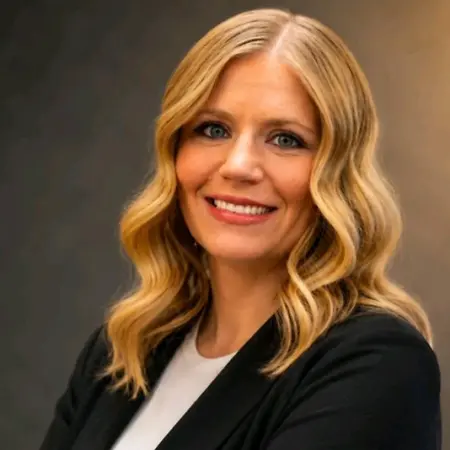
Her Story
About Jessica
Jessica Cain is a dedicated behavioral health professional, crisis response specialist, and graduate student committed to supporting individuals and families through some of life’s most challenging moments. Based in McAlester, Oklahoma, she serves as a Crisis Response Specialist and Case Manager II with CREOKS Health Services, where she provides crisis intervention, safety planning, care coordination, and recovery-focused support. Her work centers on helping children, adolescents, and families navigate mental health challenges, while ensuring access to compassionate, evidence-based care and community resources.
Jessica’s path into the mental health field is both inspiring and deeply personal. After beginning her journey as a client at the very clinic where she now works, she was encouraged by a supervisor who recognized her potential and invited her to pursue a career in behavioral health. Drawing from her own experience as a person in long-term recovery, she has become a trusted advocate for youth facing addiction and mental health struggles. Over the past four years, she has developed expertise in crisis response, suicide risk assessment, behavioral health coaching, peer recovery support, family support services, and working with at-risk adolescents. Her ability to combine professional training with lived experience allows her to build meaningful connections and provide hope to those facing difficult circumstances.
Alongside her professional responsibilities, Jessica is pursuing a Master’s degree in Clinical Mental Health Counseling at East Central University, where she maintains outstanding academic performance and continues to expand her clinical knowledge. She is an active member of the American Psychological Association and the Oklahoma Counseling Association, reflecting her commitment to lifelong learning and professional excellence. Guided by values of compassion, dignity, community service, and resilience, Jessica is dedicated to helping vulnerable individuals achieve stability, recovery, and a brighter future while contributing to the advancement of mental health care in her community.
Her Interview
Ten minutes with Jessica
01What do you attribute your success to?
I attribute my success to my supervisor seeing potential in me when I was completely unaware of the potential I had in myself. When I first got into this field, I told them I didn't want to work with kids at all because I was afraid that I would mess up somebody's kid. But they told me, 'Well, they come to us messed up, so you can just help.' Because I did have a story, and a lot of my stuff started when I was a teenager, they thought that kids would listen to what I had to say. And they really have. So it was really about having someone believe in me before I believed in myself, and that mentor giving me that push to work with the population I was most afraid of but turned out to be most effective with.
02What’s the best career advice you’ve ever received?
The best career advice I've ever received is to not take things personally. Because I work in crisis and I'm with people right when something is going wrong, we get cursed out or things like that. I just try to focus on what the need is, because I know that they're not cursing me out because it's my fault. They're just very stressed out, and they don't know what to do. So I try not to take anything personally and instead focus on understanding what they need in that moment.
03What advice would you give to young women entering your industry?
My advice to young women entering this industry is that boundaries are not selfish. We need to have boundaries, and we need to teach the people we work with to have their own boundaries. It's not a bad thing to have your own boundaries. This is so important because boundaries directly contribute to preventing burnout. If you don't have boundaries, you will burn out. What we teach our clients isn't just meant for them, it's meant for us too. We have to be practicing what we preach. The field is constantly low-staffed because people don't practice what they're teaching the clients, so taking care of yourself through boundaries is essential to staying in this field and providing quality care.
04What are the biggest challenges or opportunities in your field right now?
The biggest challenge in my field is burnout. People get burnt out and leave the field and never come back, or they get burnout and their quality of care that they're giving people is not what it should be. The clinician doesn't necessarily know how to take care of themselves, so that's a huge issue. The biggest opportunity in my field is probably going to be all the tech stuff coming in. We've got some AI coming in to help us write notes and make things more efficient, so we're not spending as much time on the computer. We don't want to record someone's whole session, but we can talk into it and it'll write what we did. This means less time on the computer and more time with the patients, which is exactly what we need.
05What values are most important to you in your work and personal life?
The values most important to me are community, compassion, and service. Community is going to be number one for me. I also value compassion, which means always caring about other people and what they're going through, and then treating them with dignity. The third value would be service. I think that it's really important to contribute to something larger than my own self. These values guide everything I do, both in my work with suicidal kids and families and in my personal life with my own family and community involvement.
Join Influential Women and start making an impact. Register now.