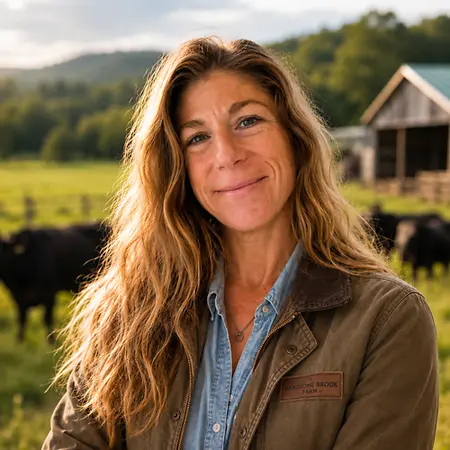
Her Story
About Jessica
Jessica Coslow, Director of Pasture Management at Handsome Brook Farms, brings over 20 years of dedicated experience in regenerative organic agriculture with a primary focus on livestock production systems. Her career began in cow calf operations and expanded into grass fed and grass finished dairy systems where she advanced into livestock management roles and led teams of emerging farmers. In these roles she emphasized hands on training in regenerative grazing practices and supported producers in building the skills and confidence needed to establish and sustain their own farming operations. She spent four years at the Stone Barns Center for Food & Agriculture where she contributed to research farm operations with a focus on alternative food waste systems and food fermentation research. This work deepened her interest in circular food systems and unlocking the ecological potential of food byproducts. For the past two and a half years she has worked with Handsome Brook Farms supporting more than 300 farms across 15 states. In this role she travels extensively often on the road 75 percent of the month visiting farms designing pasture systems for rotational grazing and supporting multi species livestock production on small scale USDA certified organic operations primarily under 100 acres. Her work is especially focused on underserved family farms including Amish and Mennonite communities where she helps implement practical infrastructure improvements through cost share programs. She also has extensive experience in animal welfare and pastured poultry systems. Her work is driven by a long standing commitment to making farming more viable for family operations and ensuring that regenerative agriculture remains both practical and accessible.
Her Interview
Ten minutes with Jessica
01What do you attribute your success to?
I owe much of who I am, both personally and professionally, to my father. Growing up, I watched him work hard to provide for our family, always leading with integrity, discipline, and a genuine sense of pride in what he did. He taught me that showing up, putting in the effort, and maintaining a positive attitude matter just as much as talent or opportunity. One of the greatest gifts he gave me was the confidence to follow my own path. Even when that path led me into livestock and regenerative agriculture, a field that can be physically demanding and often male-dominated, he never questioned my ability to succeed. Instead, he encouraged me, supported my decisions, and reminded me that hard work and determination can open doors anywhere. His example continues to shape how I approach challenges, relationships, and my career. When things get difficult, I often find myself drawing on the lessons he taught me through both his words and actions. His influence remains one of the strongest guiding forces in my life, and I am grateful every day to be his daughter.
02What’s the best career advice you’ve ever received?
The best career advice I’ve ever received is to always make sure your knife is sharp. It may sound simple, but in the context of livestock and hands-on agricultural work, it’s a constant reminder to stay prepared, intentional, and effective in everything I do. It reflects the importance of maintaining your tools, your skills, and your mindset so you can work safely, efficiently, and with purpose. In my line of work, where conditions can change quickly and decisions have real impact on animals, land, and people, that advice has become a guiding principle for how I show up every day.
03What advice would you give to young women entering your industry?
Take your time and be patient with yourself. Don’t be afraid to ask questions or make mistakes, because mistakes are part of how every farmer becomes skilled and confident. In this field, you can plan everything perfectly and still arrive to find that nothing goes as expected, so it’s important to stay flexible, not take challenges personally, and get out of your own way when things shift in the moment. As a woman in agriculture, it took me time to recognize my own strength and to step into roles where I was often overlooked early on, whether that meant being passed over for tractor work or cattle handling in favor of more routine tasks. Eventually, I learned to speak up and simply say, let me try, and that changed everything. While the industry has evolved, I still encourage young women to advocate for themselves, seek out environments where people are willing and excited to teach, and not be discouraged by bad experiences. There are many incredible farmers who genuinely want to mentor and support the next generation. Stay true to yourself, keep learning, and don’t be afraid to move on from spaces that don’t nurture your growth.
04What are the biggest challenges or opportunities in your field right now?
One of the biggest challenges in the field right now is the instability and reduced accessibility of key federal support programs, grant cutbacks significantly impacting farmers’ ability to fund essential conservation and infrastructure projects and, in many cases, diminishing trust in those funding systems. At the same time, climate change is creating increasingly urgent on the ground pressures, including water scarcity and the need for alternative water systems as traditional sources become unreliable, all while farmers are navigating broader economic constraints and regulatory requirements that can slow adaptation and increase operational strain.
Despite these challenges, there are meaningful opportunities in the continued growth of regenerative agriculture and strong consumer demand for organic and pasture raised products, even amid rising food costs, signaling a resilient market for producers willing to adapt. Regenerative practices such as rotational grazing, cover cropping, and diversified livestock systems offer proven pathways for building ecological and economic resilience, and while monoculture operations face increasing pressure, there is significant opportunity for innovation, collaboration, and long term sustainability as farmers continue to pivot, share knowledge, and implement more adaptive and diversified production systems.
05What values are most important to you in your work and personal life?
I place a strong value on trusting instincts and intuition, especially in work that requires constant attention, awareness, and responsiveness to both animals and land. In an increasingly distracting world, I believe it is essential to stay grounded in authentic, sensory experience and to slow down enough to truly observe what is happening in front of you. In practice, that means paying attention to the details of the environment, how the ground feels underfoot, what is being seen and smelled, and what those observations are signaling about the health of a system. I also value curiosity and reflection, often encouraging both myself and my team to document observations, ask questions, and treat even small or seemingly simple details as meaningful data for problem solving. Above all, I value authenticity, self-awareness, and the discipline of staying present and intentional, both in the field and in life, without diminishing one’s voice or intuition for the comfort or expectations of others.
Join Influential Women and start making an impact. Register now.