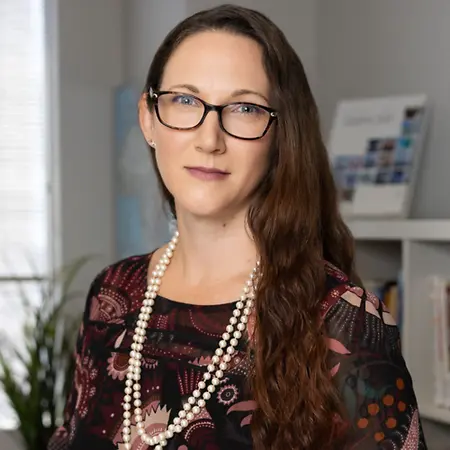
Her Story
About Jessica
I currently work for Schiller International University, where I serve as the global librarian overseeing all libraries across our four physical campuses and one online campus. My role is incredibly diverse - I manage all the research resources for students across our campuses, teach English and political science along with whatever else they need me to teach, and handle academic coordination, faculty training and onboarding, and student advising. Because it's a small private university, I basically do whatever they need me to do. I've been in academic libraries for about 4 years now. Before joining Schiller, I was a circulation supervisor at the University of Tampa's library. Prior to my academic library work, I spent nearly 5 years as a children's librarian in Pasco County after finishing my master's degree in 2016. I also spent a year in Texas working on my doctorate research, focusing on ESL or English as a Second Language Education. Right now, I'm particularly proud of a major project I've been leading - we're rolling out a new library website and suite of digital resources for all of Schiller's campuses. This has involved a year of negotiations with database providers across multiple time zones, working with counterparts in Dubai, India, and the UK, and collaborating with research and database corporations to find the most cost-effective way to provide better digital resources for our students who are literally all over the world, including many in the Middle East and Africa who absolutely need robust digital access since they don't all have local library systems they can easily access.
Her Interview
Ten minutes with Jessica
01What do you attribute your success to?
I attribute my success to just dogged determination and never giving up. When you're getting graduate degrees or looking for work, it's a marathon, not a sprint. It's about continuing to do the same kind of repetitive and often disheartening tasks day after day after day until they finally pay off, and just not giving up. Graduate school isn't necessarily intellectually complex - it's physically, emotionally, and intellectually draining. So you just have to keep going. That persistence and refusal to quit, even when things get tough, is what has gotten me to where I am today.
02What’s the best career advice you’ve ever received?
The best career advice I ever received came from an Albanian friend who works in finance. She told me when I was working on my graduate studies to go and pick out a job that I want, and then figure out what I need for that job, and that is where I need to start. Rather than students going into college and saying 'oh, I'm gonna take this because this is interesting to me' or 'I'm gonna study this program,' which is kind of going about it backwards, what you should do instead is find a person or a job listing with a particular role, and then really deep dive exactly what steps need to be taken to end up in that particular role. This helps with the jobs crisis for students graduating now, because most students coming out of undergrad find it very difficult to find a job and end up underemployed or unemployed because they're going about their choice of college program backwards. Instead of interviewing somebody in a particular role to make sure it's a good fit and asking exactly what they did to get there, they just start taking classes based on their interests. That's what I did with my international relations degree - I loved traveling and international relations and current events, so I studied it, but I didn't talk to someone at the UN or an international NGO about how they got there. Then I had a bachelor's degree with no jobs available for it. When I was looking at graduate schools and programs, my friend's advice helped me do it the right way. It took a long time, but here I am.
03What advice would you give to young women entering your industry?
In my industry, I would honestly say don't go into libraries. I would not advise anyone to go into this field right now. The vibe is just very, very bad. It's very disheartening every day to have to defend things that you know to be right. I think this field, both libraries and academics, are really on a course to change very, very dramatically, and I don't think this is a good career path right now. With the development of AI, I do think that appreciation for real academic knowledge will return eventually, but right now, I would not advise anyone to get into libraries in general. One positive thing about AI is that it is going to be an equalizer - college degrees are not going to be as important as other kinds of skills, because students and faculty are all leaning so heavily on AI that they're not really learning in college the skills they need to get ahead. Moving forward, you're not going to have to get a $100,000 education to go into most fields. What you're going to need is emotional intelligence, the ability to manage your time well, the ability to work independently, and the work ethic to pick up these skills on your own. If there is one positive outcome from AI, it is that you are not going to need a college degree to get ahead anymore, because it is rendering some of the more archaic things about higher education completely obsolete.
04What values are most important to you in your work and personal life?
I have an attitude of service that's most important to me. I worked in restaurants for many years as I was working on my education and other jobs, so my attitude whenever I am working is that I am here in service to the people around me - not even just customer service, but thinking about who are all of our stakeholders. If somebody needs help, whether it's faculty, a student, a staff member, or a colleague, I need to make sure that I stop what I'm doing and I help them. My role is to provide the best possible help and service to those around me. I also never have an attitude of being too good for any task. If a task needs to get done, I just need to recognize it and do it, or make sure it gets done. I never look at something and say 'that's not my job.' I'm not stepping over pieces of garbage on the floor. Even if you can't solve a problem, people can see that you're trying to solve the problem, and that matters.
Join Influential Women and start making an impact. Register now.