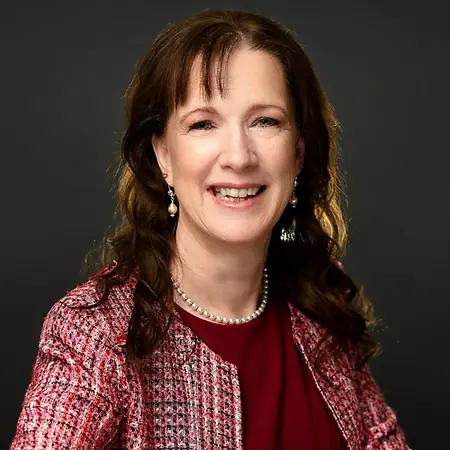
Influential Woman · AI Strategy and Governance / Cybersecurity Consulting
Dr. Jessica Parker, DBA, PMP®
Founder and President, Wise Bites LLC
Moapa, NV 89025
I stopped managing how I was wired and started leveraging it. The difference was immediate and irreversible.
Dr. Jessica Parker, DBA, PMP® · In Her Own Words
Her Story
About Jessica
Dr. Jessica Parker, DBA, PMP®, has spent 25+ years helping organizations do one of the hardest things in technology leadership: make confident decisions in the face of complexity. As founder and President of Wise Bites LLC, she advises corporate boards and C-suite executives on AI governance and cybersecurity risk — translating fast-moving technical challenges into governance frameworks that protect organizations and position them for what's ahead.
Dr. Parker holds a Doctorate in Business Administration in Business Intelligence from Marymount University, an MBA, and PMP® certification. Her doctoral research focuses on human-centric AI governance and cybersecurity risk, and she is a published author in peer-reviewed journals covering AI governance, insider threats, organizational risk, and the behavioral dimensions of cybersecurity.
Her career spans Fortune 500 companies, enterprise consulting, government, and nonprofit board leadership. She has guided organizations through large-scale digital transformation, led technology teams across six continents, and most recently served as Director of Digital Skills and Adoption for the Nevada Governor's Office of Science, Innovation and Technology. She currently serves as Vice President on the CyRoot Academy Board of Directors — giving her firsthand insight into the governance questions boards grapple with when navigating AI and cyber risk.
Beyond her advisory work, Dr. Parker serves as adjunct faculty at the College of Southern Nevada and remains active in professional communities focused on technology, cybersecurity, and leadership development. She is based in the Las Vegas Metropolitan Area.
She believes the best use of hard-won expertise is making the path clearer for those who follow — in the boardroom and beyond.
Her Interview
Ten minutes with Jessica
01What do you attribute your success to?
My career has been built on one consistent habit: raising my hand.
When an opportunity appeared — even one I wasn't entirely sure I was ready for — I said yes and figured it out from there. That combination of bias toward action and genuine love of learning has opened more doors than any credential I've earned.
The most durable lesson I carry came from an early mentor who gave me my first positional leadership role — because everyone needs a first one — and offered a reframe that changed how I operate: everything is an opportunity. The difficult colleague. The impossible problem. The setback you didn't see coming. Reframe it as an opportunity and you move through it differently. I'll be honest: I thought he was polishing a very shiny version of a difficult reality. But the longer I lead, the more I know he was right.
I've also been shaped by people who chose to invest in me before I had all the proof. They made room, opened doors, and took chances they didn't have to take. That's not something you can repay directly — but you can pay it forward. At this stage of my career, that's a responsibility I take seriously.
02What’s the best career advice you’ve ever received?
The best career advice I received came at a point where I'd been in my job for a number of years - I think I'd been at that company for 5 years - and I'd hit a wall from a growth perspective, because it was back in the day, and unfortunately, my boss was awesome, but his boss had some sexist perspective, so that limited my opportunities. One of my friends said, hey, you know, let me put you in contact with this friend of mine, he'll take a look at your resume and let you know what he thinks. And when I spoke with that individual, he said, you know, have you ever thought about consulting? I'm like, well, I hadn't. And then he followed that up by telling me that he could pay me half again my salary to go to consult, and would basically help me get into that job. And I'm like, wow, yeah, I'm open to consulting. And consulting was really exciting, and continues to be something I enjoy doing, because you get to go to new companies, experience new industries and their cultures, and see the things that are similar across organizations, and the things that are different. Consulting isn't for everybody, but that opportunity was really exciting, and so trying consulting was absolutely an eye-opener and a door-opener for me.
03What advice would you give to young women entering your industry?
My first piece of advice is also my most urgent: enter the field and stay.
There's a well-documented trend of women leaving IT around the eight-year mark, not because they couldn't cut it, but often because they concluded the industry wasn't for them. Sometimes that's true. But sometimes they left the wrong company and called it the wrong industry. Those are very different problems, and conflating them costs us talent we can't afford to lose.
Here's why it matters beyond the individual: the people building technology set the rules for everyone who uses it. When those rooms lack diversity, bias gets baked in — not through malice, but through the simple limits of any homogeneous group's perspective. No single viewpoint covers the full range of human experience. The only fix is more women at the table, doing the work, shaping the tools.
Yes, you will be the only woman in the room. More than once. Probably often. The sexism is real — I won't minimize it — and it shows up differently depending on the company, the team, and the leadership. Some environments are genuinely better than others. If you land in one of the worse ones, the instinct may be to leave the field entirely. Resist that instinct long enough to ask whether it's the industry or just that organization. Those are not the same thing.
What I can tell you is that the support infrastructure for women in tech is stronger now than at any other point in my career. There are more women actively working to lift each other up, open doors, and make the path clearer than I've ever seen. That's not just encouraging — it's a real, tangible resource. Use it.
The field needs you. Stay.
04What are the biggest challenges or opportunities in your field right now?
The single biggest challenge in technology right now is the pace of change — and the near-impossible task of training for a target that won't stop moving.
Three years ago, generative AI was the inflection point everyone was orienting around. Today, agentic AI is dominating the conversation. In two more years, quantum computing may redefine it again. Organizations are struggling to build workforce capability fast enough, and the traditional model of "train now, apply later" simply doesn't hold when the landscape shifts faster than the curriculum can.
I watched this firsthand. When I began my doctorate, ChatGPT had just launched (November 2022), a moment that genuinely changed everything. By the time I finished, we were in a full-scale AI arms race: OpenAI, Anthropic, Google's Alphabet, DeepSeek, and Elon Musk's xAI all racing to outpace each other, each release leapfrogging the last. The field I was researching was materially different at the end of the program than at the beginning. That's not hyperbole — it's what's actually happening.
The flip side of that challenge is one of the most exciting opportunities in the history of the field: if you love to learn, this moment is extraordinary. Your role today will look fundamentally different in three years. The skills that matter most aren't the specific tools — those will change — but the capacity to adapt, contextualize, and apply new capabilities strategically. That's a human skill. And right now, it's one of the most valuable things you can bring to any organization navigating this.
For those who are comfortable with ambiguity and energized by what's next, there has never been a better time to be in technology.
05What values are most important to you in your work and personal life?
Two values drive nearly every decision I make, professionally and personally: continuous learning and leaving things better than I found them.
The learning piece is non-negotiable for me. I genuinely believe we are never stuck where we are today — there is always a better version of ourselves available if we're willing to pursue it. I measure a good day simply by asking: Did I learn at least one thing? If yes, it was worth it. That mindset has shaped my career more than any title or credential.
I discovered relatively late in life that I have ADHD. And once I understood how that brain works — including its well-documented pull toward addictive patterns — the reframe was immediate: my brain is addicted to learning. I couldn't have designed better wiring for the field I'm in.
The second value is impact — specifically, the kind that helps other people. I don't measure my days by output or optics. I measure them by whether something moved forward: a process improved, a person supported, a problem solved. Did I make it better? If the answer is yes, it was a good day.
These aren't abstract principles; instead, they're the actual filter I run decisions through. What makes both of them sustainable is collaboration. There is something extraordinary about the perspective you gain from working alongside people who think differently from you. That's where the real breakthroughs happen.
Join Influential Women and start making an impact. Register now.