
Documentation is the only evidence that clinical care ever happened. This powerful exploration reveals why thorough, honest charting isn't just a requirement—it's a sacred responsibility to patients, families, and future clinicians who depend on the medical record to understand the complete story of care delivered.
Her Story
About JoNel
JoNel Chensky is a respiratory therapy leader specializing in post-acute respiratory care, ventilator program development, and operational improvement for medically complex patient populations. With more than 15 years of experience spanning acute care, LTACH, and skilled nursing, she focuses on building sustainable systems that improve clinical outcomes while supporting frontline healthcare teams.
As Director of Respiratory Therapy at Larchwood Care Skilled Nursing and Rehabilitation in Cleveland, Ohio, JoNel oversees respiratory operations, ventilator and tracheostomy programs, policy development, staff education, quality improvement initiatives, and interdisciplinary collaboration. Her work emphasizes reducing preventable hospital readmissions, strengthening documentation, improving operational efficiency, and advancing evidence-based respiratory care.
JoNel is also an emerging healthcare writer and thought leader whose work explores the often-overlooked challenges of post-acute care. Through articles and educational content, she advocates for better recognition of respiratory care's role in long-term care, improved documentation practices, thoughtful healthcare policy, and practical solutions that strengthen care delivery. Her thought leadership has been featured by KevinMD, where she writes about post-acute respiratory care, documentation, healthcare systems, and leadership.
Earlier in her career, JoNel received Select Medical's Pulmonary Center of Excellence Award, becoming only the second respiratory manager to earn the recognition among more than 150 hospitals during a five-year period.
She maintains active memberships with the American Association for Respiratory Care (AARC), the National Board for Respiratory Care (NBRC), the Ohio Society for Respiratory Care (OSRC), and the Global Tracheostomy Collaborative. She is completing her bachelor's degree in Healthcare Sciences at Cleveland State University.
Based in Cleveland, Ohio, JoNel is passionate about helping healthcare professionals see what is often overlooked—and building practical systems that improve patient care, support clinicians, and strengthen post-acute respiratory programs.
Her Interview
Ten minutes with JoNel
01What do you attribute your success to?
I attribute my success to curiosity more than confidence. Throughout my career, I've been less interested in simply finding answers and more interested in understanding why problems exist in the first place. That mindset has led me to look beyond symptoms, question assumptions, and develop practical systems that improve patient care and support healthcare teams.
I've also learned that success is built through collaboration. Every meaningful improvement I've helped implement has been the result of listening, learning from others, and remaining willing to adapt. I don't believe leadership is about having all the answers—it's about creating an environment where people can succeed together.
02What’s the best career advice you’ve ever received?
One piece of advice has stayed with me throughout my career: "Fake it until you make it—just don't kill anyone."
While it's humorous, it reflects an important truth. Growth requires stepping into responsibilities before you feel completely ready. Confidence comes through preparation, continuous learning, and experience—not waiting until you feel perfect.
I've also learned that competence isn't measured by always having the answer. It's measured by knowing when to ask questions, seek guidance, and continue learning.
03What advice would you give to young women entering your industry?
Never stop asking why.
Healthcare is full of routines, but meaningful improvement comes from understanding the reasons behind them. Learn the science, understand the systems, and never be afraid to respectfully question processes that don't make sense.
Don't underestimate your voice. Some of the most important improvements begin when someone notices what everyone else has accepted as normal. Stay curious, keep learning, and remember that your perspective has value—even early in your career.
04What are the biggest challenges or opportunities in your field right now?
One of the greatest opportunities in healthcare is improving how we care for medically complex patients after they leave the hospital. Post-acute care is becoming increasingly specialized, yet many of the challenges faced by these providers remain poorly understood.
Better documentation, stronger interdisciplinary collaboration, operational innovation, and evidence-based respiratory care all have the potential to improve patient outcomes while reducing preventable hospitalizations. I believe we also have an opportunity to bring greater awareness to the critical role respiratory therapy plays in these settings and to help shape policies that reflect the realities of modern post-acute care.
05What values are most important to you in your work and personal life?
Integrity, curiosity, compassion, and continuous growth guide both my professional and personal life.
I believe in doing the right thing even when it's difficult, approaching challenges with an open mind, and treating people with respect and empathy. I also believe that learning never stops. Every experience—whether successful or challenging—offers an opportunity to improve, grow, and help others do the same.
Ultimately, my goal is to leave every system, team, and patient population better than I found it.
Her Content Hub
Articles by JoNel
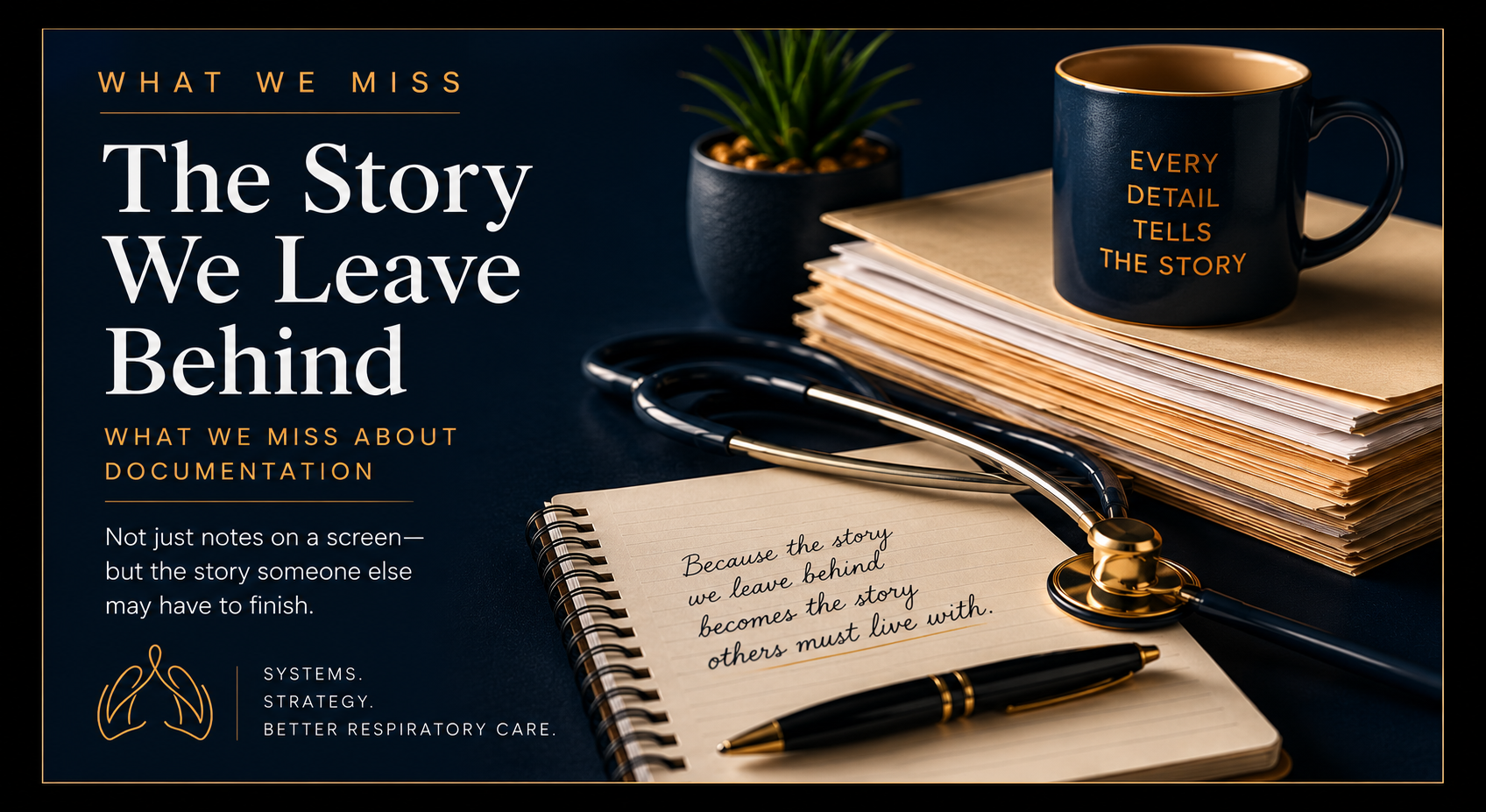
The Story We Leave Behind
Why Complete Documentation Is a Sacred Trust, Not Just a Task
Documentation Isn't a Record
It's the Only Evidence the Story Ever Happened.
We often think of documentation as the task we complete before the end of a shift.
Something left until the last minute.
- A requirement.
- A legal safeguard.
- An interruption.
Some lessons are learned through education. Others are learned when routine parts of our practice are suddenly viewed through an entirely different lens.
Those lessons have a way of changing not only what we do...
They change how we think.
It changed how I think.
What we miss is that documentation isn't written for today.
It's not written simply to satisfy a policy.
It's written for every person who will one day need to understand what happened after we're gone.
It's the patient's voice.
It's our voice.
It's the voice of truth.
For years, I repeated the phrase every clinician knows by heart.
"If it wasn't documented, it didn't happen."
I believed it.
I taught it.
I expected it.
Looking back, I understood the words.
I hadn't yet experienced their weight.
At least... not until I was the one reviewing and explaining what had happened that day.
The Story Had Never Been Written
During a comprehensive review of patient care, every assessment, every intervention, every timestamp, and every clinical decision were examined in extraordinary detail.
I reviewed the record, looking for evidence of our care.
It was surprisingly difficult to find.
Not because the care hadn't happened.
The documentation couldn't prove it.
Because the story had never been written.
I already knew my team delivered exceptional respiratory care.
Families told me.
Surveyors recognized it.
I had witnessed it myself.
But reading that chart felt like standing in the middle of a desert while a lone tumbleweed rolled by.
You knew life had been there.
You just couldn't see much evidence of it.
We got through the review by the skin of our teeth.
I asked myself:
Could I walk through this review again and feel confident the documentation would tell the full story?
The answer was painfully simple.
No.
Not "maybe."
Not "probably."
No.
In that moment, I understood why every detail mattered.
A family wasn't looking for perfect documentation.
They were looking for answers.
The Story Stopped at the Bedside
Walking away from that experience, I realized something uncomfortable.
We weren't failing because the care was poor.
We were failing because the story stopped at the bedside.
The care was there.
But the documentation didn't reflect the story of the care that had been given.
That wasn't a failure of my team.
It was a failure of my expectations.
Somewhere along the way, I had accepted documentation that was good enough instead of asking whether it truly explained the patient's story.
Documentation doesn't end when a shift ends.
That's when its real work begins.
Weeks...
Months...
Sometimes years later...
- Surveyors.
- Insurance reviewers.
- Hospital physicians.
- Attorneys.
- Families.
- Future clinicians.
None of them were there.
Documentation becomes everyone else's reality of the care that was provided.
The medical record has to tell the same story as the care that was delivered.
That's a responsibility I had never fully appreciated until that day.
The Chart Becomes the Story
"If it wasn't documented, it didn't happen."
I no longer think that's the lesson.
The lesson is this:
Documentation is the only part of the care that remains long after it has been given.
Long after the shift ends...
Long after memories fade...
Long after the patient moves on...
The chart becomes the story.
Not the story we remember.
The story we leave behind.
Every note we write becomes part of a story someone else may one day have to finish.
What we leave behind isn't just documentation.
It's trust.
Because the story we leave behind becomes the story others must live with.
Join Influential Women and start making an impact. Register now.