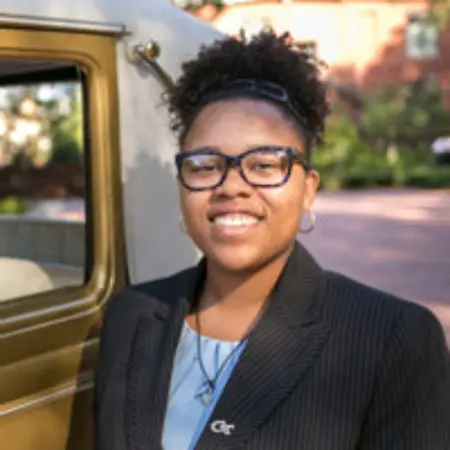
Her Story
About Joy
I studied biomedical engineering at Georgia Tech, where I always thought I wanted to do research and development, particularly in prosthetics and medical technology innovation. But I was recruited at a national engineering conference for GE Healthcare's operations rotational program, and I stumbled into manufacturing - and I absolutely love it. I started in summer 2020 during COVID, and they sent me to Madison, Wisconsin to work on ventilators. Getting to help build a second ventilator line when demand went up 1500% during a global pandemic was such a meaningful experience. Through my two-year rotational program, I moved across the country - from CT machines in Waukesha, Wisconsin, to MRIs in Florence, South Carolina, where I got to be both a people leader and a buyer. But I kept coming back to the technical side, the problem-solving and process engineering. For my last rotation, I came to Phoenix working on ultrasound equipment as an advanced manufacturing engineer, improving processes and making operators' lives better. I loved Phoenix so much that when I finished the program in 2023, I rolled off into a technical role here. Now I focus on root cause analysis, figuring out what's causing our manufacturing issues and defects, and continuing to improve how we do things. Working in healthcare means everything I do ultimately helps patients get the equipment they need, and that passion for improving lives is what drives me every day.
Her Interview
Ten minutes with Joy
01What do you attribute your success to?
I would say a lot comes from my upbringing with my parents - they always taught me to be the best I could be, and that's all I've ever strived to be. You can't do better than your best, so I'm always gonna try my best to make them proud, and make myself proud, mostly. I also attribute a lot of my success to Georgia Tech. It just made me a very tough person. Georgia Tech is still the hardest thing I've ever done - I haven't stressed, really, ever since I graduated college. It was so hard and tough, and it definitely made me a very good problem solver and kept me very dedicated and made sure I was a hard worker. Now, so far, nothing has been as difficult as that. It's like a breeze to me. I feel like I can solve anything, and if I don't know the answer, I know how to use my resources to figure out someone who does. Networking is also very important - that's another thing I would attribute to my success.
02What advice would you give to young women entering your industry?
I would say that you should definitely be open to opportunities, because you don't really know what you're gonna like or not like until you try it. For me, every single time when I was going for internships or full-time roles, I was telling everyone at first that I want to do R&D, this is what I want to do, I don't really want anything else. And then I never got an R&D-type role, but I did get a manufacturing-type role. Someone just placed the opportunity in my lap, and I took it, and I haven't looked back since. So I would say definitely always be open to any opportunity thrown at you. You can figure out if you like it or don't like it afterwards, and you can choose to move on later when the time is right, and you don't ever have to be stuck with one thing.
03What are the biggest challenges or opportunities in your field right now?
I think an opportunity is utilizing AI within what we do. GE Healthcare is really big on AI application right now. We actually have the most AI applications out of all the medical device companies in the world - it's over 100 new ones that we have as of the last time I heard, like a month ago. And I think we need to continue growing that, because I do think AI can be a very good tool to help us reach our patients in a better, quicker way. As for challenges, there's so many challenges right now, especially with the political state of the world, with tariffs and stuff like that. We have to change how we're maneuvering day-to-day. And just in general, manufacturing can be tough. You gotta make sure and keep your scrap down. So definitely a lot of opportunities to improve manufacturing and how we do things in an effective and efficient way.
04What values are most important to you in your work and personal life?
I would say passion is probably number one. Working in healthcare, I always chose healthcare because I have a passion for improving the lives of others, making it easy and accessible for everyone to get what they need. If you don't really have that passion and you come work in a field like healthcare, it's kind of just monotonous, and you don't really care, and you might not be working as hard to make sure that our customer at the end has what they need and gets it in a timely manner. It goes a long way when you actually understand the value in the work that you do. I also value empathy, even in the workplace, so in both workplace and in personal life. When you come in to work, you have to know that you don't know what anyone is going through. I don't really believe like anyone is coming to work to ruin your day. They don't wake up and say I'm gonna ruin Joy's day today. Things just happen, and you have to have some empathy, give people grace, and be able to grow from that, check in on people, make sure everything is okay. I think it really does go a long way, even if someone is having a bad day, and they know that they can trust you to move on past it and still be able to build on whatever you're supposed to be doing at work every day.
Join Influential Women and start making an impact. Register now.