Her Story
About Joy
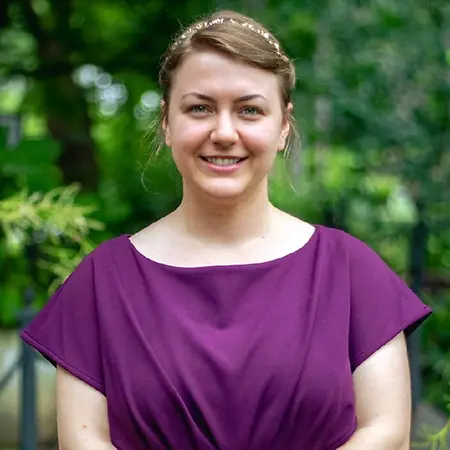
Joy Siler serves as the Administrator of the Cedar Hill Museum of History, where she has her hand in all aspects of museum operations. As the sole employee, Joy manages everything from administrative tasks to exhibits, education programs, and collections management. She works closely with volunteers and the board to oversee daily operations, leads frontline public relations, manages social media, and collaborates on strategic planning. In 2024, she guided the museum through its integration into a newly built library, restructuring professional documents and designing interactive gallery experiences for visitors, creating a dynamic, community-focused environment she deeply enjoys.
Joy’s professional journey in museums and historic preservation is both diverse and hands-on. She previously worked at the Denton County Office of History and Culture, assisting with collections management and historic preservation applications, including projects for cemeteries and a historic house now listed on the National Registry. She also contributed as a STEM Programs Graduate Apprentice at the Mayborn Museum Complex, helping children explore STEM concepts in an innovative makerspace, and as a Visitor Experience Specialist at the Dr Pepper Museum, where she honed skills in welcoming visitors and enhancing their experience of museum spaces. These roles helped her cultivate expertise across collections, education, historic preservation, and public engagement.
A committed scholar and community leader, Joy holds a Master of Arts in Museology/Museum Studies from Baylor University and a Bachelor of Science in History from Texas Woman’s University. She is a 2016 Terry Foundation Scholar and currently serves on the Terry Foundation Alumni Advisory Board. Through her work, Joy combines administrative acumen, educational programming, and community engagement to ensure that history is accessible, interactive, and meaningful for all visitors.
Her Interview
Ten minutes with Joy
01What do you attribute your success to?
I would say my support structure and the grace of God. I've had a very supportive family, professors, and colleagues within my programs that have been very inspirational and very supportive. They helped me to bounce ideas off of them when I was struggling to comprehend what I truly wanted and they were very open to supporting me during the times when I needed them most. Having that support structure in place has been monumental in being able to get to where I am now. I've moved around almost every 2 years in the last 8 years or so because of school and different jobs in different locations, and knowing I could stay with a family member while I took a part-time job to get the experience that I wanted or know that I had someone to help with my skills transitions as I took on something new, have been some of the most impactful things. Even when a job wasn't going to be enough to pay rent at the time, having somebody to support me and to trust when I hit a roadblock made it possible to gain the experience I needed.
02What’s the best career advice you’ve ever received?
Allow yourself to stretch beyond a job description, and don't discourage yourself if there's something that you don't know how to do yet. Likely someone is going to extend a job to you, and it sounds really intimidating for the long list of skills that they have on that job description, but the whole point is to bring someone on board to bring new ideas, and you already get a period of orientation. They're going to help you learn the job as well. There are going to be aspects where you may be a little bit weaker, but that's okay. It's better to take a job where you feel like you can grow as well, because if you check every single box, then it's not going to be a learning experience for you. You're not going to really, truly gain another skill or experience that may help you. Diversifying what you do can also be a really great strength, because if you take those almost far-stretched ideas--like okay, this sounds like a really cool experience, but would it really work?--just throwing yourself into it and seeing what comes up on the other end can actually be a great experience and give you extra skills that would surprise you later on.
03What advice would you give to young women entering your industry?
Explore and look at every opportunity as a growth experience. Take on volunteering positions and internships that help to build your knowledge about how museums function and how particular departments are run. That hands-on experience is invaluable and can teach you just as much as a classroom lecture. There are times when you will come across an opportunity that may cater directly to what you want to do, but museums are so interdepartmental and collaborative that knowing what it takes to run any sector will greatly inform how you interact with coworkers down the line.
04What are the biggest challenges or opportunities in your field right now?
I would say the number of opportunities available for a fully sustainable job and general funding are the biggest challenges. COVID hit us hard. A lot of museums had to close, had to really realign their budgets, and it's still a field that is professionalizing in many ways. Museums of all sizes cannot pay high salaries or offer full-time work with benefits. Some are grassroots organizations just trying their best with a group of volunteers to safeguard the history that is still left in their communities. It's starting to bounce back now, but visitorship also dropped off drastically during COVID, and then after, it took a long time for visitorship numbers to reach pre-pandemic levels. Ticket sales and memberships are a key way for museums to receive funding, but a lot of them also rely on grants and individual giving. There has been a lot of political turmoil as well, which has cut off or reduced funding pipelines, like the Institute for Museum and Library Services almost being shut down. Both of these aspects are difficult because museums are non-profits, and they are very dedicated to maintaining public trust by holding collections that have been donated. We have a lot of ethical responsibilities for what museums do. Those challenges bring out a kind of tightrope walk sometimes when you are really trying to make sure that a museum can stay open or can function to its best potential. We need the funds to be able to take care of all the older objects we have, to make sure that they are kept safe and kept in a certain condition for the community to enjoy for years to come. But we also want to provide really great programs and experiences for people coming in, and to have our doors open. Being able to make sure that the bottom line is met and that a lot of the internal functions can run as they need to is probably one of the biggest challenges for a lot of museums, especially currently.
05What values are most important to you in your work and personal life?
I would say faith. I'm personally a person of faith, and that has definitely influenced a lot of my personal work and my personal philosophies. But I think it can also be defined in another way, as faith in people. Being able to extend trust, extend kindness, and have faith that that will be returned to you. Sometimes it's hard, especially in today's society, because a lot of people have been hurt or become suspicious and wary of everyone, and rightfully so in many cases. But being able to have the faith that there is good in humanity, that there is that seed of goodness deep down in all of us is so important to maintain. Sometimes it's a risk, but sometimes you also have to extend that hand of service before it can be returned. Just showing respect, kindness, being open, honest, and welcoming is something that I've really tried to hold on to. As a museum professional, it really does influence a lot of my direct work, because as you're walking someone into a space, bringing them with you, you want them to feel like they can ask questions, that they're able to explore, that they don't have to be nervous about sounding ignorant on a certain topic. That's why we have exhibits, that's why we're here to help them learn, and allow them to have that educational moment. Feeling vulnerable is okay, and being able to have that safe space to broaden your experience is important. I think those themes have always been part of my work. I try to hold on to those no matter what I'm doing because it goes for working with staff and colleagues too. We rely on each other for everything, and that kindness really does help and comes back to you as well.
Join Influential Women and start making an impact. Register now.