Her Story
About Judith
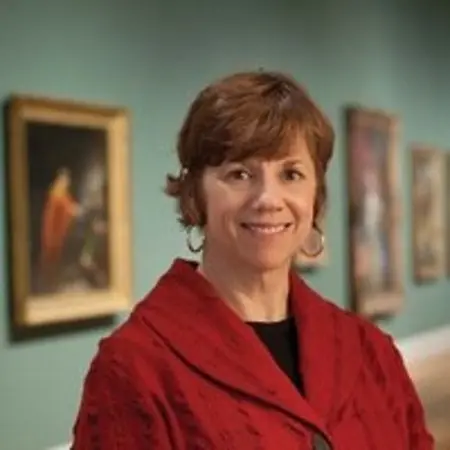
Judith Mann has devoted over 37 years to the St. Louis Art Museum, where she serves as Curator of European Art to 1800. Her journey into art history began unexpectedly when she switched her undergraduate focus from mathematics to art history after taking a required course in the subject. Following graduation, she worked in various roles before returning to graduate school, completing her PhD over a decade while raising her two children. Early in her career, she gained experience teaching at local universities and temporarily filling curatorial positions, ultimately securing a permanent role at the museum, where she fell in love with the work.
Throughout her career, Judith has specialized in exhibition curation and art historical research, with a particular focus on sixteenth- and seventeenth-century Italian art, including Artemisia Gentileschi, Caravaggio, and Federico Barocci. She has curated major exhibitions, such as a project on a seventeenth-century female painter and her father, which has become a key reference for subsequent scholarship. In addition, she organized a celebrated Federico Barocci exhibition that traveled from St. Louis to the National Gallery in London, winning the AAMC Award for Outstanding Museum Exhibition in 2012.
Judith is also deeply committed to mentorship and education. She established a summer internship program at the museum to provide hands-on experience to aspiring art historians and has taught courses in Medieval, Renaissance, and Baroque art at a local university. Beyond her curatorial and teaching work, she actively supports community engagement and accessibility, advocating for free public access and robust museum programming. As she approaches retirement, she continues to focus on one final project, leaving a legacy of scholarship, mentorship, and community impact in the field of art history.
Her Interview
Ten minutes with Judith
01What do you attribute your success to?
I attribute my success to never giving up and being persistent through setbacks. My first major project was canceled or looked like it wasn't happening several times, but I just have an ability to not give up. If something doesn't work one way, I try another. I also learned early on to meet as many people as I possibly could and to ask questions, even though I didn't have much mentorship at the beginning and had to figure things out on my own. I was very lucky in many ways. Luck often plays a role in one's career, but I also figured out the right people to ask for help. My first major project involved working with one of the most eminent people in my field starting in 1995. There was no reason he would work with someone like me because at that point I had no reputation and nothing under my belt. A lot of people thought I was kind of crazy since he was at the Metropolitan Museum of Art, but I said I'd try, and it turned out he was actually interested in my project. That opened a lot of doors for me, and he became a guide and mentor through 2000. I also had advantages like being married to a husband who was willing to support me when I was looking for work, so I wasn't depending on needing to support myself. That's a huge thing that not everyone has.
02What’s the best career advice you’ve ever received?
The best career advice came from a career counselor I saw after getting my PhD when I wasn't finding an academic job for a couple of years. She helped me see that what I should do is think of what I really want to do and maybe put together a few jobs rather than relying on a single position to take me through my career. I didn't need to do this in the end, but that advice about being flexible and willing to put together maybe not quite the single thread career you had anticipated has stayed with me. I also learned through experience that you have to take responsibility and not wait for opportunities to come to you. You need to introduce yourself, ask people to have coffee with you, and be aggressive. I found that most people are rather generous when you ask them for help. You should spread out and not rely on a narrow set group. Try to expand and get to know as many people as you can. Ask questions, ask for coffee, email people when you can, and if you have questions, don't hesitate to reach out.
03What advice would you give to young women entering your industry?
If you can, identify a career counselor and mentor early on. I set up an intern program here at the museum back in the mid-2000s, and I always used to tell the interns to always ask people to have coffee with you and be aggressive. Don't wait for there to be an opportunity. Introduce yourself. You have to take the responsibility and not wait for it to come to you. I find most people are rather generous when you ask them. There are a few who aren't, but in general, I make sure to say that we are all potential helpers to you, so take advantage of that. Get to know people, ask questions, ask for coffee, email when you can, and if you have questions, reach out. Don't rely on a narrow set group. Try to expand and get to know as many people as you can. Think of what you really want to do and what you're passionate about, and make a list of several job potentials to have a wider range of options. Be flexible and be willing to put together maybe not quite the single thread career you had anticipated. You may need to combine part-time teaching with other work. People don't go into this profession to make a lot of money, so be prepared for that. Also, be prepared for initial setbacks. You don't go from success to success to success. Some younger students, particularly very gifted ones, have been used to being rewarded and things coming easily, but when you enter some professions at the beginning, things aren't easy. You have to be committed and keep going and not give up.
04What are the biggest challenges or opportunities in your field right now?
The biggest challenge right now is that it's not a promising moment for museums. Many of them were hit hard by COVID, and a number of museums are still struggling to get back and recoup the losses they suffered. Many museums are making big cuts of staff, so just getting a job is a challenge in itself. Another major challenge is the rising costs of doing exhibitions, which are a key part of what curators do. COVID and now the war in Ukraine have caused oil prices and shipping costs to go up so high that it's hard to do the kinds of shows we used to do. We're really rethinking everything. It used to be you had an idea and looked around the world to think of the best works of art that could play into that theme. Now, at least for American museums, you kind of have to limit yourself to what's available here in the United States. The costs for doing the things we do are going up while museums are very strapped, so they're not hiring as much. There are also fewer grants available now. With the current administration and cutbacks, I got an NEH grant early in my career to visit institutions that had paintings by the artists I was working on, but there are not very many of those grants anymore. Those means of supporting oneself or getting money to do what you need to do are fewer now. Additionally, at my own institution, there's been a change in administration and my area is not valued anymore at the museum. They're cutting back on the space for the art that I work with, which has been tough.
05What values are most important to you in your work and personal life?
Connecting to others is really important to me. A salary or a lot of money has never been something that I wanted to achieve. I think you have to feel that you're making an impact on people's lives, and I actually feel museums do that. The museum I work for happens to be free, and I think it offers a lot to people who can come in and have a very rich experience without needing to worry about spending money to do so. Reaching out to other people and connecting with other people is a really important part of life for me. I feel strongly about giving back to the community. We do a lot of programming for mothers with babies, people with young children, and high school students. I'm on the arts commission for the town I live in, which I feel helps the community. I also serve on the board of another non-profit museum as a way to help. I'm very active in the Midwest Art History Society that mentors younger artists, which is important to me because I didn't have that full opportunity early on when I was forging my career. We're constantly working on how to reach out to people who don't have the advantage of going to schools that help you more than others to advance in your career.
Join Influential Women and start making an impact. Register now.