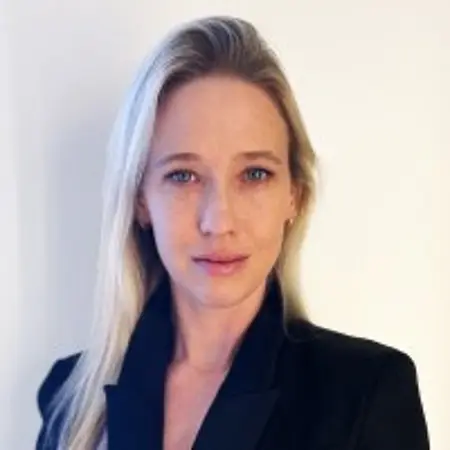
Her Story
About Julia
Julia Dinkel is a policy and social impact professional specializing in clean energy policy, technology, and economics, currently serving as Associate Director of Public Policy at Novogradac & Company LLP in Washington, D.C. In this role, she leads efforts related to renewable energy tax policy, regulatory implementation, and federal energy developments, acting as a subject-matter expert for both internal teams and industry stakeholders. Her work involves tracking complex legislative and agency activity, producing thought leadership, and advising clients on navigating evolving frameworks that shape clean energy deployment in the United States.
Julia’s career reflects a strong commitment to advancing sustainable energy solutions through policy and advocacy. She began her professional journey at Arabella Advisors, where she worked in nonprofit management and philanthropy, before pursuing her Master of Public Policy at Georgetown University McCourt School of Public Policy with a focus on energy and environmental policy. During and after her graduate studies, she gained experience in federal lobbying and energy policy at Massie Partners, where she spent several years developing expertise in legislative strategy, stakeholder engagement, and regulatory analysis. This foundation positioned her to transition into a leadership role focused on renewable energy finance and policy at Novogradac.
Driven by a passion for combating climate change, Julia brings a purpose-oriented approach to her work, emphasizing the importance of translating complex policy into actionable insights for industry leaders. She is actively engaged in the broader clean energy community through professional organizations such as Women of Renewable Industries and Sustainable Energy (WRISE), and regularly participates in industry conferences and events. Through her work, she remains dedicated to accelerating the transition to a more resilient, secure, and sustainable energy future.
Her Interview
Ten minutes with Julia
01What do you attribute your success to?
I attribute my success to pursuing work that genuinely interests me and gives me purpose, while staying flexible and willing to take my career one step at a time rather than trying to force a fixed path.
02What’s the best career advice you’ve ever received?
The best career advice I've ever received is to really try to find something that sparks your interest, that fills you with purpose and gives you meaning. If you can do that, it will inherently lead to better success than doing something your heart isn't in. I refrain from using the hot button word 'passion' because we all can't grow up to be famous singers and astronauts, but the pursuit of finding work you're genuinely interested in is worth it. Every day I wake up and it doesn't feel like a burden or work to read about energy all day, every day, to help the industry and work for the best outcomes for renewable developers around the country. The more specific advice is to take it a day at a time. You don't have to have an exact plan laid out that you update like a strategic plan every few years. Life is complicated and throws you curveballs, so if you take it a step at a time, pursue a path that feels true and right for you, and roll with the punches, adapt, be flexible, think outside the box, and maybe take the job that doesn't fit into the box you previously defined, you could be surprised. I didn't necessarily think I was going to end up at a financial services firm working in energy, but it's the best thing that could have happened to me. I love my current role, it's opened up a lot of doors, I've met wonderful people, and things continue to fall into place. You can't predict everything, and while it's good to have goals and an overarching purpose, like I'm pursuing renewable energy to fight climate change, within that there's a lot of different possibilities and opportunities. I try to leave a little wiggle room and remain flexible in the way that I pursue my mission.
03What advice would you give to young women entering your industry?
I would say be bold, be curious, reach out to people, ask questions, and don't be afraid to put yourself out there. Being in the spotlight and having attention on you can certainly be intimidating and a little nerve-wracking as you get used to it, but the energy industry desperately needs more women. Desperately. The renewables sector specifically is getting better, but we do need more women. We need more creative, flexible thinkers, people that are able to really connect with others. I think one of the things the industry struggles with is connecting with everyday people, so we really need women who can help bridge that gap.
04What are the biggest challenges or opportunities in your field right now?
There are certainly a lot of policy challenges right now. We really need more people that understand energy policy and how to navigate that. But also, just connecting with everyday people is a major challenge. A lot of folks who do not work in this industry are just energy consumers and do not understand the intricacies of where their energy comes from, how it's priced, and the politics behind that. People are typically nervous and afraid of change, so the renewables industry has been plagued often by communities resistant to something new. It really is about community engagement and communication, and helping everyday people understand exactly how energy works, where it comes from, and how that culminates in their utility bills before them, and the types of choices that they can make and how they can participate.
05What values are most important to you in your work and personal life?
The values most important to me in my work and personal life are environmental stewardship and combating climate change, staying grounded in purpose-driven work, maintaining curiosity and flexibility as I grow, and prioritizing clear communication that connects complex policy to real people’s lives and experiences.
Join Influential Women and start making an impact. Register now.