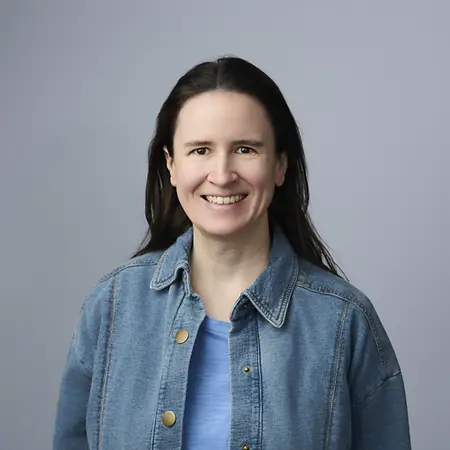
I found grounding by anchoring progress in what I was building and its impact, not recognition. Staying aligned with values and creating enduring work helped.
Julia Parker Goyer · In Her Own Words
Her Story
About Julia
Julia Parker Goyer, Ed.D., Rhodes Scholar is a distinguished education researcher, policy scientist, and founder of Coach for College, a pioneering program that empowers student-athletes to engage in meaningful service, cross-cultural learning, and youth mentorship. Currently serving as a Policy Research Scientist at The College Board since January 2022, Parker designs rigorous program evaluations, conducts advanced statistical and econometric analyses, and translates research into actionable insights that inform education policy and practice.
Parker’s career has been shaped by a long-standing interest in how people pursue goals within institutions—especially how they gain access to college—and why individuals with similar talent can experience very different outcomes depending on context. She founded Coach for College in 2008 after formative experiences in Vietnam and Belize, with the goal of supporting low-income, rural Vietnamese adolescents’ persistence in school through culturally immersive education programs. The model paired bilingual Vietnamese college students with American college-athletes to teach academics, sports, and life skills during intensive summer camps, creating both local relevance and aspirational role models.
As part of her MSc in Comparative and International Education at Oxford, Parker conducted an early evaluation of Coach for College that examined its initial impacts on students’ motivation and risk of school dropout. That work showed promising effects on educational engagement and helped clarify the program’s underlying theory of change—how near-peer role models, structured challenge, and supportive relationships can shift students’ beliefs about their educational futures. She later developed this work into a published book chapter focused on the use of sports and college-student role models to enhance educational outcomes among rural Vietnamese adolescents. In its second year, the program received support through a U.S. Department of State international sports programming grant and continued to grow through partnerships with universities and public institutions.
Over nine years, Parker expanded Coach for College from a pilot with Duke and UNC–Chapel Hill to a program involving student-athletes from more than 35 universities, including institutions that are often athletic rivals. With the support of senior university leaders, the program scaled nationally through the Atlantic Coast Conference and served thousands of Vietnamese youth across multiple regions. It was intentionally designed to be durable: Coach for College continues to operate today under new leadership and adapted even during COVID, when camps were held virtually to maintain continuity and connection.
Parker’s approach to bridging research and practice was shaped early at Duke University, where there was a strong emphasis on knowledge in the service of society, and continued through her doctoral training at Harvard, where she completed a randomized controlled trial of Coach for College in two provinces of Vietnam. She later held postdoctoral appointments at Stanford and the University of Pennsylvania, working across education, psychology, and economics on large-scale field experiments involving tens of thousands of students and multi-institution research teams. During this period, she often stepped into established interdisciplinary collaborations and integrated quickly—learning their data, methods, and institutional constraints well enough to contribute at a deep level and help translate complex analyses into coherent findings.
Several of these research programs are now being extended internationally, including efforts to adapt brief interventions related to social belonging and discipline for secondary schools in the United Kingdom. This work builds on large-scale field experiments Parker conducted during her time at Stanford, often involving tens of thousands of students across secondary and postsecondary settings. She also continues to collaborate with economists and policy researchers on multi-site studies examining how environmental and institutional conditions shape student learning and persistence across educational contexts.
Today, as a Policy Research Scientist at the College Board, Parker works at the intersection of research, technology, and practice, helping connect evidence to decision-making at a system-wide level. Her work draws on longitudinal data covering millions of students and spans the full pipeline from secondary school preparation through postsecondary enrollment. One current line of research examines how college enrollment patterns shifted in the first year after the Supreme Court’s 2023 affirmative action ruling, documenting how high-achieving students from historically underrepresented backgrounds were less likely to enroll in highly selective colleges and instead cascaded into less selective institutions, with implications for long-term educational and economic outcomes. Another project estimates the causal impact of air pollution on student learning, showing that even moderate pollution levels—below current regulatory standards—disrupt academic performance during the school year, with particularly large effects for students in more challenging educational environments.
To support this kind of work, Parker has developed close working relationships with engineering teams and built fluency in data systems and analytical tools, allowing her to bridge researchers with those responsible for stewarding large, sensitive student data infrastructures. This has been essential to supporting national collaborations such as the Admissions Research Consortium and to overseeing the development of a nationally normed “challenge” metric that integrates educational, socioeconomic, and neighborhood-level data to contextualize students’ opportunities. In parallel, she has led data-intensive collaborations with professional organizations in law and medicine, merging decades of applicant data with College Board records and helping develop contextual measures relevant to professional school admissions.
Across her work, Parker’s role has been consistent: translating across disciplines, institutions, and technical domains so that complex systems can produce evidence that is both rigorous and usable. She is currently working on a book and a theory paper that synthesize her founding and research experiences into a broader framework for understanding how institutions create—or constrain—opportunity.
Her Interview
Ten minutes with Julia
01What do you attribute your success to?
I attribute my success to mentorship, disciplined curiosity, and learning how institutions actually work. Early mentors taught me to take ideas seriously while also being honest about the structures required to sustain them. Over time, I’ve learned that persistence matters, but alignment matters more: good ideas need the right pathways, incentives, and supports to take hold. I’ve also learned how to integrate quickly into existing teams and systems—understanding what’s already working, identifying what’s missing, and contributing in ways that strengthen the whole.
02What’s the best career advice you’ve ever received?
Don’t confuse individual effort with institutional support. Several mentors helped me see that success is rarely just about working harder; it’s about choosing environments where effort can compound. That insight has guided how I select projects, build programs, and decide when to push forward versus when to rethink the structure around an idea.
03What advice would you give to young women entering your industry?
Build strong analytical, quantitative, and writing skills, and learn to recognize how different institutional environments shape what strategies are effective. Careers are rarely linear, and progress often depends less on having a perfect plan than on understanding the constraints and opportunities a given environment presents. Seek mentors who both encourage your ambitions and challenge your assumptions, and don’t be afraid to step out of a channel that no longer supports your development. Knowing when to persist, when to pivot, and how to adapt your strategy to context is a critical leadership skill.
04What are the biggest challenges or opportunities in your field right now?
One of the biggest challenges is the gap between the quality of evidence we can produce and institutions’ capacity to absorb and act on it—especially during periods of legal, political, or environmental change. At the same time, there is a major opportunity: unprecedented longitudinal data now allow us to study how policy, context, and institutional design shape outcomes over time. The next frontier is not just better analysis, but better pathways for translating evidence into fair, usable, and responsible decision-making.
05What values are most important to you in your work and personal life?
Bridge-building is central to my work and values—across disciplines, institutions, and systems that shape access to opportunity. For me, effective bridge-building depends on honesty: being clear about what evidence shows, where constraints exist, and what different perspectives actually mean. I look for unexpected connections among people and ideas, especially where shared understanding can emerge without oversimplifying differences. Across my work, I aim to align people, data, and institutions so that evidence can move into practice and expand access to higher education, while prioritizing long-term impact and respect for institutional complexity.
Join Influential Women and start making an impact. Register now.