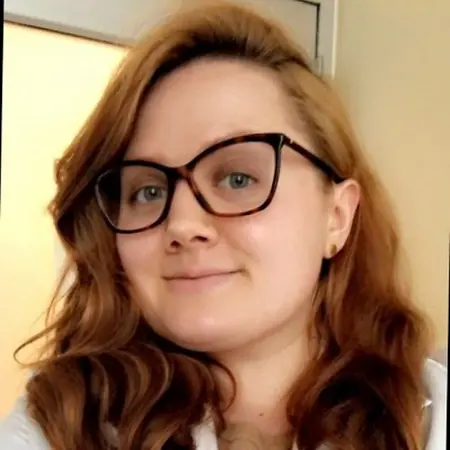
Her Story
About Julia
I grew up in Michigan, and my family is from Chicago. I went to school at the University of Michigan to get my Bachelor's of Science for my undergraduate degree, and then I went to Northwestern University in Chicago to get my master's. I worked as a full-time clinical researcher the entire time I was getting my master's, doing a lot of infectious disease work during COVID. I was a student trying to get my degree, but I was also working full-time and doing HIV, AIDS, infectious diseases work, specifically with a focus on harm reduction and support and care within the LGBTQIA plus community. I also did a lot of volunteer and advocacy work with Planned Parenthood of Illinois for over 7 years, where I had a leadership role as a volunteer and did a lot of work in the advocacy community for reproductive justice and health. I really tried to use my position as a scientist to bridge gaps in healthcare and address really severe health equity issues. When I found out they were looking for a new director of research in Texas, I saw a real need here. They had never had a research department in Planned Parenthood of Greater Texas, so I was asked to come and build a research program here and help patients. That's my whole goal, to reduce health inequities and to try to improve the reproductive health landscape in Texas. A lot of clinical research scientists started out with the hopes that they were going to be a physician. Not very long ago, I did. I wanted to be an obstetrician and gynecologist, but as I got older and I did more schooling, I just saw how truly broken our healthcare system is. I realized that I wanted to work in research and help our patients get better access to care through human research, get our patients free access to healthcare through trials that they're eligible for.
Her Interview
Ten minutes with Julia
01What do you attribute your success to?
I will say, I'm incredibly tenacious. Sometimes the more I get put down, or the more negative experiences I had as a young woman, I would be like, no, this is my dream, and this is what I meant to do. I know that in my heart, and it's just gonna make me fight harder. I will also say I was raised by an incredible single father of two little girls. Both of his daughters are in STEM. My sister is a physician's associate in Women's Health, and I am a Director of Clinical Research in Women's Health. So, I would also say my father, my beloved father, really raised incredibly brave, strong, and determined young girls who went out in the world and did what they needed to do.
02What advice would you give to young women entering your industry?
I know it's hard, but don't ever let someone make you feel like you don't belong, because you do. Generations of women have fought for the right for us to have that seat at that table. Don't ever take up less space than you deserve, even when they tell you to.
03What are the biggest challenges or opportunities in your field right now?
I will say, it's really hard to admit this, but being a woman in STEM is still incredibly difficult. I think there's this perception out there that just because our numbers of women going to college and to graduate school are rising, that things are easier for us. And I really want to say, as a woman in this field who has been in this field for so long, and mentored other young women, I hear so many experiences, and I've experienced my own experiences that rival things I've talked to my grandmother about, that she was experiencing when she was a professional and a leader in her field, in education back in the 60s and 70s. So much time has passed, and we've made progress, but not nearly enough. The importance of getting marginalized voices, so young women, people of color, queer people interested in STEM, and then allowing them a seat at the table, that's what's most important in research. It's not just important that we have diverse groups of people that we're allowing into research studies so that they can get access to that healthcare. It's fundamentally important that we have diverse groups of people as the scientists designing those trials, designing those products, because we can't claim to be advancing in this field if we're still pigeonholing minority and women.
04What values are most important to you in your work and personal life?
Strength of spirit, really, your convictions and your integrity. I work in fields, medicine that is so dominated by the need for integrity and ethics. Research is, we fall under two umbrellas. We have all the regulations of medicine, and then we have all the regulations, the extra regulations of research, so really understanding the importance of having strength in your convictions, leading with integrity and honesty, and doing what is ethically right for your patients. When so much of the world that I'm in has been dominated by, I hate to just say capitalism, but it's true, we have become so far removed by all the new products flooding the market and all of the startups, and it's really about patients. That's who we're trying to serve here, and making sure that we're upholding the highest ethical standards of research and training the next generation of scientists so that they understand the importance of this and continue the work. Because science is wonderful and innovative and fun and exciting, but I believe it needs to have a purpose. And the purpose is to better humanity.
Join Influential Women and start making an impact. Register now.