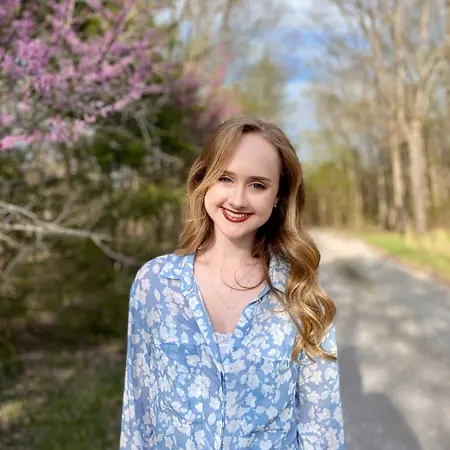
Her Story
About Juliana
Juliana Upchurch is a public health researcher whose work sits at the intersection of global women’s health, policy, and advocacy. She began her academic journey in Tennessee as a pre-med student, initially pursuing a path toward becoming an OBGYN. However, through her studies in organic chemistry and biochemistry, she realized her true calling lay beyond clinical practice. Drawn to broader, systems-level impact, Juliana shifted her focus toward research and public health, where she could influence policy, expand access to care, and empower underserved populations through education and advocacy.
Currently, Juliana serves as a research associate at New York University, where she works closely with Dr. Cheryl Hilton on the development of a forthcoming textbook with Springer titled Global Women’s Health. In addition to contributing as a junior editor and author, she supports a companion course as a teaching assistant, helping to shape and mentor the next generation of public health leaders. Her work spans a wide range of topics, from analyzing U.S. healthcare policy and global programming to exploring complex issues such as pandemic response, generational trauma, and epigenetic impacts on vulnerable populations. She has also contributed to research at Emory University focused on intimate partner violence and gun violence, further deepening her commitment to addressing some of the most pressing public health challenges.
A Fulbright alumna, honors program graduate, and valedictorian, Juliana brings both academic excellence and purpose-driven passion to her work. She has also completed specialized training in Trauma-Informed Clinical Practices through NYU, equipping her with a deeper understanding of how trauma shapes health outcomes across communities. Whether she is conducting research, mentoring students, or contributing to global health education, Juliana is driven by a desire to create meaningful, lasting change. Her work reflects a commitment not only to advancing knowledge, but to ensuring that knowledge is used to uplift, inform, and empower.
Her Interview
Ten minutes with Juliana
01What do you attribute your success to?
I attribute my success to resilience - this idea that exposure to trauma, especially during upbringing, while it can reshape your genetics and brain, also generates this ability to adapt and grow and navigate challenges in a way that people who might not have experienced those same challenges can't. I have this gratitude that I have had experiences that, ironically, have caused me to develop resilience, but that have enabled me to have this consciousness of the struggle I've experienced as a result of that environment, and how that's making me capable of seeking out healthcare for myself, education for myself, and the ability to empower myself, so that I'm not stuck in that same system of perceiving myself in a way that keeps me in a place that is not empowering. I think that desire to share that empowerment with others, especially those who felt disenfranchised, drives me. I feel a very strong, passionate drive to advocate for others, and especially in this environment where so many people have lost their ability to advocate for others, I am so grateful that even in some capacity, I have the ability to help empower people. My heart breaks for people who have to work just to provide for themselves and not because they genuinely love what they're doing and what they're able to create in the world. I truly think that everyone should have the opportunity to feel safe and healthy and happy, and I truly want to be able to actualize that through my work.
02What’s the best career advice you’ve ever received?
The best career advice I ever received wasn't even advice so much as being truly seen and recognized for my talents. I had a professor in undergrad, Dr. Lawrence, who taught history of medicine at the University of Tennessee, Knoxville. She was this incredible, powerful force in the classroom, dressing in her Chanel suits, very authoritative when it came to her intellect and talent. One time in her office hours, she sat me down and said, 'Juliana, what are you doing here?' She told me she read my work and didn't know what I was doing there and not somewhere like Yale, and that with my talent, I could be doing anything. For the first time, I had been told by someone that they recognized my talent - my skill and my ability to use my intellect to form cohesive thoughts, develop argumentation, and solve organic chemistry synthesis problems. I had never seen myself that way because of my inferiority complex and imposter syndrome that so many people experience. It was this strong, unapologetic woman who was so intelligent, talented, and driven - her seeing that value in me really inspired me to not only embrace that self-acknowledgement, but to seek out ways to empower other people with that same empowerment, because it makes you so much happier to finally acknowledge that you are very talented in specific areas, that you have skills, and that you can actually use these skills to make change.
03What advice would you give to young women entering your industry?
It's going to be hard, but do it anyway. It does get easier over time for women working to enter fields where it involves taking on power, because empowerment means stepping up and taking space. If you're working in a field where you're advocating for people who, especially increasingly, people in positions of power don't want those people to take up space or to feel empowered, you have to fight against those internal drives, but you also will have to fight against them externally. If you are looking to feel empowered, not just individually, but if you're looking to empower your community and yourself, and you're looking to make the world a better place by your individual passions, one publication at a time, one job at a time, know what you're getting into - but don't be afraid. There are other women in the area, there are other people in the area and in the world who are there to support you, and if we weren't making progress, people wouldn't be so angry about the progress we're making. There is hope. Joy is resistance, and I think to take joy in the work you're doing to fix the problems that you see in the world is something so subversive, but so fun, so whimsical - to say, you know what, in the face of all this oppression, what I'm gonna do is I'm gonna choose to imagine a better world, and I'm gonna have the audacity to try to enact change to make it that way, because I have power, and I can make change.
04What are the biggest challenges or opportunities in your field right now?
I would say this last year has been really, really challenging as a whole, because one of the most integral parts of public health and being able to make effective changes is being able to actually materialize knowledge in the form of policy and policy enforcement. Our aim is to protect the public in some way, and that requires funding, that requires trust, that requires the perception of value in the work that's being done to protect the public. Over the last year, we've seen a significant decline in trust in institutions hoping to help people, but not only that, we've seen a decline in the perception of value of that work and research being done. We see measles outbreaks happening and children dying, and people are sticking to their ideology and rhetoric, rather than acknowledging that there is an on-the-ground issue that needs to be actively pushed back against, and those people are dying for no reason. There's this sort of cognitive dissonance that's happening on not just a national level, but internationally, between people's understanding of prioritizing themselves and their communities over a broader subscription to some ideology that benefits someone other than working-class people. The biggest challenge is knowledge of policy and procedures, and being able to actually materialize that knowledge into effective change when trust and funding are declining.
05What values are most important to you in your work and personal life?
First and foremost, respect. I know with Gen Z people in the workforce, they have this really hard time with people equating the expectation of respect with entitlement, but really, the expectation of being respected, of wanting to be treated as a person with equal value as a human being - with the right to be sick, with the right to want to spend time with their family, with the right to be spoken to in helpful and developmental and transformative ways, rather than in exploitative ways - that's what respect means. That very core understanding of what respect means comes from growing up in working-class families and seeing the way that our parents were worked to the bone, seeing our parents come home and fall asleep sitting in chairs because they're so tired and they don't get to enjoy their life outside of work. Really valuing that peace and protecting that peace is a really core principle of mine - respecting yourself and your right to have those things, but also respecting others and their right to their own autonomy and agency. Mind your business. I think that so many people are obsessed with policing other people when they should be minding their business. Why are you obsessed with what everyone else is doing? Do you not have something else to do?
Join Influential Women and start making an impact. Register now.