Her Story
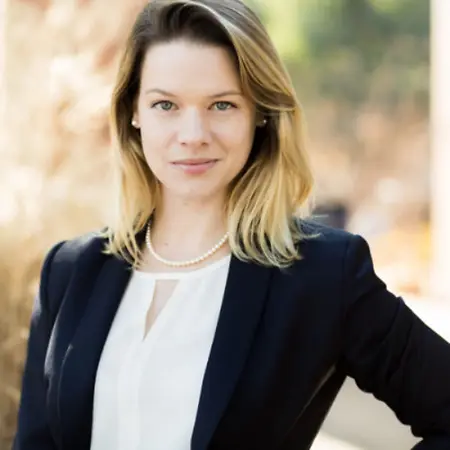
About Juliet
I've spent my entire 14-year career at Microsoft, which makes me one of the rare breed who has stayed with one company throughout their career. I've always worked in the software industry, and for the past two and a half to three years, I've been serving as a Business Outcome Specialist and Strategic Partnership Lead, though I describe what I do as essentially being a strategy consultant. I work mostly in AI these days, helping to articulate the business case of AI - what is the ROI, what is the cost and benefit, and how companies can take advantage of it. My ideal day involves sitting down with the C-suite of a company and facilitating strategy workshops where we articulate what they want to accomplish in the next one to three years. I help them tie their North Star vision to specific strategies, then identify how AI can be applied to their challenges and opportunities, ensuring everything connects to measurable KPIs and OKRs. I work exclusively with high-tech clients, from ISVs and startup companies to larger customers like Adobe, Salesforce, and ServiceNow, and even AI companies themselves. Before this role, I worked in cloud economics, helping companies understand the value of moving from on-premise technology centers to the cloud and why that makes dollars and sense. I also create assets to help educate the field sales teams that nominate clients to work with me, and I only work with clients when our field sales team brings them to me.
Her Interview
Ten minutes with Juliet
01What do you attribute your success to?
I attribute my success to hard work and dumb luck, honestly. I've always had a strong work ethic as part of my core ethos, and I'm very intentional about learning and being open to trying new things. In my world, you kind of have to be constantly learning because there's always something new happening. But dumb luck is very real too - like working at Microsoft when AI blew up and we happened to be in the front running of that. Microsoft was not cool when I joined, let me be very clear, but then we ended up being one of the founding investors in OpenAI. I didn't plan it out this way, and I think if you look at most people's level of success in their careers, most people are like, yeah, I didn't plan it out this way. So it's really about putting the effort in to make things good, being intentional about learning, and then also being in the right place at the right time.
02What’s the best career advice you’ve ever received?
One of my mentors really early on in my career told me, 'Microsoft will take up as much oxygen in the room as you let it, and you have to decide if it's going to choke you or not.' It was a strong analogy, but it was very much around intentionally choosing how much you're going to take on and how much you're going to let be forced upon you. It's about choosing your boundaries, choosing your expectations, setting them, and keeping them. Especially as a younger person in your career, you kind of don't feel empowered to say no, but this advice reminded me that this is your life and you get to choose. You get to choose how much your career is going to take up space in the room of your life. Know when to say no, know when to step back, and know when that flux comes and is necessary. It might be okay for your career to take up more of your life in some phases and not in others, and that's okay. But you get to choose your boundaries and keep them, regardless of what your company or your boss or whoever makes you feel like you should or shouldn't be doing. At the end of the day, yes, there are consequences for the boundaries that you do or do not choose, but it's still your choice. It's still your life.
03What advice would you give to young women entering your industry?
I would say focus on your skills, and focus on what I would call uniquely human skills. As we look to the future of AI disrupting the workforce, which it will, humans will always be working but they will be working differently into the future. So for women entering the field right now, focus on the skills that you bring and be able to articulate them. Focus on your human skills, focus on the soft skills - I think that's really important. I would say, particularly for the generation entering the workforce right now, they have a huge disadvantage in soft skills because the pandemic happened. That's just a reality for them. They were kind of done a disservice by way of communication, collaboration, and things of that nature, because that was kind of taken from them. Fair or not, they need to own the reality of that. Those who are intentional about building those skills up and using that in addition to their technical skills and building their AI skills up are going to be the most successful into the future.
04What are the biggest challenges or opportunities in your field right now?
I think the biggest challenge and opportunity in my industry right now is the pace of innovation. Every few weeks, we have a different language model, every few weeks we have a different breakthrough in what technology can do right now. It's just a crazy time to be in the technology industry, to be in the AI industry. The pace of innovation is incredible, and it's really hard to keep up because everything is happening so fast. But that's also the opportunity - it's the opportunity not only for where I work and supporting Microsoft, but also for my clients who work in technology as well. Your opportunity to create totally new experiences for your clients and make their lives easier and make things better is so high right now. It's moving very fast, so there's this cool opportunity to create things that never have been possible previously. But then the challenge is just keeping up with that, and the stress and the risk of, like, what if I create something now and then it's purely obsolete in six months? That's real. You just gotta take the jump, you gotta do something and then just trust that you'll iterate as you go. And then, of course, the social responsibility that goes along with that is also a very big topic - how do you make sure the bad doesn't outweigh the good?
05What values are most important to you in your work and personal life?
One of my core values is authenticity, and that goes for me in personal life and work life - just being authentic. I work in a consulting and sales world where it can be really easy for people to be inauthentic as a way to sell something or to manipulate people, and one of my core values is I just never want to be that way. I always want to look at myself in the mirror and feel proud. The way I think about that at work is with my clients - I don't know why, but in my head, my North Star is I always want to be able to walk into your lobby. I always want to feel okay walking into your company and not feeling like, oh crap, they're gonna kick me out or they're really upset at me. I'm very authentic of, like, I think this is gonna be good for you, I think this is gonna be bad for you, or if I'm being honest, I have no idea. I very much appreciate and value that in others that I'm working with. I also care about people - people are a big deal to me. I care a lot about the social impact and the climate impact too. For me, it's definitely an 'and' - I hope and believe that there are others like me out there that have the same mission.
Join Influential Women and start making an impact. Register now.