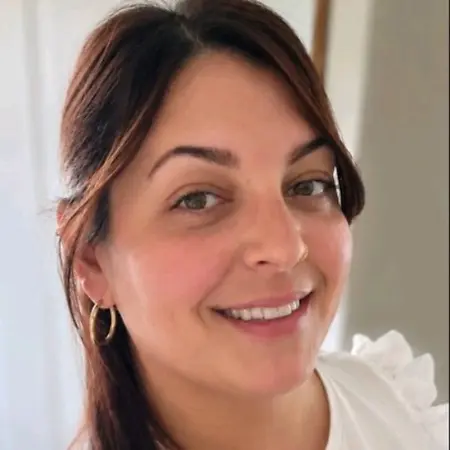
The hardest business decisions aren't about numbers. They're about knowing when to take the next step and trusting yourself enough to do it before you have all the proof.
Kadie Jeziorowski · In Her Own Words
In Conversation
Kadie Jeziorowski for Bold. Brilliant. Unstoppable.
Read the transcript
Kadie Jeziorowski: Being an influential woman means having a positive impact on the women around me, whether they're younger than me, older than me, or standing beside me in the same season of life. If something I've done, said, or shared gives another woman the confidence to take a chance on herself. Or to pursue a new opportunity or to speak up or step into something that scares her, that really means more to me than any title ever could. I believe it's an incredible honor to be considered as an influential woman, because I think as women, we spend so much time working towards the next goal, breaking barriers, building careers, taking care of people, and proving what we're capable of, that sometimes we forget to stop and recognize the impact that we're having along the way. Influence isn't necessarily about being the loudest person in the room or having the biggest platform. Sometimes it's simply showing another woman what's possible.
What's one piece of advice you would give to younger women chasing their dreams?
Kadie Jeziorowski: One piece of advice that I would give to younger women chasing their dreams is simple. Go for it. Don't let fear convince you that you're not ready. Being scared doesn't mean you're making the wrong decision. It often means you're stepping into something that matters to you. Don't count yourself out because you think you don't have enough experience, the right degree, or all the qualifications that are required on paper. Don't mute your voice. Do not make yourself small to make other people feel comfortable. Your dreams belong to you, and ultimately you're the one who has to be brave enough to pursue them. I would much rather try, fail, learn, and try again than spend my life wondering what might have happened if I had just taken the chance.
Her Story
About Kadie
Kadie Jeziorowski is a healthcare professional, business development leader, and emerging technology innovator with more than 11 years of experience spanning clinical rehabilitation, home-based care, healthcare operations, durable medical equipment, mobility technology, patient advocacy, and strategic business development.
A Licensed Physical Therapist Assistant, Kadie began her career working directly with patients in rehabilitation, developing a firsthand understanding of the physical, functional, and systemic challenges people face when trying to maintain their independence. Over time, her career expanded beyond clinical care into healthcare operations, leadership, community relations, business development, mobility technology, and the navigation of increasingly complex healthcare and benefit systems.
Today, Kadie's work crosses several areas of healthcare and innovation. As Director of Business Development for Nuclear Workers Alliance, she helps connect former nuclear workers and their families with healthcare services and resources available through federal benefits programs. Kadie also serves as Director of Operations for KoreTask.ai, where she is part of the founding team developing a new approach to household management. KoreTask combines dedicated human support with thoughtfully integrated artificial intelligence and technology to help individuals and families manage the everyday responsibilities that consume time, energy, and mental bandwidth. Her role includes helping shape the service model, operations, community outreach, market positioning, and the practical integration of AI into a highly personalized human service.
Her interest in technology is rooted not in replacing human interaction, but in identifying where technology can remove unnecessary complexity. She is particularly interested in how AI can support people behind the scenes—helping organize information, remember preferences, coordinate schedules, reduce repetitive administrative work, and allow professionals to spend more time on the work that requires human judgment, creativity, and connection.
Throughout her career, Kadie has consistently gravitated toward gaps in existing systems: people who need help but do not fit neatly into traditional healthcare models, individuals struggling to understand complex insurance or benefit programs, and families trying to maintain independence without necessarily needing traditional caregiving. Her ability to combine clinical knowledge, operational experience, business strategy, relationship-building, and emerging technology allows her to approach these challenges from multiple perspectives.
Community education is also an important part of her work. In 2026, Kadie created and hosted the Lifestyle & Longevity Forum, bringing together professionals from healthcare, insurance, finance, rehabilitation, technology, and other community resources to make complicated topics more accessible and encourage meaningful conversations about how people can better prepare for the future.
Kadie earned an Associate of Applied Science in Physical Therapist Assistant studies from Professional Skills Institute in Toledo, Ohio. Across each of her roles, she remains focused on a common goal: finding practical, innovative ways to make complicated systems easier to navigate while helping people maintain greater independence, choice, and quality of life.
Her Interview
Ten minutes with Kadie
01What do you attribute your success to?
I attribute much of my success to curiosity, persistence, and a willingness to step outside of my comfort zone. I have never been someone who is satisfied with simply knowing my own piece of a system—I want to understand how all of the pieces work together, where the gaps are, and how we can make things better.
I am also genuinely motivated by helping people. Whether I am working in healthcare, mobility technology, business development, or emerging AI solutions, I tend to gravitate toward complicated problems and people who are struggling to find the right information, resources, or support.
I have built my career by asking questions, building relationships, learning from people with different areas of expertise, and being willing to speak up when I think there is a better way to do something. I think my success has come from that combination of compassion and problem-solving, the ability to care deeply about the person in front of me while also looking at the larger system and asking, “How can we do this better?”
02What’s the best career advice you’ve ever received?
One of the best pieces of career advice I’ve learned is to listen—really listen—to people. Too often, especially in business development and sales, the focus becomes telling someone what you offer or looking for the opportunity to make a sale. I’ve found that the better approach is to first understand the person in front of you: What is their problem? What do they actually need? What are they struggling with?
When you listen first, you can focus on finding the right solution rather than trying to make your solution fit every situation. Sometimes that may lead to your business or service, and sometimes it may mean connecting them with someone else entirely. I think people recognize when you are genuinely trying to help rather than simply trying to sell them something.
Compassion is a big part of that as well. Whether I’m working with a patient, a family, a healthcare professional, or a business partner, I try to remember that there is a person behind every problem. Listening, understanding, and leading with compassion have probably influenced my career more than any single piece of traditional career advice.
03What advice would you give to young women entering your industry?
Don’t decide you’re not qualified for an opportunity simply because it feels unfamiliar or intimidating. Some of the biggest growth in my career has come from stepping into roles where I didn’t already know everything and trusting that I could learn. Ask questions. Listen to people who know more than you do. Be willing to admit what you don’t know, but don’t confuse not knowing something yet with not being capable of learning it.
I would also encourage young women not to feel like they have to stay in one lane. Your experience can translate into places you may not initially expect. My own career has moved through clinical care, operations, business development, mobility technology, and emerging technology, and each experience has made me better at the next one.
Take calculated risks, build genuine relationships, and don’t automatically talk yourself out of the room. You may not feel completely ready when the right opportunity comes along. Sometimes you become ready by saying yes and figuring it out
04What are the biggest challenges or opportunities in your field right now?
One of the biggest challenges—and opportunities—I see in healthcare is recognizing when a common problem has become so normalized that people stop looking for a better solution. Healthcare tends to operate within established systems, reimbursement models, and traditional service categories, but people’s real-life needs do not always fit neatly inside those boxes.
I think there is a tremendous opportunity for professionals who are willing to pay attention to those gaps, understand emerging technologies and new models of service, and ask whether there is a better way to solve the problem.
That may mean new mobility technology, a different approach to supporting people at home, better ways of navigating complex benefits, or using AI to reduce the everyday workload that consumes people’s time and energy. The technology itself is not necessarily the innovation—the innovation is recognizing a problem that has not been adequately solved and finding a practical way to address it.
I think the challenge is being able to identify which new ideas truly improve people’s lives versus adopting something simply because it is new. The opportunity is enormous for people who can understand both the human problem and the emerging tools available to solve it.
05What values are most important to you in your work and personal life?
The values that matter most to me, both personally and professionally, are integrity, kindness, humility, authenticity, and accountability. I have a tremendous amount of respect for people who can be successful, intelligent, ambitious, and innovative while still being compassionate and treating people well. I don’t believe strong leadership and kindness are mutually exclusive.
I also value honesty and follow-through. I try to be someone who shows up, does what she says she is going to do, and is willing to have difficult conversations when they are necessary—but to do so respectfully and fairly. I would rather be genuine and direct than tell someone what I think they want to hear.
And I’m very intentional about what I’m willing to be part of. I don’t believe in bad business, short-term wins at someone else’s expense, or sacrificing people for profit. Whether it’s in my career or my personal life, I want to surround myself with people who are kind, supportive, humble, driven, and positive. At the end of the day, I want people to be able to say that I’m a good person, that I have a good heart, and that they can count on me.
Join Influential Women and start making an impact. Register now.