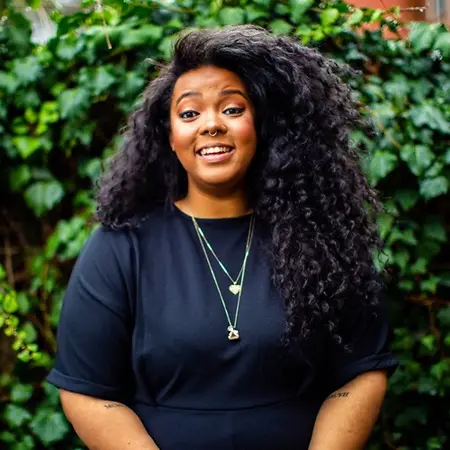
Influential Woman · Neuroscience nonprofit
Kaela S. Singleton
PhD
Director of Grants Management, Cure Alzheimer's Fund
Austell, GA
Her Story
About Kaela
I don't come from a family of scientists, so any achievement I have that allows them to understand what I do better is really meaningful to me. Being featured in Forbes 30 Under 30 in the science category was a really big day for my family to understand the impact and work that I do. More recently, I was featured in Vox Media's Future Perfect 50, which is about imagining a better future for a greater world for all of us. These recognitions help my family see that the sacrifices they made are worth it. What I love most about my career is being at the forefront of scientific discovery, getting to read someone's super preliminary data in their grant and how they think that's going to lead to drug development. The other thing I love is communicating science to the public, talking to people about their experience with Alzheimer's disease that affects millions of people, and feeling like I'm playing a part in untangling that mystery. Getting to be part of educating the masses on what's going on and explaining really complicated processes is incredibly fulfilling.
Her Interview
Ten minutes with Kaela
01What do you attribute your success to?
I attribute my success to a lot of hard work that I put into what I do, and a lot of sacrifices from myself and my family. But I also attribute some of it to the beautiful naivety and luck of being the first person in my family to go to grad school and be interested in science. I don't attribute it to just one individual, but I think I had support from a lot of people. If I had to choose one person, I would probably say my dad, in everything that he has sacrificed and done for me. He constantly reminded me that I could do hard things and to put myself out there. He uses a sports analogy and frames it as shots on goal - you have to take as many shots on goal as possible, you have to believe in yourself, and every shot on goal you take is you getting a step closer to making the basket, making the goal. If you give up or stop, then you're never going to get there. So it's really about hard work and fortitude in general, and believing in yourself that you can do something.
02What’s the best career advice you’ve ever received?
The best career advice I ever received was probably from Legally Blonde, a movie I watch before I have to do anything challenging or just need a pick me up. It's quite simple, "don't forget to always have faith in yourself."
03What advice would you give to young women entering your industry?
I would tell them to make sure that they find their people, whether that's folks in their program, people that they network with online, me, whoever it is. You really can't get through science without a network of support, and it can make all the difference beyond just your family and your official mentor or boss. So finding community, I think, is the most important thing that you can do.
04What are the biggest challenges or opportunities in your field right now?
I think the opportunities and challenges are connected. The challenge is instability in federal funding, like the priorities of NIH or NSF. But that gives us, really, as an organization, our greatest opportunity to give bridge funding to investigators who need it, to try and give money to early career researchers, and provide a place of community and support, but also keep the field going as a whole.
05What values are most important to you in your work and personal life?
There's overlap in the values between my work and personal life. I'm a really big lover of accountability, of trust, of respect, of mutual aid. I believe in the idea that everybody has basic human rights that should be met and needed. The way that shows up in science is that sort of obligation to explain what taxpayer money is funding and to circle back to the public to say, this is what your $2,000 to the NIH did for us. Accountability has always been a really big one for me, and I think that's one that sticks out across everything. But I also think fun and whimsy are values that I very much have. I think that sometimes we're all a bit too serious, and that life is meant to be enjoyed, too.
Join Influential Women and start making an impact. Register now.