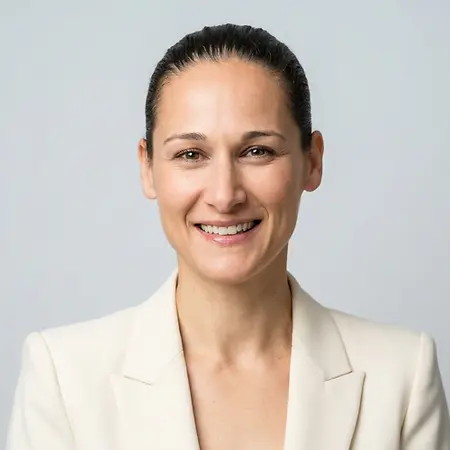
Her Story
About Karen
Karen Rohrkemper is a seasoned telecommunications executive and Chief Operating Officer at Arium Networks, with more than 25 years of experience spanning sales, product management, infrastructure construction, network operations, engineering, and technology leadership. She assumed the COO role following the company’s divestiture from Crown Castle and is focused on leading operational execution through exceptional teams during this next phase of growth.
In her current role, Karen is driving on-time, on-budget delivery of infrastructure projects, strengthening alignment to customer outcomes, and elevating financial acumen across the organization to enable scalable, sustainable growth.
Karen’s career path reflects both nontraditional beginnings and consistent progression. She began selling cell phones in a mall for Cincinnati Bell Wireless while working through college, building a strong foundation in customer engagement and operational discipline. She advanced into product management and ultimately led the company’s wireless data product organization through its exit from the wireless business in 2014. She then led the wirelins business' major fiber expansion initiative, scaling deployments from 10–20k homes annually to more than 100k homes passed in a single year, while maintaining oversight of legacy copper networks and network transformation initiatives.
Following this success, Karen joined Crown Castle, where she led connectivity initiatives across fiber enterprise solutions, venues, and small cell networks. During a period of significant organizational change and multiple executive transitions, she successfully guided large teams through transformation while maintaining strong performance to deliver for the customer, low attrition, and high employee engagement.
Karen also serves as a Board Member for Warriors4Wireless, reflecting her commitment to workforce development and industry advancement. She holds a bachelor’s degree from Northern Kentucky University and is recognized for her ability to combine strategic vision with hands-on operational leadership.
Her Interview
Ten minutes with Karen
01What do you attribute your success to?
I attribute my success to two things: people believing in me, sometimes before I fully believed in myself, and a relentless work ethic.
One of the biggest influences in my life is my dad—he’s the hardest-working person I know. From him, I learned that you can’t control most things, but you can absolutely control how you respond. If you put your head down and do the work, you can get through just about anything.
Throughout my career, there have been moments where I know I wasn’t the most qualified person in the room. But I was always willing to outwork everyone else. I’ve told people directly, “I can’t promise I’ll be the best, but I will work harder than anyone else here.” That’s the one thing I can control.
I’ve also been fortunate to have leaders take a chance on me. And for me, success has meant honoring that bet—showing up every day and doing everything I can to deliver on the trust they placed in me.
02What’s the best career advice you’ve ever received?
The best career advice I’ve received is to stay humble and stay flexible.
Early in my career, I looked at senior leaders and assumed they had everything figured out. What I’ve learned over time is they don’t—they just have more experience navigating both success and mistakes, and they’re more balanced in how they handle uncertainty.
For me, humility means constantly asking, “How can I show up better tomorrow?” That applies to everyone around you—your team, your peers, and your leaders. The willingness to listen and learn at every level is what allows you to keep improving.
The other piece is flexibility. Careers rarely follow a straight line. You may start in one direction and find yourself taking a completely different path—and that’s okay. Companies change, leadership changes, strategies shift, and challenges like restructuring happen.
You can’t control all of that, but you can control how you respond. If you’re willing to adapt, embrace change, and look for opportunity in those moments, you’ll come out stronger on the other side.
03What advice would you give to young women entering your industry?
My biggest advice is to intentionally build a strong and diverse network—and not just in the traditional sense.
Surround yourself with people who think differently than you, who have different experiences, and who challenge your perspective. That can mean different industries, different education paths, different life experiences, and people you don’t always agree with. It’s not just about diversity for the sake of it—it’s about breadth of thinking.
What I’ve seen is that many people build very linear networks—people who went to the same schools, followed similar paths, and have similar viewpoints. That works until life doesn’t go according to plan. Careers shift, companies change, challenges come up—and when that happens, having a narrow network can limit your options.
What has made a difference for me is having a wide range of people I can lean on—individuals who have seen different things and can offer different perspectives. That diversity gives you more ways to navigate change and more doors to walk through.
It also creates opportunity. The broader your network, the more likely you are to hear about paths you never would have considered—but that might be exactly the right next step.
04What are the biggest challenges or opportunities in your field right now?
One of the biggest challenges in our field right now is the pace of change. Across the industry, we’re seeing continued M&A activity along with shifts in leadership and evolving strategic priorities. As organizations adapt, it naturally creates changes in direction and execution focus.
While that can create opportunity, it also introduces a level of disruption. Keeping teams stable, engaged, and confident through periods of uncertainty can be challenging. Both within organizations and across the broader ecosystem, people are moving roles more quickly, and that can impact continuity and momentum at important times.
Another major challenge—and one I’m personally passionate about—is building the future workforce, particularly bringing more women into the industry. This isn’t something that can be solved at the hiring stage alone. It has to start much earlier—junior high and high school—when people are first forming their views on career possibilities.
If we want infrastructure, construction, and telecommunications to look meaningfully different 20 years from now, we have to invest in that pipeline today. It’s a long-term effort, but it’s critical to the future of the industry.
05What values are most important to you in your work and personal life?
The value that matters most to me—both personally and professionally—is simple: be a good human. It’s what I tell my kids all the time. I don’t care what you do, how you perform, or what grades you get—what matters is how you show up for other people.
For me, that means living with a mindset of service. It’s about giving more than you take and showing up consistently for others in a genuine way. When you do that authentically—not forced or performative—people feel it. And when people trust your intent, they’ll go above and beyond alongside you.
I’ve seen that play out both personally and professionally. Whether it’s family, friends, or teams at work, if people see you willing to roll up your sleeves, do the hard things, and never act like you’re above the work, they’ll run through walls with you.
For me, the greatest fulfillment comes from doing for others—and especially in the toughest moments, when it requires personal sacrifice. If more people led that way consistently, we’d solve a lot of problems—at every level.
Join Influential Women and start making an impact. Register now.