Her Story
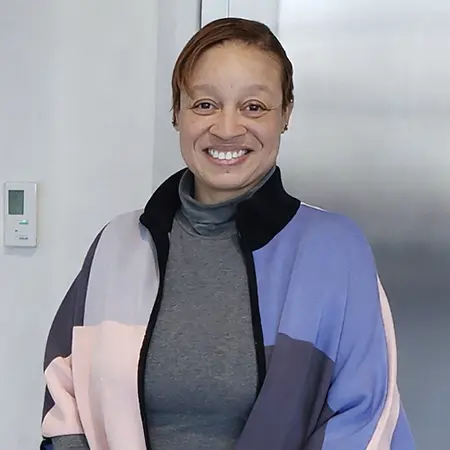
About Karesa
Karesa Leverette is a seasoned transportation operations leader and United States Marine Corps veteran with a career built on perseverance, leadership, and continuous professional growth. She began her transportation career in June 1996 as a bus operator and steadily advanced through progressively responsible roles including station manager, train operator, and interlocking operator, a role comparable to a yard master responsible for coordinating rail movements and maintaining operational safety and efficiency. Her early career reflects her commitment to working from the ground up, gaining deep operational knowledge of transit systems while delivering dependable service to the communities she served.
At a pivotal point in her career, Karesa chose to pursue a path of service by transitioning into law enforcement through enlistment in the United States Marine Corps, where she took a leave of absence from her transportation career. During her military training, the events of September 11 profoundly changed her trajectory and reinforced her sense of duty and resilience. After being honorably and medically discharged due to an injury sustained during service, she redirected her focus back to transportation, demonstrating adaptability and determination. She returned to her transit career as a training instructor, where she helped develop the next generation of transit operators while sharing her operational knowledge and field experience. As she approached 10 years from retirement, she chose to continue contributing to the organization by transitioning into a Rail Quality Control Officer role, where she conducted operational audits and ensured compliance with safety and performance standards, ultimately retiring from that position after 27 years of service at age 49 and a half.
Although initially planning to remain retired, Karesa’s passion for transportation led her back into the industry when she joined RATP Dev USA. She began as an Operations Supervisor working in the control center, where she gained experience with light rail systems, including learning about catenary power systems and the operational similarities between light rail and heavy rail transit. Within a year, she was promoted to Operations and Training Manager after demonstrating the ability to successfully oversee both functions in support of organizational needs. When the Director of Operations was temporarily unavailable due to medical leave, she was subsequently named Interim Director of Operations. In this role, she works closely with the general manager to ensure contractual obligations are met for clients while mentoring staff, delegating training responsibilities to team members she has developed, and continuing to drive operational excellence, safety, and service reliability. Karesa remains committed to advancing within transportation leadership roles while supporting the growth and success of the teams and communities she serves.
Her Interview
Ten minutes with Karesa
01What do you attribute your success to?
I attribute my success to a genuine interest in what I do. I genuinely like transportation, and I like to know something well enough to teach it. I didn't realize how much I actually knew about transportation until I came to this company after doing 27 whole years at my previous employer. When I came here, it was so different, and all I had was the knowledge and experience I gained from those 27 years, and I realized, like, that's a lot! I know a lot! I shocked myself. The fact that I not only learned a lot along the way, but that it made sense and helped me do well here, helped me realize that rail transportation is rail transportation. There are some things that are consistent throughout it. You vary by your source of electricity, your source of power, some of the components on the vehicle are different, but that gave me confidence to feel like I got this, I can do this. It's like languages are different, but numbers are the same type of realization. This is one big thing that I know and I'm familiar with.
02What advice would you give to young women entering your industry?
There are three main things I would tell her. First, always walk in a room and hold your head up and be confident. No matter what you feel on the inside, nobody can see your feelings. They see what you display on the outside. So walk into a room and hold your head up, be confident in your purpose for entering that room, and that is every single room you walk in. Second, stand strong in your integrity and don't let your integrity be compromised. And most importantly, be confident in what you know, and don't be scared to ask a question about things you don't know. Always be willing to learn. I think a lot of times, as women, we want to come off as being strong and knowledgeable, so we feel like not knowing is a weakness, but we all didn't know something. Everybody had to be taught everything they know, no matter how they learned it. So be confident in what you know, and don't be scared to learn more. Don't be scared to ask the question. Asking the question doesn't make you stupid. It makes you smart, because you want to learn. Be confident in who you are, never compromise your integrity, walk into a room confident with what you bring to the table, your purpose for being there, and don't be scared to ask the questions.
03What are the biggest challenges or opportunities in your field right now?
My greatest opportunity was coming here to DC Streetcar. After working my whole career and thinking I was finished, this has been my greatest opportunity. My first employer was very structured and did things a certain way for a certain reason, so it was hard to introduce your personality and your way of things, your idea of doing things. When I came here, there was not as much structure, so there comes the opportunity, but there also comes the challenge. Most industries rely on software to do things, and there were a lot of ideas I had that they were like, great, how you gonna make it happen? So now I'm challenged to engineer it also. I've learned so much about Excel and created things in Excel. My challenge has been to show and prove, okay, you have this great idea, how you gonna make it happen? So, as simple as that sounds, it's like, goodness gracious, how do you take an idea and bring it to fruition? In one of the training classes I had, one of the ladies asked me what I think my proudest moment here was at this company, and I said, you know, I'm glad I did not lie on my resume, because this company has tested every last one of my skill sets.
04What values are most important to you in your work and personal life?
Integrity is most important to me. I stayed steady on my course and stayed true to who I was throughout my career. Even when I got turned down for job after job because the quote-unquote favorite female got it, I just had to duck my head and tuck my tail between my legs and keep doing what I was doing with the same pride and integrity that I was doing it with. I didn't compromise who I was. I stayed true to my integrity and didn't say, oh, well, if she's sleeping around and she got it, maybe I should sleep around too. I stayed dedicated to my path even when it looked like it wasn't going anywhere and people were moving up around me, beside me, and in front of me. I hope it inspires others to find a path and stay dedicated to it, and don't blow wherever the wind goes. Have a purpose about yourself. I'm not a braggadocious person, I'm a very humble person, and I'm willing to help. These qualities matter and make a difference.
Join Influential Women and start making an impact. Register now.