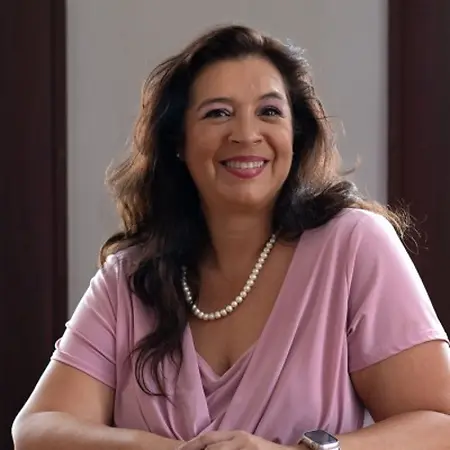
Her Story
About Karina
My caregiving journey began when I was young and agreed to help my grandfather care for my grandmother who had Alzheimer's. About two and a half months after arriving, my grandfather had a stroke and ended up in a wheelchair with a speech impediment, so I found myself taking care of two older adults just three days before I turned a certain age. Years later, my first husband presented with a chronic disorder a year into our marriage, and I spent the next six years caring for him through hospitalizations, disability, and health crises. After my dad died of a stroke, I cared for my mom in my home, supporting her through depression that my dad had hidden and then through five bouts of cancer before she passed. I've experienced caregiving as a granddaughter, as a spouse, and as an adult child, so I can truly empathize with people because I've been there. These experiences, combined with witnessing tragic end-of-life situations at a young age, made me realize there has to be a better way to deal with aging and caregiving. That passion led me to earn my PhD in Health Promotion and Gerontology in 2004, along with an MBA. I've spent my career in public health, including running the HIV and AIDS department for the state of Texas and serving as diabetes coordinator for the city of Austin. Now I focus on architecting people's longevity, helping them design the next 30 years of their life through my books, workbooks, hospital programs, family consultations, and speaking engagements. I'm driven by two main things: making sure one medical crisis does not become a generational financial crisis, and helping people understand that the greatest gift they can give their family is to make choices over their own life themselves.
Her Interview
Ten minutes with Karina
01What do you attribute your success to?
I think it's listening and holding space for people. When you truly listen and create that space for others to share their concerns, their fears, and their needs, you can really understand what they're going through and provide the support they need. It's not about telling people what to do, but about being present with them and helping them navigate their own journey.
02What’s the best career advice you’ve ever received?
Follow your passion. Money will follow. I truly believe that if you pursue what you're passionate about, the financial success will come naturally. You can't just chase money - you have to have that genuine passion for what you do, especially in a field like mine where you're dealing with difficult conversations and challenging moments. When you come from a place of passion, you're able to approach everything from the heart.
03What advice would you give to young women entering your industry?
You have to have a passion for it. You really do. If you're not passionate about it, I mean, you'll do okay, you'll make a good living, but you have to have the passion, because there are going to be some really tough conversations, there are going to be some really hard moments. You're gonna have to look at a family and say, you know, are you prolonging your mom's life or their death? And be able to do it in a sensitive way, and be able to hold that family. So I think being able to have that passion, and then because that allows you to come at it from the heart, is really important.
04What are the biggest challenges or opportunities in your field right now?
The biggest challenge is where do you go to find information about caregiving, and how to deal with all the crazy emotions that you're dealing with, and how do you balance having a job, having a life, taking care of your own family and caregiving, and do so within a system that's not designed to support you. Someone ends up in a hospital, and then they get discharged into your care, and it's the first time you've ever heard about the disease they have, or multiple complicated things that are going on with them, and you may have to do things like medication management, and even IV, or GI feeding. The amount of things that we put onto our families when their loved one is fragile presents so much opportunity. There's an opportunity to work with people, even in their 40s and 50s, on planning for their future self. We talk about saving money for retirement, but what about saving your body and conditioning it so that you can win the marathon at the end, so that you don't end up dependent for 3 to 5 years? It starts today. It can't wait till tomorrow.
05What values are most important to you in your work and personal life?
I think my biggest value is respecting personal choice. Everybody's different, everybody has their own story, everyone has their own background. And, you know, we're not here to judge them. We're not here to tell them what to do. We're here to support each other, and it may not be the choice I would make, but if it's the right choice for you, go for it. I think that's really important. I think, you know, as humanity, we forget that. I find this a lot with dealing with caregiving, because a lot of times adult children want their parents to do certain things or live a certain way, and I'm like, why do you want them to move? They're fine in their home for now. Adults are able to make bad choices. Your older adult is not drinking drugs, they're choosing to stay in their home a little bit longer. We need to respect their wishes as long as they're staying safe, as long as they're able to care for themselves. They don't need a mother or father. They raised you.
Join Influential Women and start making an impact. Register now.