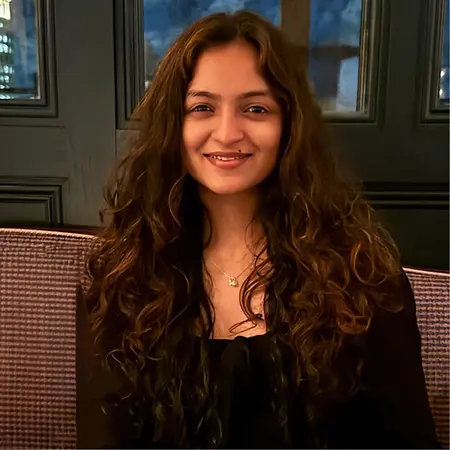
Her Story
About Karishma
I've loved biology for as long as I can remember. I did my undergraduate degree in biotechnology in Mumbai, then came to the U.S. for my master's at Northeastern University. My broader vision has always been to contribute to science that can help patients in some meaningful way. I didn't start out with cancer specifically in mind; that came through the journey.
One of the courses I took at Northeastern was what really sparked my scientific curiosity in cancer immunotherapy. I remember thinking, this is incredible, this is something I want to be a part of. When the time came to do my mandatory co-op, I chose a company in that space, and I loved everything about it: the goal, the work, every part of it. That experience told me exactly what I wanted to do next.
For the last three years, I've been at a clinical-stage biotech doing laboratory research. I design and run experiments that test how effectively and potently our drug candidates kill tumor cells. The work I do at the bench is the first step in a longer journey: if a molecule shows real promise in the lab, it moves into animal studies, and eventually, hopefully, into the clinic.
What pushes me most is knowing that the work I do here has the potential to reach patients someday. For people whose cancers haven't responded to anything else, the next option might be a therapy that started on a bench like mine. That possibility, however small my contribution, is what drives me.
Her Interview
Ten minutes with Karishma
01What do you attribute your success to?
Honestly, more than anything, I attribute it to having a clear sense of why I'm doing this work. The research I do at the bench is the very first step in a long journey: if a molecule works well in the lab, it eventually moves to animal studies, and hopefully into the clinic. Knowing that something I contribute to could one day reach a patient whose cancer hasn't responded to anything else is what got me into this field, and it's what keeps me here on the days when the science is slow or the data is messy.
A purpose like that does more than motivate you. It makes you a better scientist. It pushes you to ask sharper questions, to be more careful with your data, to push back on assumptions, and to keep learning. It's also what makes the long road of drug development tolerable, because you remember you're playing a long game with stakes that actually matter.
So if I had to name the single biggest reason I'm where I am, it would be that. Everything else, the skills, the experience, the people who invested in me, has built up around that core.
02What’s the best career advice you’ve ever received?
Early in my career, a mentor told me not to wait until I felt fully ready to take on something new, because readiness comes from doing, not from waiting. I think about that often. Some of the work I'm proudest of, executing the majority of the in vitro research for a clinical-stage bispecific program, presenting to academic collaborators, and mentoring others, came from saying yes when I felt about 70% qualified. Women in science especially can hold ourselves to a standard of needing to know everything before we step forward. The truth is, growth lives in that gap between "ready" and "capable."
03What advice would you give to young women entering your industry?
My biggest advice: come into science, and stay. STEM needs women. I genuinely believe the next breakthrough is going to happen in a lab when a woman is looking at flow cytometry data no one's seen before and notices something the room missed. We need that perspective.
When you get there, own your work. If you led an experiment, say "I led it", not "I helped." Women are often socialized to soften our contributions, and it's a habit that quietly costs us credit and visibility over time. Be specific about what you did.
Speak up in every room, even when it's full of people a decade more senior than you. Ask the question. Offer the opinion. Push back when something doesn't sit right. The only way people will know you're in the room is if you make yourself heard; your work alone won't do it for you.
And find your people. Mentors, peers, the woman a few steps ahead who will tell you what no one else will. Science can feel solitary, but careers aren't built alone. The women I lean on, and the juniors I mentor, are as much a part of my growth as any experiment I've run.
This is an extraordinary field to be part of. Go for it.
04What are the biggest challenges or opportunities in your field right now?
The biggest opportunity in immuno-oncology right now is that we have more ways to fight cancer than ever before. T-cell engagers, antibody-drug conjugates, novel immune checkpoint targets, these are all coming of age at the same time. The first wave of cancer immunotherapy, the anti-PD-1 drugs, transformed the field, but many patients with solid tumors still don't respond to them. The next wave is about reaching those patients. What gives me hope is the pace of discovery. Newer targets keep opening up patient populations that haven't had good options. Every therapeutic program is a chance to push that frontier forward, and that's what makes this field worth showing up for.
05What values are most important to you in your work and personal life?
Purpose. What keeps me in biotech is that the work has stakes beyond the lab. Behind every cytokine release assay and every cell-killing curve, there's a patient somewhere waiting for a better option, and that's a privilege to carry. Outside of work, I try to bring the same sense of intention to how I spend my time and energy, choosing the things that actually matter to me, and showing up fully for them.
Resilience. Drug development is a long game, and most things you try will not work the first time, or the tenth. Assays fail, programs get reprioritized, hypotheses don't hold up. I've learned that the scientists who go the distance aren't the ones who never get knocked down; they're the ones who can sit with a disappointing result, figure out what it's telling them, and keep going. I try to bring the same attitude to the rest of my life: setbacks are information, not verdicts.
Growth. Almost every meaningful step in my career, moving from Mumbai to Boston, doing my first co-op, getting promoted, and presenting at SITC, happened outside my comfort zone. I think the moment you stop being a beginner at something is the moment you've stopped growing. So I try to keep putting myself in rooms where I have something to learn, both at work and outside of it.
Join Influential Women and start making an impact. Register now.