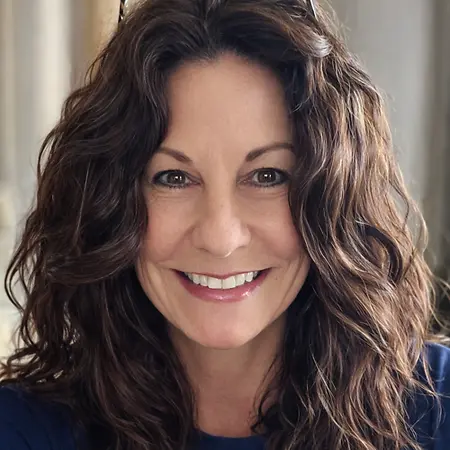
Her Story
About Kate
I have been an English professor since 1990, which means I've been in this field for 36 years. I was an English major in my undergraduate career, and the logical next step for people like me was to go to graduate school. I went directly to graduate school at the University of Alaska Fairbanks, quickly transferring down to Arizona State University, where it was much warmer, and where I had great success. I was a graduate student at ASU from 1991 to 1994, then I worked there from 1994 to 2000 as a lower-tiered professor. I was also hired as the director of the Writing Center. I did all of that before getting my current job, which is a full-time faculty member in the community college district. I have been in this district since 1995, spending my first 5 years as an adjunct and the last 26 years as a full-time residential faculty member at Mesa Community College, which is my home school. I am knowledgeable about mental illness, neurodivergency, and disability; all of that came as a result of discovering that not only was I an alcoholic, but I had bipolar disorder, and I was autistic. Those revelations later in life steered me in a healthier, more productive direction.
Her Interview
Ten minutes with Kate
01What do you attribute your success to?
First and foremost, I had a loving family and parents who provided me with a safe, nurturing environment in which to explore and develop as a child. Growing up undiagnosed with bipolar disorder and autism, I was often confused, scared, and lonely. I was lucky to have a good home, go to good schools, and get pointed towards college.
Secondly, I would never have reached the point where I am now (in great physical shape, confident in my ability to make change, self-aware, and most importantly, in control of myself and my life) if I had not gotten sober, and then sought treatment for mental illness. Without those two serendipitous events, I would still be masking–pretending to be comfortable and in control. Without sobriety and sanity, I would never be able to perform at my best professionally and personally.
Finally, other professional women I met along the way during my education and career bolstered my success in many ways. They helped me make healthy, constructive connections with others in my field. They helped me see opportunities that otherwise I might have missed. They watched out for me when I experienced a bipolar mania at my college and couldn’t take care of myself; women were the most protective of me. Now, I belong to a union that has a strong female contingent, and I feel at home there. Of course, there have also been men who encouraged and supported me along the way. Anyone who believed in me and nudged me forward contributed to my success.
02What’s the best career advice you’ve ever received?
The best career advice I’ve ever received came from a very successful businessman who I befriended at the beginning of my college teaching career. He said, “Keep your job.” That simple directive has stayed with me through all the upheaval and trouble I have had in my workplace as a result of being neurodivergent and bothering other people. I have alternative ideas and am quite stubborn; I am an outlier in many ways. This has resulted in complaints, warnings, and disciplinary measures being taken against me throughout my career. I work hard to achieve equity, inclusion, and appropriate accommodations for myself and others, and I still work hard to keep my job.
03What advice would you give to young women entering your industry?
Young women who want to teach college-level English have many routes towards that goal. In general, they should go to college and then graduate school, try to get a teaching assistantship, and lean on mentors in their programs to guide them professionally. The higher education landscape looks much different from when I entered it in 1986 as a college freshman. I always made my way by working closely with my professors, actively looking for advancement opportunities, and believing in myself. I entered my career because I liked to read, write and do research, and I discovered I could also teach those topics. While I worked steadily towards becoming a college English professor and had that goal in mind, I did not foresee my participation or investment in the “industries” of mental health advocacy or disability justice. I was not expecting to discover that I had a major mental illness (bipolar disorder), or that I was autistic. I am an English professor who never planned to be a mental health advocate or a union representative. I would advise any young woman entering the field of education to do so because they love helping others. I advise anyone starting their career to pursue what they’re naturally interested in and always keep an eye out for people in need, and new opportunities.
04What are the biggest challenges or opportunities in your field right now?
One of the biggest challenges in my field of college composition is student use of A.I. In just a few years’ time, I have gone from seeing written work from students that is full of grammatical and punctuation errors to seeing written work that is nearly perfect in execution, style, and content. However, the content is also artificially generated. My students are turning in far too much A.I material, and they can get very frustrated when I don’t accept it.
One of the biggest opportunities in my field is the growing influence of entrepreneurship throughout higher education nationwide. There is renewed interest in helping students grow their ideas into real businesses through organizations such as The National Association for Community College Entrepreneurship. Even as an English instructor, I encourage all of my students to seek out the entrepreneurship programs and scholarships being offered. I had one student win a $1000 scholarship last semester to develop her business idea. Opportunity is everywhere, but sometimes you need to seek it out.
05What values are most important to you in your work and personal life?
What is most important to me is reaching other people with positive messages about neurodivergence, mental illness, addiction, autism, and any other behavioral or mental divergence that they might be struggling with. I want people to know that there's hope. There are new medications and new types of treatment coming out all the time. I know that families understand the struggle with supporting mentally challenged children and other family members, and they need our support, they need to know that there is hope out there. So I use myself as an example of someone who was truly at risk in all ways, who took advantage of resources and support and achieved peace, good health, and career success.
I just want to spread hope. I highly recommend looking at yourself, engaging with yourself and trying to figure yourself out, to bring yourself to your best. You have to know what your weaknesses are and what your vulnerabilities are before you can soar.
Join Influential Women and start making an impact. Register now.