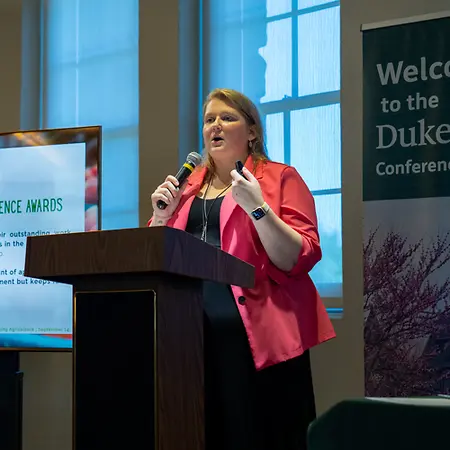
Strength wasn't found in a dramatic moment. It built quietly through resilience, persistence, and learning that confidence comes from acting even before you feel ready.
How She Found Strength in an Unexpected Place
Explore moreI realized I was burned out when I couldn't remember the last time I had simply enjoyed the work I loved. I didn't need a different purpose. I needed a different pace.
Katelyn Katzer · In Her Own Words
Strength wasn't found in a dramatic moment. It built quietly through resilience, persistence, and learning that confidence comes from acting even before you feel ready.
How She Found Strength in an Unexpected Place
Explore moreHer Story
Katelyn Katzer is the Farmland Preservation Manager and SCADB Administrator for Somerset County, New Jersey, where she leads the County’s Farmland Preservation Program. Over her 17-year career in environmental planning, Katelyn has developed a deep expertise in farmland preservation, open space management, and sustainable land use. She works closely with state, municipal, and nonprofit partners to protect farmland, support farmers, and ensure that agriculture remains a vibrant and sustainable part of the County’s future. Her mission is to preserve farmland in perpetuity, safeguard farm history, strengthen local food systems, and provide future generations access to farms and fresh food. Katelyn’s professional journey began in pharmaceutical biology, with an intended focus on cancer research, but she shifted her focus when she felt a call to sustainability. Influenced by her mother, an environmental planner, she changed her major to environmental science and discovered her true passion in environmental planning. Her early career included roles at the Freehold Soil Conservation District, where she learned the impacts of construction on soil and water, and the Monmouth County Park System, where she worked on open space preservation and park creation, including a pocket park in Asbury Park. She later gained experience at the State level, learning the rulemaking process and navigating frequent policy changes, before finding her calling in farmland preservation at the county level. At Somerset County, Katelyn revitalized a previously dormant farmland preservation program as its sole administrator. She rebranded the program, created new educational materials, established internal tracking systems, and built lasting trust with the agricultural community. Her work spans preserved and unpreserved farms, Right-to-Farm cases, and farmer–neighbor–township disputes, all while helping farmers retain ownership of their land and use preservation funds to support operations or retirement. Recognized as “cutting edge” by State organizations, her program has received awards and legislative recognition for innovation and impact. Katelyn combines technical expertise, strategic leadership, and a genuine passion for connecting people, land, and ideas to build healthier, more resilient communities.
Her Interview
01What do you attribute your success to?
First and foremost, I attribute my success to my family. When I changed my major early on, my parents were incredibly supportive, and they continued to encourage me as I found my place within the planning sector. I would not have been able to dedicate the time and energy I have to this program without their, and my husband's, constant support and understanding.
I am also deeply grateful for the support of our County Commissioners and their strong commitment to preserving and strengthening agriculture in our community. Without their leadership and recognition of agriculture’s importance, this program would not have achieved the level of success it has today.
Equally important has been the support of our farming community. Building trust took time. It required patience, consistency, and a genuine commitment to showing that I was there to support—not regulate or hinder—their work. I believe success is rarely individual; it is built by the many people who believe in you, your vision, and the work you are striving to accomplish. In many ways, it truly takes a village.
02What’s the best career advice you’ve ever received?
The best career advice I have received is to pursue every opportunity to expand your knowledge through courses, trainings, and professional licensing. Continuously investing in your education not only deepens your understanding of your industry, but also broadens the range of career paths available to you. It helps prevent becoming overly specialized too early and keeps you adaptable as industries evolve.
In a smaller or highly competitive field, maintaining a diverse skill set can be especially valuable. It positions you to identify and pursue opportunities that others may overlook and ensures you remain competitive in a sometimes saturated market.
03What advice would you give to young women entering your industry?
I would encourage young women entering this industry to explore different areas of planning early in their careers. Gaining exposure to a variety of roles and specialties helps build a well-rounded foundation and provides clarity about where your strengths and interests truly align. Early career movement in your twenties, whether through internships or different positions, is not only expected, but encouraged in developing perspective and confidence before making long-term commitments to a job.
Internships, in particular, can be instrumental in shaping career direction. I have seen firsthand how those early experiences can open doors. One former intern, for example, now works in the same office where she first began building her professional foundation and found her calling in preservation through the internship opportunity with my program. Another has applied to work with the State in their Farmland Preservation Program. I am thrilled to see these young women finding their passions and reaching for them.
04What are the biggest challenges or opportunities in your field right now?
One of the biggest challenges in my field right now is balancing the restrictions of preservation programs with continually evolving state regulations. As new requirements related to stormwater, wastewater, and other environmental standards are implemented, preservation programs must be flexible enough to work within those frameworks. Otherwise, we risk unintentionally hindering the growth, viability, and long-term sustainability of the very farms we worked so hard to protect.
For example, when a farmer needs to construct a barn, additional impervious coverage may trigger stormwater management requirements. However, preservation program guidelines can sometimes be unclear in these situations. We need more definitive guidance to ensure we are not creating barriers to a farmer’s operational needs, while still protecting farmland and complying with updated regulations. Striking that balance is critical.
At the same time, there are significant opportunities in the field. Support for agriculture within the broader community continues to grow. Through strong partnerships with agricultural organizations and ongoing collaboration with the State Legislature, agricultural viability remains an active and largely bipartisan conversation. This has led to expanded grant opportunities, increased program support, and a shared commitment to ensuring that regulations ultimately strengthen, rather than burden, agriculture in our State.
05What values are most important to you in your work and personal life?
Authenticity is the value I hold most important in both my professional and personal life. Leading with sincerity allows me to build trust, particularly when working with farmers in the context of a government program, where skepticism can understandably exist. By approaching every interaction with honesty, transparency, and integrity, I am able to cultivate meaningful relationships and foster confidence in both the work I do and the programs I represent.
Her Content Hub
A personal journey of self-discovery and resilience, exploring how changing direction, overcoming self-doubt, and embracing uncertainty can lead to a fulfilling career and authentic life path.
Finding Your Path When Life Takes an Unexpected Turn
How many of us felt like we had our entire future mapped out when we were younger?
For me, the answer was simple—I thought I had it all figured out. I loved science, so when I went to college, I chose biology as my major. It felt like the right path. It was safe, logical, and aligned with what I thought I was supposed to do.
Here’s something no one really tells you: just because something looks like the right path does not always mean it is your path.
As I moved through college, my interests began to shift. I found myself drawn to environmental science, agriculture, and the protection of land and natural resources. What started as curiosity gradually became something more, pulling me in a direction I had not originally planned.
Changing direction can feel uncomfortable. It can make you feel like you are falling behind or second-guessing your choices while it seems like everyone else has everything figured out. Looking back, that shift did not mean I had failed—it meant I was paying attention to what truly mattered to me.
Today, I have a career where I help protect farmland, support farmers, and work on issues that impact entire communities. It is work I care deeply about, but the path that led me here was anything but straight, and that is where the real story begins.
Early in my career, I found myself in environments that were not always welcoming. Working in a male-dominated field came with challenges. There were moments when I was made to feel like I was not enough—not smart enough, not experienced enough, not confident enough.
Sometimes those messages were not spoken directly, but they were felt—being talked over in meetings, having ideas dismissed, or watching someone else take credit for work you poured your time and energy into. Experiences like that can make anyone question themselves. They can make you wonder if maybe you do not belong.
One of the most important lessons I have learned is this: other people’s opinions are not the final draft of your story. Just because someone does not recognize your value does not mean it is not there. Just because someone tries to take your voice does not mean you should stop using it.
There was not one defining moment where everything changed for me. Instead, it was a series of small decisions—choosing to speak up even when I was not completely confident, trusting my ideas enough to share them, and learning to stand my ground even when it felt uncomfortable. Over time, those small choices added up. They built confidence. They built resilience. They led me to a realization that changed everything: I did not need to wait for someone else to tell me I was ready. That is a message that extends far beyond my own experience.
Every person is at the beginning of their own story. Some people have a clear vision of where they are headed, while others are still figuring it out. Both are valid. Both are part of the process. What matters most is not allowing someone else to take control of that story—not a teacher, not a peer, and not anyone who doubts or underestimates your potential. The path forward may not be linear. There may be setbacks, uncertainty, and moments of doubt. Those experiences do not define the outcome—they shape it.
If there is one takeaway, it is this: your story is unwritten. That is not something to fear; it is something to embrace. It means there is room to explore, to change direction, to grow, and to become the person you want to be. The future is not predetermined. It is something you create.
And the most important part? You are the one holding the pen.
Join Influential Women and start making an impact. Register now.