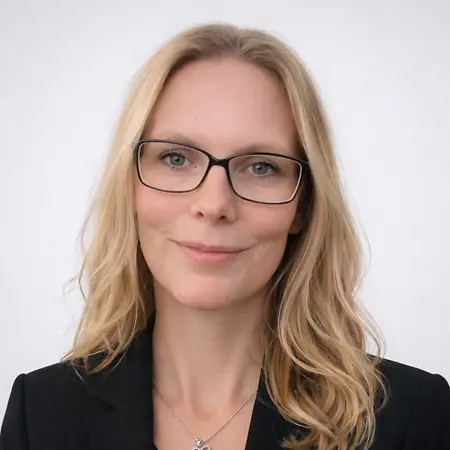
Her Story
About Katharine
Katharine Stodgell serves as Public Health Division Manager for the Anchorage Health Department, Alaska’s only standalone municipal health department, serving a community that represents approximately 40 percent of the state’s population.
With more than 20 years of experience serving communities and vulnerable populations, Katharine has built her career around the belief that effective public health starts with people. She holds both bachelor’s and master’s degrees in public health and brings experience spanning community health, program development, emergency preparedness and response, and public health leadership.
In her current role, she leads diverse public health programs and has championed efforts to strengthen community-based approaches, including establishing the Municipality’s first community health worker position and developing systems to support the program’s long-term sustainability.
Katharine’s leadership is grounded in authenticity and transparency. She believes people do their best work when they understand the why behind decisions, know where they stand, and feel comfortable bringing ideas, concerns, and even mistakes forward. She views reflection and learning, including after-action review, as essential to building stronger teams and better systems.
Her advice to women building careers in public health is simple: don’t wait for an invitation. Step forward, use your voice, and take up space. Public health needs strong women willing to lead.
Her Interview
Ten minutes with Katharine
01What do you attribute your success to?
I attribute a lot of my success to relationships. I genuinely like people, and I’ve learned that when people trust you, feel respected, and understand why the work matters, you can accomplish a lot together. I’m also someone who follows through. If I say I’m going to do something, I take ownership of it and make sure it gets done. And I think I’ve been successful because I’m willing to learn. I don’t need to be the person in the room who knows everything. I’m comfortable asking questions, listening to people who know more than I do, and then bringing the right people together to move something forward.
02What’s the best career advice you’ve ever received?
The best career advice I’ve ever received is to never wait for a seat at the table. Pull up a chair. As women, we don’t have to wait to be invited into the rooms where decisions are being made. We have to be willing to show up, take up space, use our voices, and know that we belong there.
03What advice would you give to young women entering your industry?
My advice is, do it. Public health needs strong women who are willing to take up space and use their voice. Don’t wait for someone to give you a seat at the table. Just jump in, dig in, and be willing to learn as you go. It can be hard work, but it is also some of the most rewarding and impactful work you can do. I honestly can’t imagine a career that would have been more meaningful to me.
04What are the biggest challenges or opportunities in your field right now?
I think one of the biggest challenges in our field right now is doing more with increasingly limited resources while the needs of communities continue to become more complex. Workforce capacity, funding uncertainty, access to care, and health disparities all intersect, so organizations can’t really afford to work in silos anymore.
At the same time, I think that creates one of our biggest opportunities. We have an opportunity to be much more intentional about partnerships, data, and how we engage communities. Some of the best solutions don’t necessarily require creating an entirely new program. Sometimes it’s about connecting existing resources, strengthening relationships, identifying where the gaps actually are, and making sure the work we’re doing is producing meaningful outcomes.
That’s one of the things I really enjoy about this field. There’s a lot of complexity, but there’s also a real opportunity to bring people together and turn that complexity into something actionable.
05What values are most important to you in your work and personal life?
Transparency and authenticity are probably the two values that are most important to me, both professionally and personally. I really value being genuine with people. I want people to know where they stand with me, and I think clear, honest communication builds trust, even when the conversation isn’t necessarily an easy one.
Transparency is especially important to me as a leader. People do their best work when they understand what’s happening, why decisions are being made, and how their work connects to the bigger picture. I don’t believe in withholding information unnecessarily or creating uncertainty where there doesn’t need to be any.
And authenticity goes along with that. I try to show up as the same person regardless of who is in the room. I can be professional and hold high expectations while still being warm, approachable, and human. That’s important to me in my personal life too. I really value relationships where people can be honest, be themselves, and trust one another.
Join Influential Women and start making an impact. Register now.