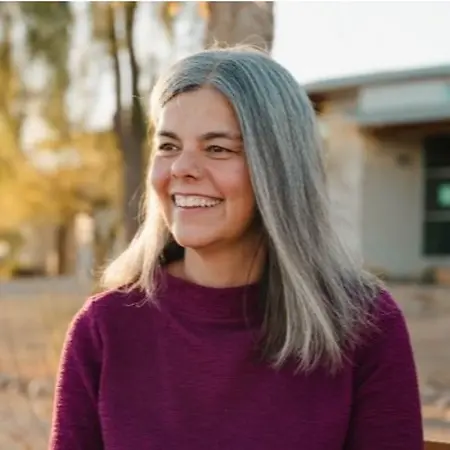
Her Story
About Katherine
My commitment to social change is both professional and deeply personal. As the daughter of a coal miner and a survivor of gender-based violence, I have experienced firsthand how economic inequality, political violence, and systems of power shape people's lives and opportunities. These experiences have informed my work and strengthened my commitment to building systems that are more equitable, humane, and responsive to the communities they are meant to serve. I believe meaningful social change happens when communities are not simply invited into systems, but have the opportunity to shape them. Across my work as a social impact leader, researcher, strategist, and program developer, I have partnered with organizations and communities in the United States and internationally to strengthen programs, develop collaborative strategies, conduct research, and advance advocacy.
Through Justice Forward Alliance and the International Commission for Equity and Peace, I work at the intersection of gender equity, human rights, research, advocacy, and community-centered change. I am particularly interested in the space where research becomes action—translating knowledge and community experience into programs, partnerships, and strategies that create meaningful and measurable impact.
At the center of my work is a commitment to advancing care-centered systems and pathways for people and communities whose knowledge and experiences have too often been overlooked or marginalized.
Her Interview
Ten minutes with Katherine
01What do you attribute your success to?
I attribute my success to a combination of curiosity, resilience, purpose, and a willingness to build rather than simply accept the systems around me. My lived experiences have given me a deep understanding of how inequity and systems of power shape people's lives, while my academic and professional experiences have taught me to approach complex challenges with both rigor and humility.
I have also been fortunate to learn from extraordinary colleagues, community leaders, young people, and advocates across cultures and generations. Their perspectives have continually challenged me to think differently and to remain grounded in the people and communities at the heart of social impact work.
Ultimately, I believe my greatest strength has been the ability to connect ideas, people, and possibilities—and to turn those connections into meaningful action.
02What’s the best career advice you’ve ever received?
The best career advice I’ve received is: “Don’t wait for someone to give you permission to do the work you know needs to be done.” That advice has stayed with me throughout my career. Some of the most meaningful work I have done began as an idea that did not yet have a position, department, funding stream, or established pathway. I’ve learned to recognize opportunities, bring people together around a shared purpose, and build something where a gap exists. I’ve learned that leadership is not about having all the answers—it is about listening carefully, being willing to learn, and creating the conditions for others to lead as well.
03What advice would you give to young women entering your industry?
Always know your value and honor your unique gifts. Please do not confuse success with fitting neatly into someone else’s definition of leadership, advancement, or prestige. Early in your career, learn as much as you can, build relationships across different communities and disciplines, and develop expertise that gives you confidence in using your own voice. Also pay attention to the ideas and opportunities that don’t yet have a clear place within existing systems. Some of the most meaningful work comes from being willing to question what everyone else has accepted as “the way things are done.”
Find mentors and sponsors to help you along the way, but do not wait for someone else to open the door. Create opportunities, ask for what you need, take thoughtful risks, and bring other women with you when you move forward. Your career does not have to follow a perfectly linear path to be meaningful or impactful.
Stay curious, protect your values, and remember that leadership is not about occupying the most powerful seat in the room—it is about using whatever influence you have to make more space in the room for people who have been historically excluded and barred from its four walls.
04What are the biggest challenges or opportunities in your field right now?
One of the biggest challenges in my field is the growing gap between the scale and complexity of the social challenges communities are facing, and the resources available to address these challenges. Nonprofits and community-based organizations are often asked to solve deeply rooted problems with short-term, restricted funding, while the systems that contribute to those problems remain largely unchanged. This creates enormous pressure on nonprofit organizations and the people involved in community-based work, particularly women and leaders from historically marginalized communities.
There is also an ongoing challenge around power. Women make up a significant portion of the social-impact workforce, yet leadership, funding, and decision-making power have not always been distributed in an equitable manner within the field. We need to continue challenging traditional models of leadership and philanthropy that privilege hierarchy, competition, and institutional proximity over lived experience, community knowledge, collaboration, and care.
At the same time, I see a tremendous opportunity in addressing these challenges. There is growing recognition that durable social change requires more than individual programs—it requires changing the systems, relationships, and structures that shape people's lives. I believe this creates a chance to build more collaborative, care-centered approaches to leadership and social change; to elevate community expertise alongside academic and institutional knowledge; and to develop funding and evaluation models that value long-term, transformative impact rather than only short-term outcomes.
05What values are most important to you in your work and personal life?
Integrity, compassion, curiosity, accountability, and courage are the values that guide both my work and my personal life. I believe in treating people with dignity, being honest even when honesty is difficult, and remaining radically open to perspectives and experiences that are different from my own. I deeply value relationships and believe that how we treat people along the way matters as much as what we ultimately accomplish in the world. I also value courage—the willingness to question systems that are not working, to speak up when something is wrong, and to take thoughtful risks in pursuit of social justice and equity. My commitment to equity means more than creating opportunities; it means examining who has access to power, whose knowledge is valued, and who has historically been left out of decision-making processes and institutions.
Ultimately, I want my work in the world to reflect my deep care, respect, and reverence for other people and my unshakeable commitment to partnering with marginalized communities to advance care-centered systems change.
Join Influential Women and start making an impact. Register now.