Influential Woman · Art Advisory, Appraisal, Fine Jewelry, Speaking, Travel & Tours
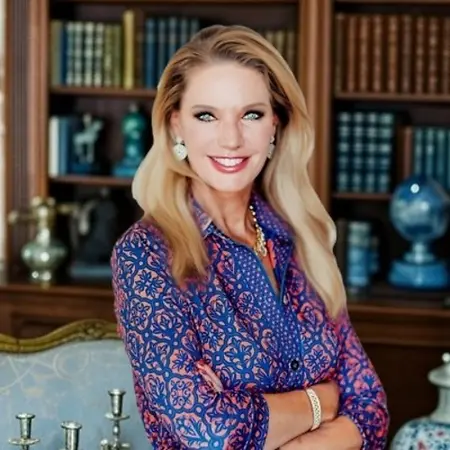
Katherine Thatcher
Owner and President, Kat Thatcher
Scottsdale, AZ 85255
Her Story
About Katherine
Katherine “Kat” Thatcher’s varied career makes the most sense when viewed through the interests that shaped her from an early age: art, beautiful objects, history, travel, and design.
Raised in Colorado in a family with deep ties to ranching, collecting, historic homes, museums, and philanthropy, Thatcher grew up surrounded by objects with stories and by people who believed in preserving history. Her grandparents built the Western Museum of Mining & Industry in Colorado Springs, and its emphasis on mining, minerals, and gold gave her an early fascination with the materials themselves—an interest that would later find another expression in jewelry.
Art was a constant throughout her childhood. She took art classes from an early age, spent summers studying at the Bemis School of Art in Colorado Springs, and eventually studied Art History and English Literature in college. During a semester in Florence, Italy, she studied Renaissance art with eminent scholar Rab Hatfield. She was captivated not only by the art, but by Florence itself—the warm ochre tones of the city, the striped marble of the Duomo and Baptistery, the Arno running through its center, and the jewelry shops lining the Ponte Vecchio. There she made her first significant jewelry purchase, a ring she still wears today.
Those seemingly separate interests in art, jewelry, history, and place would continue to overlap throughout her life.
Thatcher began her professional career at the Smithsonian Institution in Washington, D.C., before moving to London for graduate study at Sotheby’s Institute. Subsequent work in appraisal and estate management in San Francisco eventually led her to establish her own firm, Art Asset Adviser.
What has kept the field interesting to her for more than three decades is its almost endless variety. Appraisal is part scholarship and part detective work: identifying an object, researching where it came from, understanding its place within a market, determining why it matters, and then advising a client about what to do with it. Thatcher particularly enjoys the unusual assignments—the objects and collections for which the answer is not immediately obvious.
Her jewelry career developed alongside her work in art. Having designed jewelry since childhood, she created Poppy Madison in 2008 and later transitioned from a nationally distributed casual jewelry line into bespoke fine jewelry. Today, she is most interested in creating pieces with a story behind them: jewelry commemorating a marriage, family, child, place, journey, milestone, or personal symbol. Art history, architecture, antique jewelry, family crests, museum objects, and details discovered while traveling all find their way into her designs.
Travel has been equally important. Thatcher discovered early that seeing the world was not something she wanted to postpone until retirement. Over time, travel became a major part of her life and eventually another facet of her professional work. She gravitates toward trips that combine culture and history with adventure—museums and architecture alongside hiking, skiing, scuba diving, local food, and experiences specific to a destination. Clients may book her for a private or group tour.
Writing and speaking grew naturally from wanting to share those discoveries. Through The Artful Tourist, she approaches a destination much as she approaches an artwork or antique: looking beyond the surface for the history, people, craftsmanship, and stories that make it distinctive. She donates her speaking fees and offers pro bono valuation services to such charitable entities as Southwestern Wildlife Conservation Center, Foothills Animal Rescue, the Junior League, and Liberty Wildlife.
In honor of Women’s History Month, Thatcher twice helped organize and host TEDx events with documentary filmmaker Kelly Salloway, giving 22 women the opportunity to share their stories and ideas and have their voices preserved in the TED archives. The experience reflected something she values deeply: creating opportunities for interesting women to be heard.
For many years, Thatcher viewed art consulting, jewelry design, and travel writing as three different careers. Eventually, she realized that they were expressions of the same curiosity.
Each revolves around beauty, craftsmanship, history, discovery, and storytelling. Whether she is researching an inherited painting, designing a family signet, walking through a museum in another country, or writing about a place she has just discovered, the underlying question is much the same: What is the story, and why does it matter?
KatThatcher.com brings those worlds together for the first time, reflecting a career—and a life—built around discovering interesting things, understanding them, and sharing their stories.
Her Interview
Ten minutes with Katherine
01What do you attribute your success to?
Partially just being a nerd at heart! Truly. Plus a work ethic from having grown up with lots of chores. I attribute much of my success to hard work, persistence, curiosity, and continuous learning. Early in my career, I understood that credibility had to be earned, so I pursued internships, education, professional training, and as much hands-on experience as I could find. I tried to learn something from every position and every assignment rather than thinking only about what the next title would be.
I also think adaptability has been very important. My career has not followed a perfectly straight line. Art history led to museum work, appraisal, consulting, jewelry design, writing, and speaking. At different times, what might initially have looked like a detour ultimately added another layer of knowledge or experience that became useful later.
Persistence matters as well. There are periods in almost every career when things do not progress as quickly or easily as you would like. Being willing to keep working, keep learning, and change direction when necessary has served me well.
Perhaps one of the things I have learned most recently is to trust the judgment that comes from experience. After more than 30 years, you realize that expertise is not simply what you learned in school. It is the accumulation of thousands of objects examined, clients advised, markets studied, problems solved, mistakes avoided, and unusual situations encountered along the way.
02What’s the best career advice you’ve ever received?
Some of the most valuable advice I received came relatively late in my career: recognize the value of your time and expertise—and stop undercharging for it. I think women in particular tend to do this.
I eventually realized that clients are not simply paying for the hours I spend on an assignment. They are benefiting from more than 30 years of specialized knowledge and experience—the ability to recognize what matters, know where to research, identify potential problems, and reach an informed conclusion efficiently. Particularly as women, I think we can fall into the trap of believing we need one more credential or one more year of experience before we are entitled to value what we know.
I have also had to learn that not everything has to be perfect. I naturally lean toward perfectionism and can easily do far more than an assignment actually requires. Over time, I have learned to be a little easier on myself—to recognize when the work is excellent and complete rather than continuing to refine it simply because I can.
Learning both to value my expertise and to value my time has been an important part and has actually freed up more time for hobbies and interests, which also enriches my life.
03What advice would you give to young women entering your industry?
I strongly encourage young women entering the arts to get as much real-world experience as possible early in their careers. Internships can be extraordinarily valuable because they put you in rooms, museums, auction houses, galleries, collections, and professional situations that cannot be replicated in a classroom. When financially feasible, I would choose an internship that provides exceptional experience and mentorship over a position that pays slightly more but teaches very little.
I also believe in pursuing education, training, certifications, and credentials even when you cannot immediately see how you will use them. Every additional area of knowledge makes you more versatile, and you have no idea which skill may become important ten or twenty years later.
Work extremely hard during your first decade after school. Ask questions. Volunteer for assignments. Look at as many objects as possible. Go to auction previews, museums, galleries, exhibitions, and lectures. Develop relationships with people who know more than you do, and never assume that your education is finished simply because you have earned a degree.
At the same time, do not become overly concerned if your career is not completely linear. Mine certainly was not. A career can meander and still have a very clear destination when you continue accumulating knowledge and experience along the way. Sometimes the unexpected turns are what ultimately distinguish you from everyone else.
04What are the biggest challenges or opportunities in your field right now?
One of the challenges I experienced entering the high-end arts industry was that many people had family connections and established networks that helped them obtain opportunities. I did not have those same connections, so I had to work harder to establish myself and demonstrate my expertise.
A continuing challenge in the art and appraisal world is the difference between market reality and people's expectations of value. Markets change, tastes change, and values do not always move upward. Owners can understandably become emotionally attached to an earlier valuation or to what they believe something should be worth.
I experienced that very dramatically during the 2007–2008 economic downturn, when rapidly changing markets made some clients reluctant to accept valuations that were lower than what they had seen several years earlier. That period taught me an important lesson: an appraiser's responsibility is to the evidence, even when the answer is not necessarily the one a client hoped to hear.
At the same time, I think we are in a period of tremendous opportunity. There is more information available to researchers and collectors than ever before. Auction databases, online archives, digitized museum collections, and international marketplaces have transformed the amount of material we can access. But having more information does not necessarily mean knowing how to interpret it. In some ways, that makes experience and professional judgment even more important.
I also see opportunity in being willing to evolve. The 2007–2008 downturn ultimately pushed me to step away from appraisal for a period and explore jewelry design and entrepreneurship. What began as a response to a difficult market developed into an entirely new part of my career.
That experience changed the way I look at challenges. A disruption can close one door, but it can also force you to notice another opportunity you might otherwise never have considered.
05What values are most important to you in your work and personal life?
Integrity, curiosity, independence, hard work, and continued learning are probably the values that have shaped both my professional and personal life most strongly.
Professionally, integrity comes first. An appraisal or recommendation has to be based on the evidence and on what I genuinely believe to be correct, whether or not that is the answer someone hoped to receive. Discretion and trust are equally important when you are working inside people's homes, with family estates, valuable collections, and sometimes very personal belongings.
Curiosity has probably been the common denominator in almost everything I have done. I genuinely like learning—about an unfamiliar object, a new artist, a period of history, a different culture, or a place I have never visited. I never want to reach the point where I think I already know enough.
Independence is also important to me. I have been willing to create a career that did not necessarily fit a conventional model and to change direction when something new interested me or circumstances changed.
In my personal life, I place tremendous value on experiences, relationships, exploration, and giving back. I believe life should continue expanding rather than becoming smaller as we get older. There should always be another place to see, another subject to learn about, another skill to develop, and another way to contribute something useful.
For me, success has never been simply about accumulating professional accomplishments. It is having the freedom to remain curious, continue learning, do meaningful work, and build a life that leaves room for the people, places, animals, and causes that matter to me.
Join Influential Women and start making an impact. Register now.