Her Story
About Kathleen
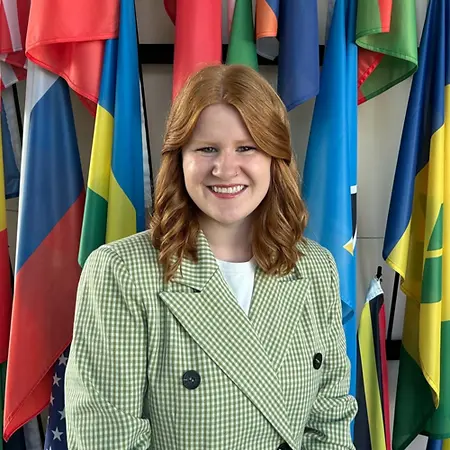
Kathleen Brett is a Policy Analyst and Researcher specializing in space security, international diplomacy, and strategic stability. She currently serves as Program Analyst, Space Security & Stability at Secure World Foundation, where she contributes to global initiatives focused on space governance, counterspace capabilities, and the evolving relationship between national security and emerging technologies. Kathleen also serves as Co-Editor of the 2026 Global Counterspace Capabilities Report: An Open Source Assessment, a leading publication examining military and strategic space developments across thirteen nations. Her work is driven by a passion for translating complex technical and security issues into accessible policy discussions that support informed decision-making and international cooperation. Kathleen’s path into the field of international affairs and space policy was shaped by both academic curiosity and unexpected opportunity. Originally majoring in history at James Madison University, she added political science as a double major after study abroad plans were cancelled during the COVID-19 pandemic. Through that experience, she discovered her interest in international affairs and later pursued graduate studies to further refine her focus. While earning her Master of Public and International Affairs in Security and Intelligence Studies at the University of Pittsburgh, Kathleen realized she needed to either remain a broad generalist or specialize in a distinct field. She chose space policy, recognizing it as one of the most dynamic and forward-looking areas within international security. During graduate school, she joined a research group focused on space policy and attended a conference at the U.S. Air Force Academy dedicated entirely to space issues. The following year, she led a collaborative working group with the U.S. Space Force and the Air Force Research Laboratory (AFWERX), examining the future weaponization of space, culminating in a presentation at the Pentagon, an experience that solidified her commitment to the field. Before joining Secure World Foundation, Kathleen served as an NGFP Graduate Fellow with the Pacific Northwest National Laboratory (PNNL), supporting the National Nuclear Security Administration (NNSA) on issues related to nuclear security policy, stockpile sustainment, and strategic security frameworks. Although space policy positions were limited and often heavily technical, her policy expertise and interdisciplinary background ultimately led her to a role uniquely positioned at the intersection of nuclear security and outer space governance. Today, her work increasingly focuses on the growing space-nuclear nexus, an area that aligns perfectly with her experience in both sectors. In addition to her professional accomplishments, Kathleen has presented research at international conferences on topics including BRICS space cooperation, defensive coalitions in orbit, and the future of space governance. She is currently pursuing a Graduate Certificate in Air and Space Law through the University of Mississippi School of Law, further strengthening her expertise in the legal and diplomatic dimensions of outer space security.
Her Interview
Ten minutes with Kathleen
01What do you attribute your success to?
I attribute my success to being an only child, which meant I had to embark on many new activities on my own, leading to my independence and drive that I possess today. Additionally, participating in and leading marching band from 8th grade through college allowed me to prove to myself that I could handle responsibility and be a part of something bigger. I am adamant about the fact that you cannot lose your leadership skills and these skills are incredibly crucial early in your career. In college, I was a section leader on a team of seven, leading 60 people in my section and I have taken those skills with me in my career. I find that it is helpful to remind myself sometimes that just because I am early career does not mean my leadership skills have evaporated; I can use those skills in different ways. My time in band allowed me to forge connections with others, which is crucial within the professional world. I am grateful for my past leadership experience and support I have received because I think that really has made a difference in the person I am today.
02What’s the best career advice you’ve ever received?
The best career advice I have ever received is to write the date and place you met someone on the back of their business card. I keep all of my business cards in a box and this makes it incredibly easy to reconnect with individuals and remember where/when you met them. In DC, there are a ton of events and people in my industry, so this practice has only helped my career growth.
03What advice would you give to young women entering your industry?
I realized I did not have to be a "STEM person" to get in space, and I think that is my motto now: "You can still contribute to the space/technical industries without being perfect at math." On another note, I was recently asked how do you not feel competitive with your peers, especially your female peers, and I think you really just need to be confident that what you bring to the table is not what others bring to the table. I find a lot of times, sometimes generationally, how women support women can differ. A lot of women were in a position in their early career where they were the only ones at the table, so they really had to stand out. I am now trying to figure out what that looks like for my generation, Gen Z, and how I can support other women who are early in career. Another piece of advice I was gave recently was be confident in what your networking approach is. You do not have to attend every networking event. My boyfriend and I have what we call the happy hour rule: if you are not happy after an hour, you can leave. Sometimes there's four happy hours in a week; you don't have to go to them all or stay the whole time because you should have a robust personal life outside of work.
04What are the biggest challenges or opportunities in your field right now?
I would say the biggest challenges/opportunities in my field is the same as several fields: the ability for your people to break into the industry. There are very few policy jobs focused specifically on space, which is what several early career professionals desire to work in post-graduation. My advice on this front is to find a role in an adjacent industry and try to figure out where space fits within the industry. This allows you to gain a new set of skills and knowledge, while enhancing your personal brand and what you (and space) bring to the table. I prided myself on being "the space girl" when I was in the nuclear security industry and I believe this helped me better understand the increasing overlap in the space and nuclear industries, which I use in my current role today.
05What values are most important to you in your work and personal life?
I think everybody should have things outside of work that fulfill them and support them, wherever your found family is. I think that is valid and important, so I just try to prioritize them in my own way. I am really lucky to have a partner that pushes me to not be a workaholic early in my career, because I think if I was not dating him, I would tend to lean in that direction. I am lucky to have him and other friends that push me to disconnect from work and enjoy my robust life outside of the office. I am certain that having that support system outside of your immediate workplace is really crucial to being successful, especially by other women, but also just other people. It is beneficial to have a sounding board that's not in my immediate work circle to give me advice and feedback.
Join Influential Women and start making an impact. Register now.